RESEARCH REPORT · 17 OCTOBER 2026
Visual Thinking in the AI Era
From key concepts and research evidence to AI implementation, instructional design, and professional practice.
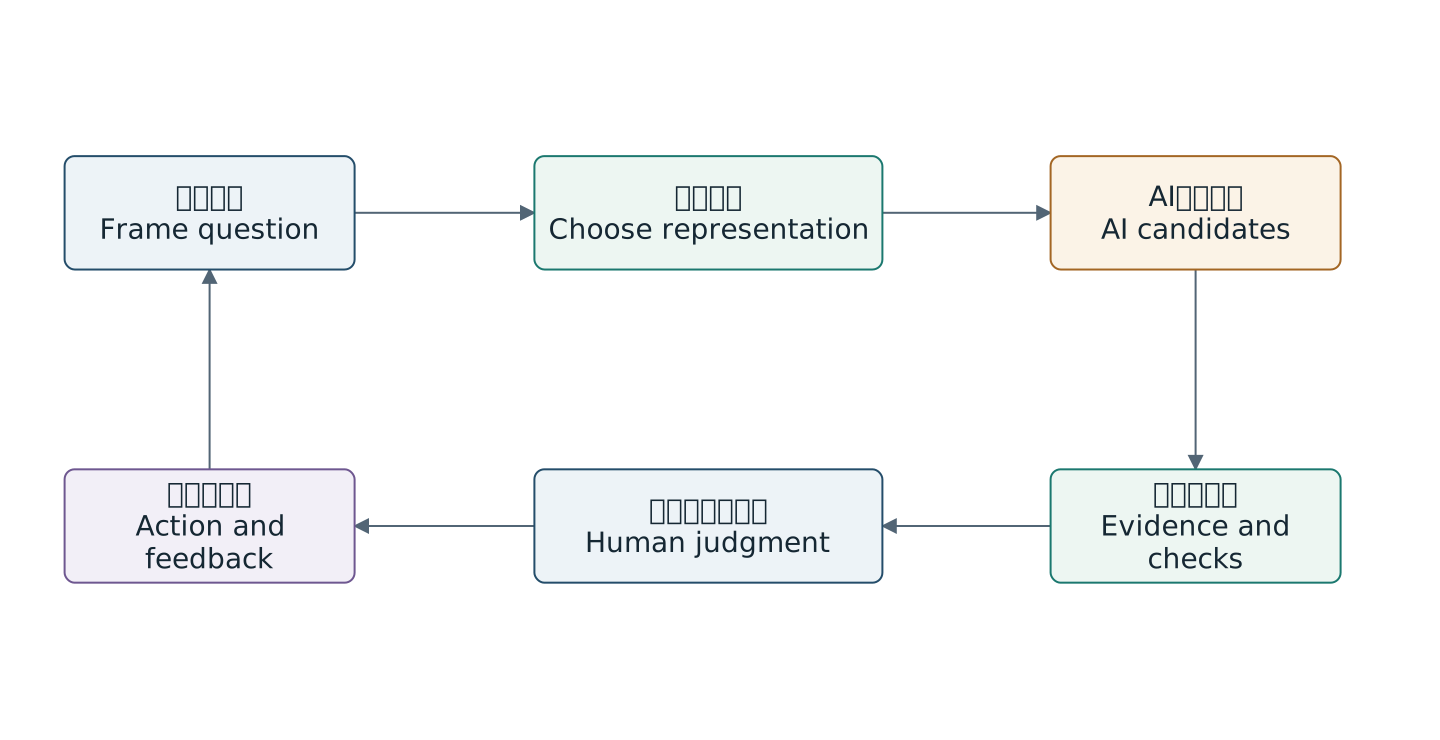
See the relationships.
Return to the evidence.
Visual thinking uses internal imagery and external representations to select information, organize relationships, explore change, and test explanations. AI can lower production barriers; its value for learning and decisions depends on people being able to interpret, revise, and question the resulting representations.
The report uses critical narrative synthesis and distinguishes experimental results, theoretical explanations, technical feasibility, and recommendations. Evidence for learner-generated drawing cannot directly establish the learning benefits of AI-generated drawing.
CONCEPTS · METHODS · APPLICATIONS · EVIDENCE
Visual Thinking Knowledge Graph
107 concept entities and 95 explicitly named semantic relationships. Search terms, follow connections, and inspect report passages and references.
Read by chapter
01 — 24Research questions and principal conclusions
4 sections · Illustrated reading ↗02Concepts and intellectual traditions of visual thinking
4 sections · Illustrated reading ↗03Cognitive mechanisms and individual differences
4 sections · Illustrated reading ↗04Evidence and boundary conditions for learning
4 sections · Illustrated reading ↗05The grammar and design of visual representations
4 sections · Illustrated reading ↗06Value and capability development in the AI era
4 sections · Illustrated reading ↗07Technical routes for AI supported visual thinking
4 sections · Illustrated reading ↗08An architecture for trustworthy generation and validation
4 sections · Illustrated reading ↗09A working method for thinking with AI
4 sections · Illustrated reading ↗10Hotel operations and service design cases
4 sections · Illustrated reading ↗11Marketing and tourism finance cases
4 sections · Illustrated reading ↗12Redesigning an introductory AI course
4 sections · Illustrated reading ↗13Classroom implementation and a complete lesson design
4 sections · Illustrated reading ↗14Skills and expert role collaboration
4 sections · Illustrated reading ↗15Evaluation experiments and research design
4 sections · Illustrated reading ↗16Risk management and implementation
4 sections · Illustrated reading ↗17Reusable tasks and prompting templates
4 sections · Illustrated reading ↗18Terminology and a research agenda
4 sections · Illustrated reading ↗19Applications in research reading and knowledge discovery
4 sections · Illustrated reading ↗20Design practice and organizational collaboration
4 sections · Illustrated reading ↗21Deployment reproducibility and daily use
4 sections · Illustrated reading ↗22Integrated case discussions and exercises
4 sections · Illustrated reading ↗23Interactive computation and visual simulation
4 sections · Illustrated reading ↗24Integrated discussion and priority actions
4 sections · Illustrated reading ↗Full report and supporting materials
The Word and PDF downloads contain the same complete bilingual edition. Web chapters present each language separately.
SEARCH CUTOFF: 17 OCTOBER 2026
References and official documentation
Original English titles are retained for discovery. Read source types and limitations alongside the chapters; preprints are not equivalent to peer-reviewed findings.
- [1]Arnheim, R. (1969). Visual Thinking. University of California Press.Theoretical monograph
- [2]Grandin, T. (2022). Visual Thinking The Hidden Gifts of People Who Think in Pictures Patterns and Abstractions. Riverhead Books.Research-informed trade book and personal perspective
- [3]Larkin, J. H., & Simon, H. A. (1987). Why a Diagram is Sometimes Worth Ten Thousand Words. Cognitive Science, 11, 65–100.Computational and theoretical analysis
- [4]Blazhenkova, O., & Kozhevnikov, M. (2009). The new object spatial verbal cognitive style model Theory and measurement. Applied Cognitive Psychology, 23, 638–663.Psychometric research
- [5]Blazhenkova, O., Becker, M., & Kozhevnikov, M. (2011). Object spatial imagery and verbal cognitive styles in children and adolescents Developmental trajectories in relation to ability. Learning and Individual Differences, 21, 281–287.Developmental correlational research
- [6]Pashler, H., McDaniel, M., Rohrer, D., & Bjork, R. (2008). Learning Styles Concepts and Evidence. Psychological Science in the Public Interest, 9, 105–119.Critical evidence review
- [7]Uttal, D. H., et al. (2013). The malleability of spatial skills A meta analysis of training studies. Psychological Bulletin, 139, 352–402.Meta-analysis
- [8]Mayer, R. E. (2021). Cognitive Theory of Multimedia Learning. The Cambridge Handbook of Multimedia Learning, third edition, chapter 5.Theory and research synthesis
- [9]Ainsworth, S. (2006). DeFT A conceptual framework for considering learning with multiple representations. Learning and Instruction, 16, 183–198.Conceptual framework
- [10]Rau, M. A. (2017). Conditions for the Effectiveness of Multiple Visual Representations in Enhancing STEM Learning. Educational Psychology Review.Review
- [11]Fiorella, L., & Zhang, Q. (2018). Drawing Boundary Conditions for Learning by Drawing. Educational Psychology Review.Review
- [12]Cromley, J. G., Du, Y., & Dane, A. P. (2020). Drawing to Learn Does Meta Analysis Show Differences Between Technology Based Drawing and Paper and Pencil Drawing. Journal of Science Education and Technology, 29, 216–229; first online 2019.Meta-analysis
- [13]Leutner, D., & Biele, J. (2025). Without Integration Everything Is Nothing A Meta Analysis of the Effectiveness of Instructional Support for Drawing to Learn. Educational Psychology Review, 37.Meta-analysis; fetched full paper record
- [14]Rexigel, E., Kühn, J., & Becker-Genschow, S. (2024). The More the Better A Systematic Review and Meta Analysis of the Benefits of More than Two External Representations in STEM Education. Educational Psychology Review.Systematic review and meta-analysis
- [15]Zhang, Q., & Fiorella, L. (2021). Learning by drawing When is it worth the time and effort. Contemporary Educational Psychology.Two experiments; source record
- [16]Tversky, B., Morrison, J. B., & Betrancourt, M. (2002). Animation can it facilitate. International Journal of Human Computer Studies.Review and design analysis
- [17]Kirsh, D., & Maglio, P. (1994). On Distinguishing Epistemic from Pragmatic Action. Cognitive Science, 18, 513–549.Situated cognition analysis
- [18]Cleveland, W. S., & McGill, R. (1984). Graphical Perception Theory Experimentation and Application to the Development of Graphical Methods. Journal of the American Statistical Association, 79, 531–554.Graphical perception experiments
- [19]Sutherland, I. E. (1963). Sketchpad A Man Machine Graphical Communication System. MIT doctoral dissertation.Technical dissertation
- [20]Hu, Y., et al. (2024). Visual Sketchpad Sketching as a Visual Chain of Thought for Multimodal Language Models. NeurIPS 37.Peer-reviewed technical benchmark study
- [21]Dibia, V. (2023). LIDA A Tool for Automatic Generation of Grammar Agnostic Visualizations and Infographics using Large Language Models. ACL System Demonstrations.Research system
- [22]Wang, C., Thompson, J., & Lee, B. (2023). Data Formulator AI powered Concept driven Visualization Authoring. IEEE VIS; Microsoft Research publication record.Research prototype and small user study
- [23]Microsoft Research (2024). Data Formulator Exploring how AI can help analysts create rich data visualizations. Research project account.Primary project description
- [24]Masry, A., et al. (2022). ChartQA A Benchmark for Question Answering about Charts with Visual and Logical Reasoning. Findings of ACL, 2263–2279.Benchmark
- [25]Rahmanzadehgervi, P., et al. (2024; revised 2025). Vision language models are blind Failing to translate detailed visual features into words. arXiv 2407.06581, version 6.Preprint benchmark; version-specific findings
- [26]Lu, P., et al. (2024). MathVista Evaluating Mathematical Reasoning of Foundation Models in Visual Contexts. ICLR; arXiv 2310.02255.Benchmark
- [27]Vaccaro, M., Almaatouq, A., & Malone, T. (2024). When combinations of humans and AI are useful A systematic review and meta analysis. Nature Human Behaviour, 8, 2293–2303.Preregistered systematic review and meta-analysis
- [28]Lee, H. P., et al. (2025). The Impact of Generative AI on Critical Thinking Self Reported Reductions in Cognitive Effort and Confidence Effects From a Survey of Knowledge Workers. CHI; DOI 10.1145/3706598.3713778.Self-report survey
- [29]Bastani, H., et al. (2025). Generative AI without guardrails can harm learning Evidence from high school mathematics. PNAS, 122, e2422633122.Randomized controlled trial
- [30]NIST (2024). Artificial Intelligence Risk Management Framework Generative Artificial Intelligence Profile. NIST AI 600-1.Official risk framework
- [31]UNESCO (2023). Guidance for generative AI in education and research. UNESCO.Policy guidance
- [32]W3C Web Accessibility Initiative (accessed 2026). Complex Images. Images Tutorial.Official accessibility guidance
- [33]W3C Web Accessibility Initiative (accessed 2026). Understanding Success Criterion 1 4 11 Non text Contrast. WCAG 2.2 guidance.Official accessibility guidance
- [34]Mermaid (accessed 2026). Flowcharts Syntax and Mindmap. Official documentation.Technical documentation
- [35]Vega Lite (accessed 2026). Visualization specification and transformations. Official documentation.Technical documentation
- [36]Wolfram Research (accessed 2026). Manipulate. Wolfram Language Documentation.Technical documentation
- [37]Wolfram Research (accessed 2026). Graph. Wolfram Language Documentation.Technical documentation
- [38]Coalition for Content Provenance and Authenticity (version 2.2). Content Credentials Technical Specification. C2PA.Technical specification
- [39]Dechamps, T., & Skulmowski, A. (2025). The Effective Design of Tasks Involving Learning by Drawing Current Trends and Methodological Progress in Research on Drawing to Learn. Educational Psychology Review, 37.Review; paper record fetched
- [40]Kim, S., et al. (2025). Can the effects of generative drawing on lasting learning be optimized through integration of retrieval practice. Learning and Instruction.Experimental study; search abstract and fetched metadata
- [41]Wu, J., et al. (2026). Visual Generation Unlocks Human Like Reasoning through Multimodal World Models. arXiv 2601.19834; preprint.Preprint technical study
- [42]Zhang, H., et al. (2025). Latent Sketchpad Sketching Visual Thoughts to Elicit Multimodal Reasoning in MLLMs. arXiv 2510.24514; preprint.Preprint technical study