13.1
Objectives and preparation for ninety minutes
A ninety-minute lesson on retrieval and escalation in hotel knowledge questions can target three outcomes. Learners explain the distinction between retrieval and generation, design an escalation route for conflicting evidence, and test their proposal with scenarios. Completing every configuration step on a commercial platform is not the primary objective. Interface work can consume conceptual learning time, so implementation may become an extension after evidence relationships are understood.
Preparation includes a short policy set, an incomplete process, three scenarios, a field dictionary, and an available demonstration interface. Policies use simulated or public information without real guest data. Two deliberate differences in dates or applicability create decisions worth discussing. The incomplete process removes meaningful judgments rather than random words. Screenshots and a manual alternative preserve the central activity if a platform or network fails.
A short entry assessment asks students to explain the difference between a fluent answer and a supported answer and identify a temporal condition in a policy. This diagnoses background knowledge without assigning cognitive types. Paper access can support learners with limited software experience while preserving the same conceptual and testing requirements.
13.2
Introduction and initial construction
The first ten minutes present two equally fluent responses supported by different evidence. Students judge which can be used and identify missing information. Their checks appear on a whiteboard before a standard diagram is revealed. During the next fifteen minutes, an instructor builds a concrete process through question interpretation, retrieval, scope checking, and response generation. Each node is introduced with its input, output, and possible failure, making the diagram part of explanation rather than an after-the-fact decoration.
Groups then spend fifteen minutes completing a partial process. Each adds one decision, one exceptional exit, and labels for two relationships. AI may ask questions about omissions but does not immediately provide a complete solution. The instructor asks what an arrow carries and what evidence supports a decision. Groups explain their most consequential revision, while peer questions focus on relationships and evidence.
Repairable errors are useful. A proposal to let the model combine all conflicting policies can prompt discussion of scope and authority. The instructor can preserve several representative structures rather than normalize every group immediately. These become test objects in the next phase, showing that errors are opportunities for examination.
13.3
Testing revision and independent transfer
From minute forty to sixty, groups exchange diagrams and apply shared tests involving missing information, conflicting dates, and requests beyond authority. Testers identify the node where the problem occurs and the required revision. Saying that the model will handle it is insufficient. The receiving group revises its process and records one rejected assumption. A working interface permits a few runs, while manual role-play can still expose many structural problems.
From minute sixty to seventy-five, the instructor compares a reference with student proposals. The discussion distinguishes indispensable rules from optional design choices rather than declaring one layout correct. Each learner then independently transfers the process to a promotional-policy scenario, explaining what can remain and what must change. This reveals individual understanding beyond group performance.
The final fifteen minutes support reflection and an exit assessment. Students submit a central explanation, a justified revision, and an unresolved question, along with a description of AI's contribution. The next lesson's scaffolds follow those responses. An extension may implement a minimal system, but acceptance includes exceptions and evidence records. Technical completion and conceptual understanding should remain separately visible in assessment.
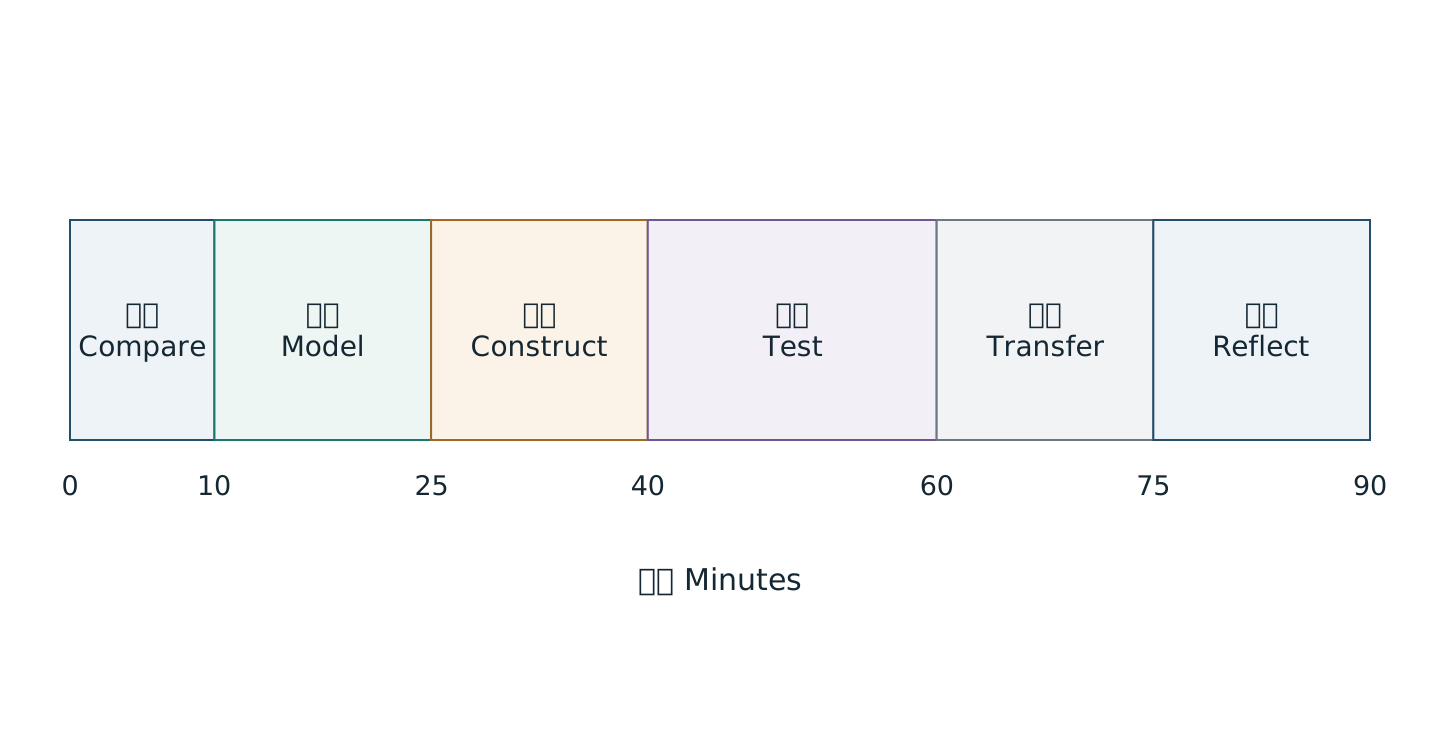
Proposed timing adjustable to learner performance
Figures retain bilingual labels; the surrounding text explains them. Open for a larger view.| Minutes | Activity | Observable outcome |
|---|---|---|
| 0 to 10 | Compare fluent answers with different evidence | Identify checks |
| 10 to 25 | Instructor builds the process | Explain inputs outputs and failure |
| 25 to 40 | Complete and label relations | A decision and exceptional exit |
| 40 to 60 | Exchange and apply shared tests | Locate issues and revise |
| 60 to 75 | Reference comparison and transfer | Justified change under new conditions |
| 75 to 90 | Reflection and exit assessment | Explain revisions and uncertainty |
13.4
Adapting to forty five minutes and prior knowledge
A forty-five-minute adaptation should retain the sequence of question, construction, testing, and transfer. Reduce the number of policies, replace some group construction with shared completion, and preserve one exception and one individual explanation. Interface configuration moves outside the lesson. Material and operation volume decrease while the essential reasoning remains. Dictionaries or source markers can be supplied according to prior knowledge.
A programming-oriented class may add structural validation and automated tests. A business introduction may emphasize definitions, applicability, and process boundaries. These are different objectives rather than a hierarchy of worth. Proficient diagram makers need more demanding explanations and transfer tasks; learners struggling with representation can begin with limited nodes and relation options. Adaptation follows performance rather than fixed learner categories.
After teaching, check for unintended misconceptions: equating retrieval augmentation with the database, assuming an agent has default authority, or believing that citations guarantee correctness. These can become the next lesson's error-diagnosis items. AI can draft them, but the instructor confirms the conceptual target. Accumulating such evidence supports continuing course improvement.