10.1
Connecting frontstage and backstage through blueprints
Hotels illustrate visual thinking because visible guest experience and backstage work do not coincide. A stay involves booking, confirmation, arrival, check-in, room use, service requests, settlement, and feedback. Supporting work includes room-status updates, cleaning schedules, inventory, payment, and channel synchronization. A service blueprint separates guest actions, visible contact, backstage activity, and support systems so that handoffs and waiting become visible. AI can propose a draft, while hotel staff confirm actual roles and rules.
An early-arrival request may sound simple but depend on cleaning status, the previous guest's departure, membership entitlements, charges, and authorization. A single AI-customer-service node hides these dependencies. A useful representation distinguishes evidence access from action permission. AI may explain rules, query authorized status, and suggest options, while an unconfirmed room must not become available merely because the model proposes it. The blueprint makes capability boundaries specific to actions.
Students can inspect simplified records, identify three possible waiting points, and specify the evidence needed to test them. Waiting for cleaning remains a candidate bottleneck, not a proven cause of dissatisfaction. Arrival distributions, room types, and staffing may also matter. AI can suggest fields to collect, while improvement requires records and trials. The representation connects guest experience with operating evidence.
10.2
Evidence flows in hotel knowledge questions
A hotel retrieval exercise can use de-identified material about breakfast, cancellation, pets, facilities, and special requests. The process interprets the question and its temporal conditions, retrieves candidates, checks scope, generates a supported response, and escalates conflicts or permission gaps. It needs an explicit unknown route. An entirely successful demonstration can otherwise make retrieval augmentation appear to guarantee factual accuracy.
Two cancellation policies with different dates support useful tests. Students first build a simple process, then handle an unspecified booking channel, policies for groups versus individual guests, and a conflict between a current rule and a signed agreement. Each test requires a condition or escalation revision. AI may draft responses and test questions, while students justify applicability and identify missing information. Scenario performance, rather than professional-sounding component names, determines accuracy.
Assessment can examine citation accuracy, scope decisions, necessary clarification, unauthorized promises, and escalation completeness. Speed and apparent helpfulness are insufficient. Automatically promising free cancellation may please a guest while violating evidence or authority. Escalating every question avoids some errors but offers little assistance. Comparing these extremes helps students design a reasoned division of work. Real use must fit the hotel's existing service and authorization system.
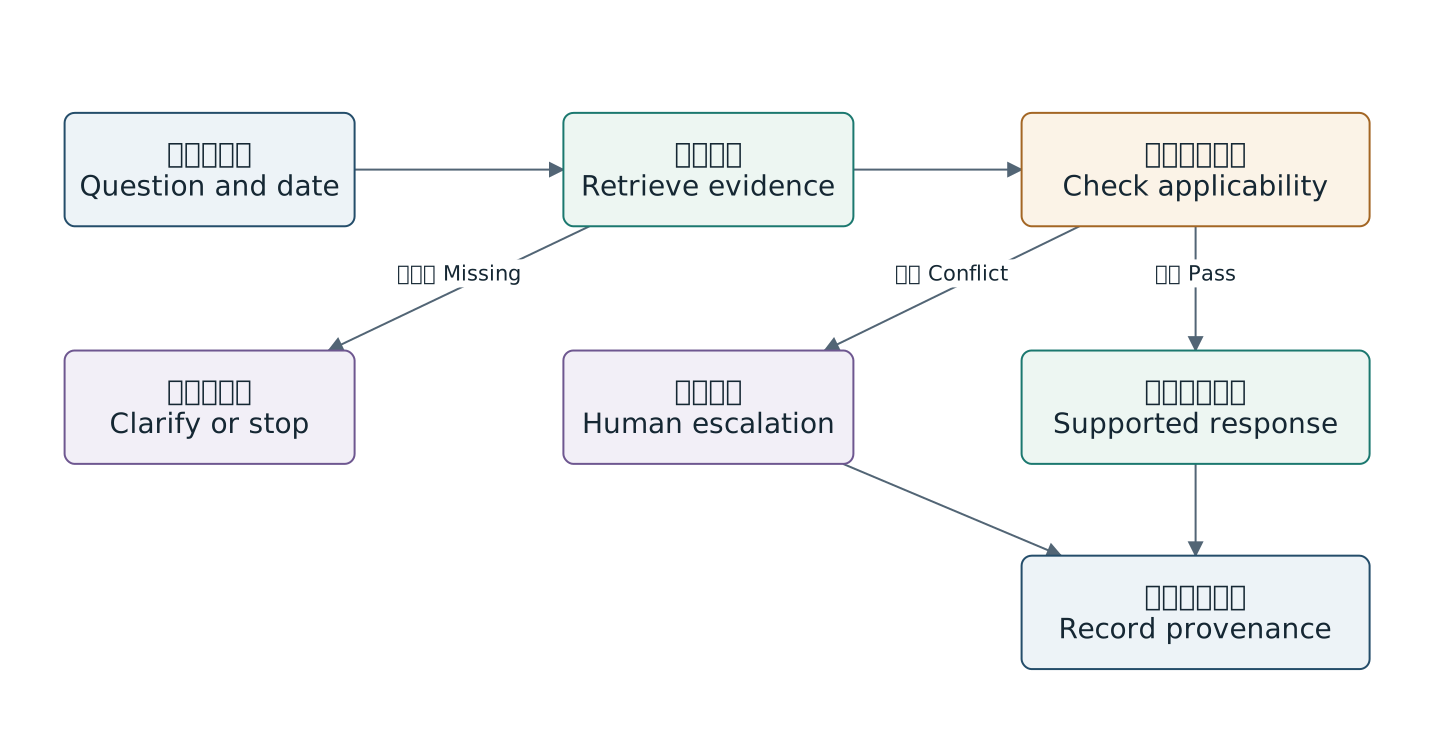
Conceptual design proposed in this report
Figures retain bilingual labels; the surrounding text explains them. Open for a larger view.10.3
A computed revenue and profit scenario
The following is a synthetic teaching scenario, not an estimate of demand for an actual hotel. There are one hundred available rooms. At price p, expected room nights sold equal ninety-five minus one tenth of p. Demand remains below capacity over the illustrated price interval. Variable cost is eighty per occupied room and daily fixed cost is eight thousand. Revenue equals price multiplied by expected room nights. Scenario profit equals price minus eighty, multiplied by expected room nights, minus eight thousand. Fractional room nights represent expectations rather than a literal daily room count.
Symbolic and numerical checks with Wolfram give a revenue-maximizing price of 475, expected sales of 47.5 room nights, and revenue of 22,562.5. The profit-maximizing price is 515, with 43.5 expected room nights and profit of 10,922.5. At price 300, expected sales are sixty-five, revenue is 19,500, and profit is 6,300. Within these assumptions, maximizing occupancy, revenue, and profit are different objectives. The model excludes room-type differences, commissions, service capacity, guest experience, and long-run demand. It does not supply an actual pricing recommendation.
Students can predict whether the peaks coincide, inspect the computation, and then change variable cost or the demand slope. They should explain why an optimum moves rather than merely report a number. An exact optimum under an incorrect demand function may have little operating value. The exercise demonstrates mutual constraints among objectives, assumptions, formulas, and graphics, while distinguishing computational correctness from empirical adequacy.
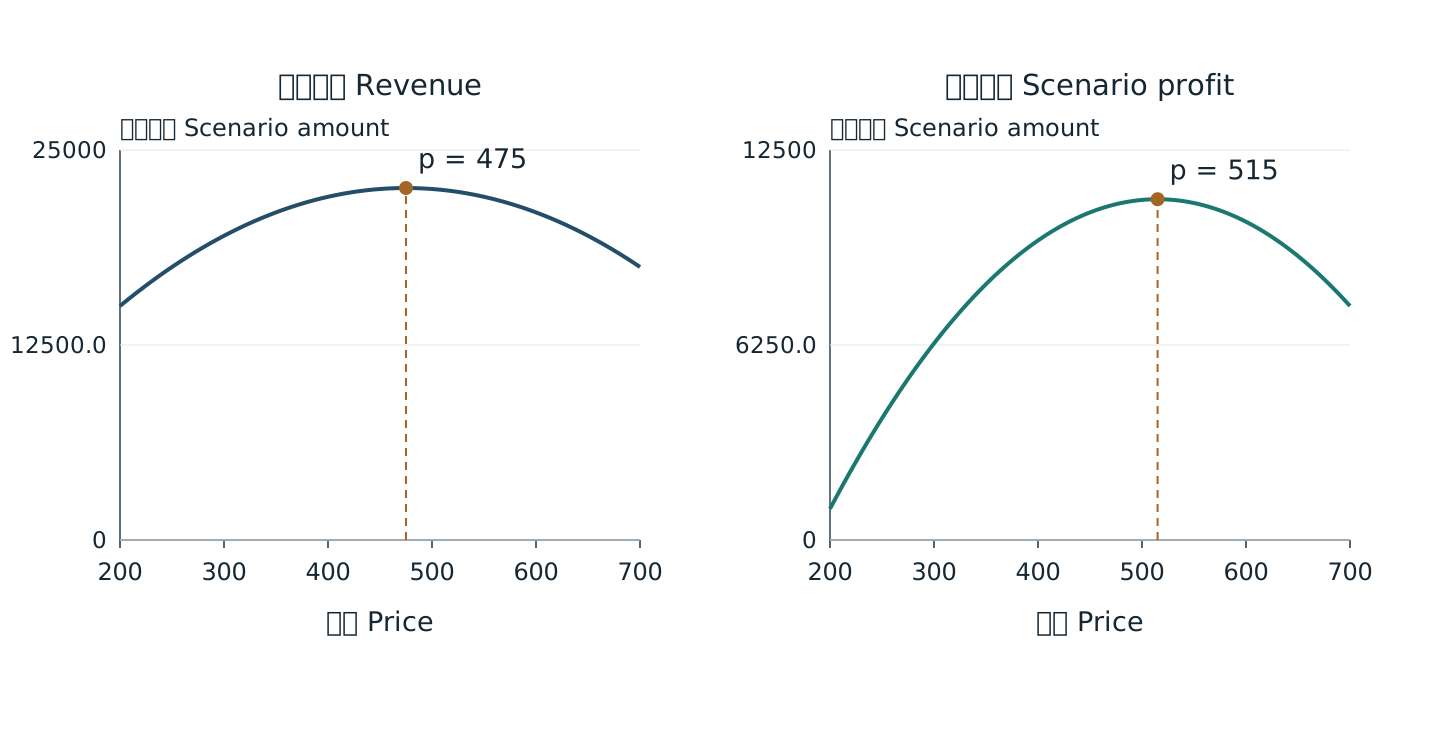
Synthetic scenario not an empirical pricing model
Figures retain bilingual labels; the surrounding text explains them. Open for a larger view.| Price | Expected nights | Revenue | Scenario profit |
|---|---|---|---|
| 300 | 65 | 19500 | 6300 |
| 400 | 55 | 22000 | 9600 |
| 475 | 47.5 | 22562.5 | 10762.5 |
| 500 | 45 | 22500 | 10900 |
| 515 | 43.5 | 22402.5 | 10922.5 |
| 600 | 35 | 21000 | 10200 |
10.4
From a chart to an executable pilot
An operational pilot should begin with a controllable, limited-consequence activity such as internal knowledge lookup or handoff prompts. Establish a current-state representation and baseline, use AI to propose a revised process with an explicit mechanism, then compare outcomes on a small scale. Measures can include completion time, errors, guest experience, and staff burden so that one improvement does not merely transfer costs to another role.
Rejected hypotheses deserve preservation. A team may initially blame slow search and later discover unclear approval responsibility. Revision history then shows where learning occurred. An unsuccessful pilot should distinguish poor model judgment, inadequate evidence, incomplete execution, and unsuitable measures. Visual thinking helps turn both success and failure into interpretable experience.