12.1
Organizing a course around demonstrable capabilities
For students in hospitality, marketing, and tourism finance, an introductory AI course can aim at solving bounded real problems with AI. Four connected capabilities are central: representing a problem, selecting appropriate AI and computational tools, validating outputs, and translating results into explainable action. Visual thinking runs through the course without replacing foundational concepts or necessary quantitative knowledge. Students need a minimum explanatory understanding while avoiding a course dominated by implementation detail.
A course map can contain problem, evidence, tool, workflow, and evaluation layers. Business objectives occupy the first, text and data the second, models and computational tools the third, collaboration and permission the fourth, and correctness and limitations the fifth. This is more faithful to work than a hierarchy in which tools simply become more advanced. A simple table may be more suitable than a complex agent.
Every module should produce inspectable evidence of capability. After prompting, learners explain how constraints alter outputs. After analysis, they reproduce a chart value. After retrieval, they judge source applicability. After agents, they identify tool failures and permission boundaries. After visual thinking, they compare representations of one problem. The final project connects these achievements rather than abruptly requiring an oversized product.
12.2
An adaptable sixteen week framework
A flexible sixteen-week design can use four phases. Weeks one to four establish problem representation, AI boundaries, evidence, and visual conventions. Weeks five to eight develop data analysis, retrieval, and verification. Weeks nine to twelve address workflows, agents, industry services, and scenarios. The final four weeks support project work, evaluation, revision, and presentation. This is a proposal to adapt to local schedules and prior knowledge.
Each week retains one central question, one principal representation, and one verifiable outcome. A data week asks how records produce a chart and yields a reproducible explanation. An agent week asks when a system should stop or escalate and yields exception tests. Students can then locate weekly learning within a consistent problem-solving process instead of remembering only application names.
The map should evolve without expanding indefinitely. A stable overview can link to topic-specific detail. Students explain new connections and identify one unresolved question at each revision. This helps an instructor assess structural understanding. AI may offer maps at different levels of complexity, while assessment remains tied to shared objectives rather than node counts.
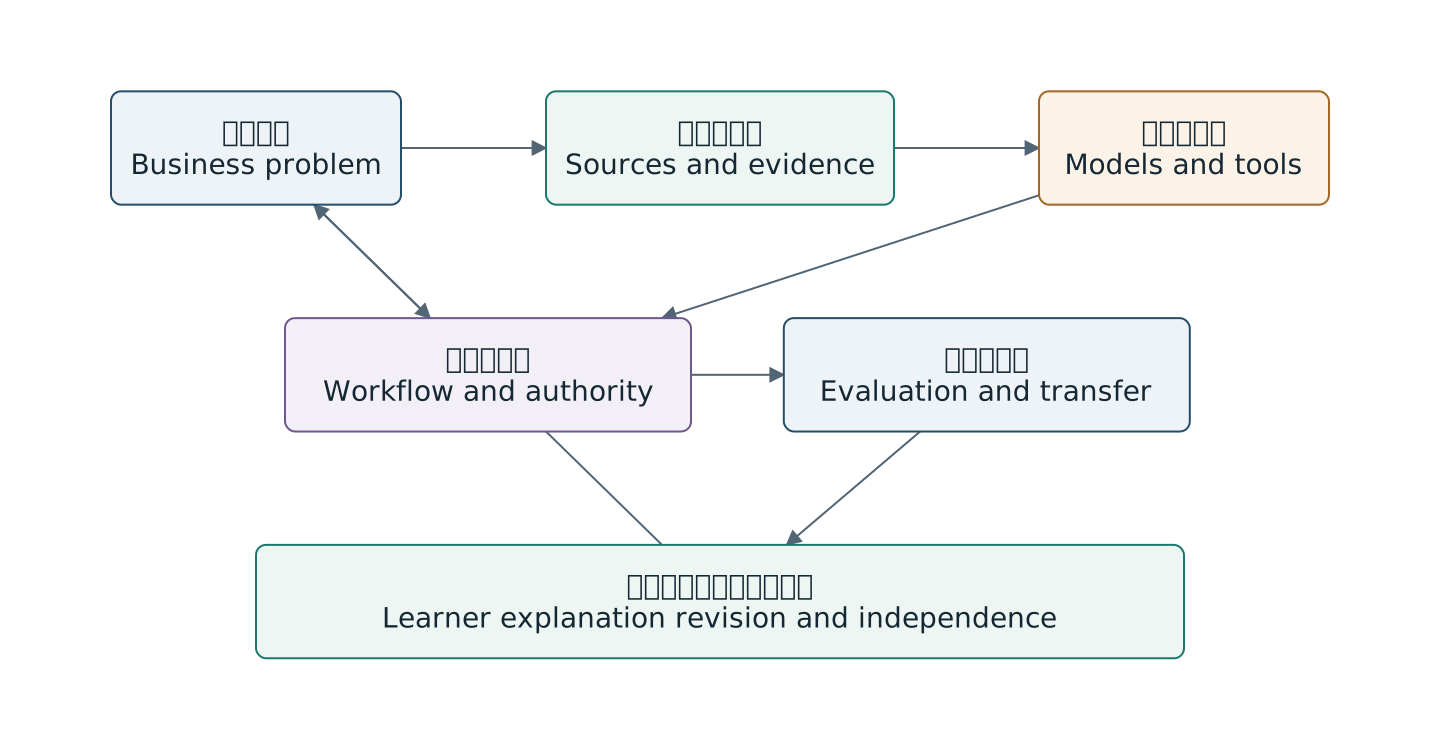
Conceptual design proposed in this report
Figures retain bilingual labels; the surrounding text explains them. Open for a larger view.| Weeks | Question and content | Evidence of capability |
|---|---|---|
| 1 to 2 | AI capabilities and problem scope | Problem map and capability limits |
| 3 to 4 | Prompts sources and visual grammar | Translation and error diagnosis |
| 5 to 6 | Data definitions and charts | Reproducible chart and dictionary |
| 7 to 8 | Retrieval and evidence | Sourced answer and conflict test |
| 9 to 10 | Workflows and agents | Permission failure and escalation |
| 11 to 12 | Industry blueprints and scenarios | Service process and assumptions |
| 13 to 14 | Pilot and revision | Tests and justified changes |
| 15 to 16 | Defense and transfer | Individual explanation and reproduction |
12.3
From instructor demonstration to learner construction
A visually rich course can still leave students passive. Responsibility needs to transfer gradually. An instructor first models extraction from a source, students then complete relationships, later choose representations independently, and finally justify revisions to others' work. Short explanations accompany each stage so that activity does not become tracing. AI feedback can help without giving everyone an identical completed artifact.
Five useful activity types are prediction before reveal, completion with explanation, error diagnosis, redrawing under changed conditions, and translation between prose and graphics. They respectively support initial modeling, relational focus, scrutiny, transfer, and correspondence. A lesson need not include all five. Instructors can record which activities help with particular concepts and build local evidence.
Scaffolds should change with demonstrated performance. A learner who confuses data and control flow may retain an arrow vocabulary, while a proficient learner defines the types independently. Templates or paper entry can reduce interface barriers while preserving the same explanatory requirements. Visual competence becomes something to develop rather than a presumed talent.
12.4
Assessment and a learning portfolio
Assessment should cover individual and group work, process and product, and performance with and without AI. One adjustable allocation is twenty percent concepts and short tests, twenty-five percent a visual-reasoning portfolio, thirty-five percent an industry project, and twenty percent an individual transfer defense. These are design suggestions rather than empirically optimal percentages. Local requirements and learning objectives determine the final allocation. The essential point is that a polished group artifact should not conceal weak individual understanding.
A portfolio can preserve an initial problem map, relevant AI feedback, a revision explanation, and an independent transfer task. The instructor need not inspect every conversation, only evidence related to important conceptual changes. Students identify their tools and what they personally verified. This supports integrity and professional communication about sources and responsibility. Assessment becomes part of the capability sequence.