9.1
Start with the question and criteria
The first step is to express the task as a question whose completion can be judged. Instead of beginning with a request for a mind map, specify that the investigation concerns why complaints accumulate at night and must distinguish demand, staffing, and escalation rules. The former specifies a product; the latter specifies a cognitive task. A clear cognitive task tells the system what evidence to request, which exceptions to preserve, and what representations may be useful. The form can be chosen after alternatives are compared.
A task brief includes the object, audience, action purpose, available evidence, and constraints. Educational work also needs prior knowledge and the capability learners must demonstrate. Industry work needs a time span, business measures, permissions, and actions requiring confirmation. AI can organize missing information into questions, but it should not invent facts for completeness. Missing data and unconfirmed relationships can remain visible while work proceeds within those limits.
Success criteria should be defined before generation. A complaint workflow might require an executable normal route, clear ownership, traceable evidence, exits for three exceptions, and an explanation of escalation. Appearance is only one criterion. If standards are chosen after seeing an attractive artifact, people may unconsciously relax content requirements. Prior criteria support fairer comparison among candidates.
9.2
Generate inexpensive alternatives
Visual work makes alternative structures inexpensive to compare early. For one problem, AI can propose a responsibility swimlane, a bottleneck timeline, and a causal-hypothesis map. People explain what each can and cannot answer before choosing the next step. Simple structural drafts are sufficient; every candidate need not become a polished image. Early comparison is often more useful than refining one format before its suitability is established.
Reasons for rejection should be preserved. The causal map may lack data and remain useful only for planning an investigation. The swimlane may have documentary support and be ready for a cross-department meeting. The timeline may require timestamps that have not been collected. Such records accumulate knowledge instead of leaving only a final artifact. AI broadens the candidate space, while people narrow it using evidence and context. More generation then supports better judgment rather than substituting for it.
Students can compare two representations without immediately naming a winner. Each group explains which question each form serves. A new constraint, such as a fixed night-shift workforce, then requires reconsideration. This develops understanding of the relationship between form and purpose and the ability to acknowledge limitations. AI supplies material for discussion rather than an authoritative answer.
9.3
Iterate through explanation revision and counterexamples
A meaningful iteration includes explanation, consequential revision, and a counterexample. Explanation guards against surface reading. Revision tests dependency understanding. A counterexample tests scope. In a retrieval workflow, a student can first explain how evidence enters a response, then add conflicting sources, and finally handle a retrieved but expired policy. These activities reveal more than changing the diagram's colors.
AI feedback can take the form of questions rather than immediate replacement: does this action require identity verification, where are conflicting dates compared, and what error could pass if review were removed? Automatically displaying a complete correct diagram after every response can reduce the learner's role to acceptance. Hints, partial examples, and full explanations can instead be released progressively.
Conceptual changes should be distinguished from layout changes. Moving a node may improve readability without changing reasoning. Adding an authorization condition changes the process itself. Students should state what changed and why. These records help assessment and allow later AI assistance to use confirmed rules rather than infer thinking from appearance. Mature collaboration preserves reasoned changes instead of producing endless alternatives.
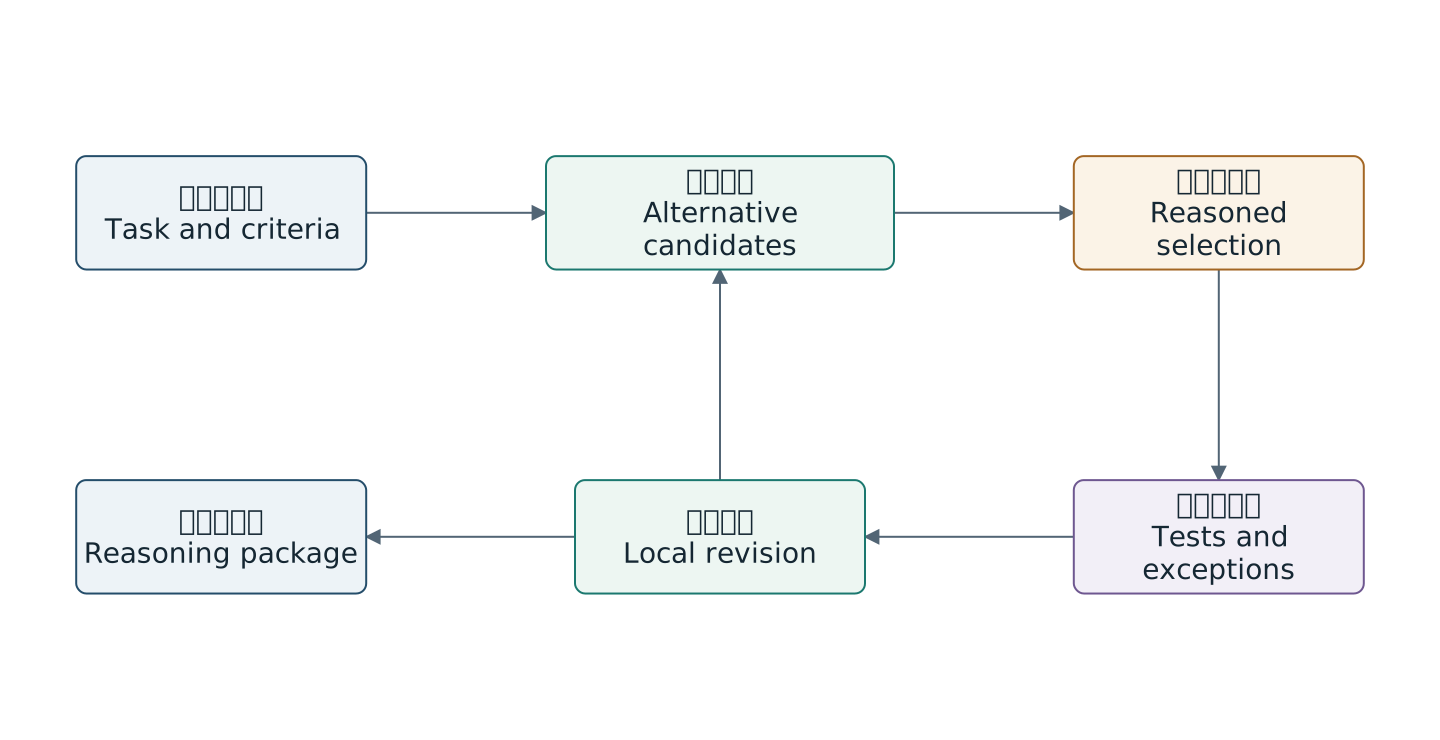
Conceptual design proposed in this report
Figures retain bilingual labels; the surrounding text explains them. Open for a larger view.9.4
Deliver a reasoning package
A final reasoning package can include a problem statement, principal graphic, evidence or data table, assumptions, alternatives, validation record, and next action. A diagram cannot carry every responsibility by itself, and prose need not repeat every node. Graphics show structure, prose interprets meaning, tables preserve comparable records, and appendices support reproduction. The combination suits both classroom defense and cross-functional business discussion.
Reading order should also be designed. An audience first encounters the question and conclusion, then relationships and evidence, with detail available when needed. Different audiences can receive different levels of expansion while retaining one factual structure. Chinese and English versions should likewise share identifiers and data while using natural expressions in each language. The purpose is to enable others to continue the reasoning.
| Stage | Record | Check |
|---|---|---|
| Clarify | Question and success criteria | Can completion be judged |
| Propose | Two or three different structures | Are differences conceptual |
| Select | Selection and rejection reasons | Do reasons follow evidence |
| Test | Exceptions and reproducible points | Do tests challenge assumptions |
| Revise | Semantic and layout changes | Are related outputs updated |
| Deliver | Reasoning package and owner | Can another person continue |