3.1 From text spans to canonical entities
Entity extraction is a sequence of related tasks. Mention detection(提及检测)finds a span of text. Named entity recognition(命名实体识别)assigns a category to that span. Entity linking(实体链接)maps it to an existing entity when appropriate. Coreference resolution(共指消解)connects expressions that refer to the same thing in context. Entity resolution(实体消歧与归一)reconciles records across sources. A system can perform well on mention boundaries while still making serious identity errors.
Consider the fictional passage: “Mei Chen presented GraphLens at Northbridge Institute. Chen later released its evaluation dataset.” The first sentence introduces a person, a method or software system, and an institution. The second sentence requires deciding that “Chen” refers to the same person and determining what “its” refers to. A pipeline should preserve the original spans and the alternative interpretations. If GraphLens is also the name of an unrelated commercial product, linking by surface name alone would create a misleading connection.
A canonical entity(规范实体)is the system's current representation of a referent. It should have a stable identifier and a record of the evidence used to attach mentions. New mentions should not automatically create new canonical entities. Conversely, unknown entities should not be forced into the closest existing candidate. A NIL or unresolved outcome is often the correct result. The graph can later revisit unresolved mentions when more information becomes available.
3.2 Methods and their appropriate roles
Dictionary and pattern based extraction remain useful when identifiers follow strict formats or a vocabulary is small and stable. A DOI pattern, an equipment serial number, or a curated list of internal project codes may be easier to extract with deterministic rules than with a large model. Rules are also transparent: a reviewer can inspect the exact matching condition. Their weakness is incomplete coverage and fragility when text varies. Combining rules with learned models can preserve precision for standardized fields while improving recall for natural language expressions.
Lample and colleagues demonstrated neural approaches to named entity recognition using character and word representations with sequence modeling [13]. BERT introduced contextual language representations that became a foundation for many extraction systems [14]. These contributions concern representation and prediction; they do not remove the need for a domain appropriate annotation policy. A model trained to recognize Person, Organization, and Location will not automatically understand the distinction between a scientific method, a metric, and a dataset version.
Span based approaches represent candidate text spans and classify them, making it easier to express overlapping or nested mentions. SpERT combines transformer representations with entity and relation extraction [16]. DyGIE++ uses contextualized span representations across entity, relation, and event extraction tasks [17]. These examples illustrate alternatives to a simple token tagging pipeline. In practice, the choice depends on whether the corpus contains nested terminology, cross sentence references, or multiple relations involving the same expression.
Large language models can produce structured entity candidates from instructions and examples. Their flexibility is valuable when a domain lacks a large annotated dataset. A production extractor should nevertheless constrain the output schema, require source spans, validate identifiers and types, and provide an abstention route. A plausible generated entity that never appears in or follows from the source should remain outside the accepted graph. Asking the model to be accurate is weaker than checking the observable properties of its output.
| Approach | Useful capability | Evaluation concern |
|---|---|---|
| Rules and dictionaries | Precise standardized identifiers | Coverage and format variation |
| Sequence tagging [13, 14] | Contextual mention and type prediction | Nested mentions and domain transfer |
| Span and joint models [16, 17] | Shared entity and relation representations | Propagation of argument errors |
| Generative extraction [19] | Structured outputs from text generation | Unsupported additions and missing qualifiers |
| Entity retrieval and ranking [15] | Scalable candidate resolution | NIL handling and incorrect merges |
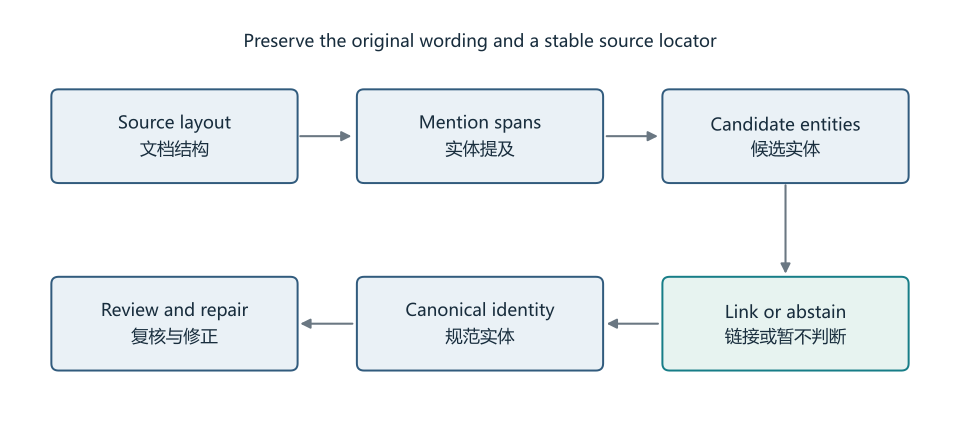
Entity extraction separates mention detection, candidate generation, linking, and review. Abstention preserves uncertainty instead of forcing an identity.
Original figures retain bilingual labels. Read alongside the explanation; open for a larger view.3.3 Linking and resolution
Entity linking usually begins with candidate generation(候选生成)and proceeds to candidate ranking(候选排序). Candidate generation should favor recall: the correct entity must be present before a ranker can select it. A ranker then compares context, aliases, descriptions, and available identifiers. BLINK uses dense retrieval followed by more detailed candidate scoring to support scalable entity linking [15]. The practical lesson is architectural: an inexpensive retrieval stage and a more selective disambiguation stage can serve different purposes.
The Research Evidence Graph uses exact identifiers first, then normalized titles and context, then a review queue for uncertain matches. An exact DOI match is strong evidence for document identity after validation. A similar title plus a different year and author list requires investigation. For people, affiliation and coauthor context may help, but they should not be treated as permanent identity attributes. A person can move institutions, and two people can share both a name and an organization.
Resolution decisions have asymmetric costs. Failing to merge two records may duplicate information, while incorrectly merging two researchers can attribute publications and claims to the wrong person. The acceptable threshold therefore depends on the downstream task. A discovery interface may show possible matches. A system used for attribution or evaluation should require stronger evidence before merging. The threshold should be chosen using labeled examples and review costs, not merely because a model emits a convenient decimal score.
An audit trail should preserve merge justifications and allow reversal. One practical representation stores a canonical entity separately from its source records and attaches a status to each mapping. If a merge is later rejected, the system changes the mappings and recomputes derived views. This is safer than destructively replacing every original identifier. The same design makes it possible to explain why an entity has a particular label or attribute.
3.4 Language layout and domain difficulties
Chinese and English mixed documents create particular extraction challenges. Chinese word boundaries are not always marked by spaces, abbreviations may remain in English, and translated names can vary across sources. Normalization should preserve the original surface form alongside any standardized form. A multilingual alias table can help retrieval, but aliases should include language and source information. Otherwise, an abbreviation that is unambiguous in one domain may incorrectly merge entities in another.
Documents also contain meaning in layout. A dataset name in a table header may apply to several rows; a footnote may qualify a numerical value; a figure caption may define an abbreviation used nowhere else. Flattening a PDF into a single text stream can destroy these associations. A reliable pipeline captures sections, tables, captions, and reading order before extraction. For scanned material, optical character recognition(光学字符识别)errors should be distinguished from the extraction model's errors because they require different remedies.
Specialized domains require careful type definitions. “Transformer” may name a model family, a particular architecture, or an electrical device. “Control” may be a study group, a procedure, or an instruction. The correct label depends on context and the graph's purpose. Annotation guidelines should include positive examples, near misses, and boundary cases. Disagreements between annotators can reveal an unclear schema rather than merely careless labeling.
3.5 Evaluation and review
Entity extraction evaluation should separate span accuracy, type accuracy, linking accuracy, and end to end canonicalization. Exact span matching is useful for reproducibility, while relaxed overlap measures can diagnose near misses. Reporting only a combined score hides whether errors originate in detection or identity. Evaluation data should contain realistic documents, including low quality scans, multilingual passages, unseen names, and absent entities. An easy benchmark with familiar names may substantially overstate deployment quality.
Review can be prioritized by consequence and uncertainty. A low confidence mention with no downstream use may wait; an uncertain identity supporting many important claims should be reviewed early. The queue can also sample high confidence predictions to detect systematic errors that confidence based selection would miss. Reviewer corrections should update the labeled evaluation set only through a controlled process, with a separate holdout set retained for measuring improvement.
The output of entity extraction should therefore be a set of evidence anchored candidates with identity decisions and recorded uncertainty. Treating extraction as a one step conversion from text to truth makes later repair expensive. Treating it as a sequence of reversible interpretations allows the knowledge graph to improve as sources, models, and human understanding change.