14.1 Better benchmarks for changing knowledge
Knowledge graphs evolve, yet many benchmarks evaluate a static snapshot. Future evaluation should test correction, deletion, temporal scope, and newly arriving entities. A system should be rewarded for revising an answer when its evidence changes and for preserving the distinction between what was believed earlier and what is accepted now. Such benchmarks would examine a capability central to practical knowledge management but easy to miss in static link prediction scores.
Another priority is evidence dependence. Several sources may repeat one original claim, while apparently contradictory results may concern different conditions. Benchmarks that require identifying these patterns would better test research assistants than questions with one isolated answer triple. They would also encourage systems to model publication lineage, study context, and uncertainty. Evaluation should include cases where the appropriate output is a qualified answer or a request for additional evidence.
14.2 Multimodal and multilingual graphs
Multimodal knowledge graphs(多模态知识图谱)connect information from text, images, tables, audio, and other sources. The difficulty is preserving what each modality actually supports. An image may establish that an object is present but not its identity; a table may establish a measurement but require a caption to define the units. Aligning modalities should retain their source specific uncertainty rather than collapsing every observation into one confident entity record.
Multilingual graphs face a related problem of alignment. Equivalent words do not always imply equivalent concepts, and culturally specific categories may not map neatly into one universal hierarchy. Future systems should support language specific labels, contextual mappings, and documented disagreements. For Chinese and English research work, terminology management is a practical starting point: retain both original expressions and the agreed concept identifier, while allowing the mapping to be revised.
14.3 Learning with constraints and explanations
Neural and symbolic methods can complement each other when their responsibilities are clear. Learned models can propose candidates and rank evidence; symbolic constraints can detect impossible types or enforce a declared rule. The research challenge is to combine them without mistaking a constraint violation for a factual error or a high model score for proof. Evaluation should measure both predictive utility and the correctness of the claimed explanations.
Explanations should become testable artifacts. A retrieved path can be checked against the graph; a rule derivation can be checked against its premises; a source citation can be checked against the passage. The stronger claim that an explanation accurately describes a model's internal mechanism requires additional evidence. Systems should expose the explanation they can verify rather than promising a deeper form of interpretability because the output includes a graph visualization.
14.4 Agents that maintain knowledge responsibly
Agents may increasingly help maintain graphs by identifying missing metadata, reconciling duplicates, suggesting schema extensions, and locating outdated claims. These tasks are attractive because their outputs can often be reviewed as concrete changes. A productive research direction is to measure how much correct maintenance work an agent completes per unit of review effort. That measure connects autonomy to a real operational benefit while keeping error correction visible.
Agent memory also needs evaluation over time. An assistant should retain useful verified information, forget or retire obsolete records, and avoid amplifying its own mistakes through repeated retrieval. Tests spanning many sessions can reveal failures that single question benchmarks miss. Shared graphs may make memory more inspectable, but they also create a durable route through which an incorrect assumption can influence many later tasks. Versioned provenance and correction are therefore central research topics.
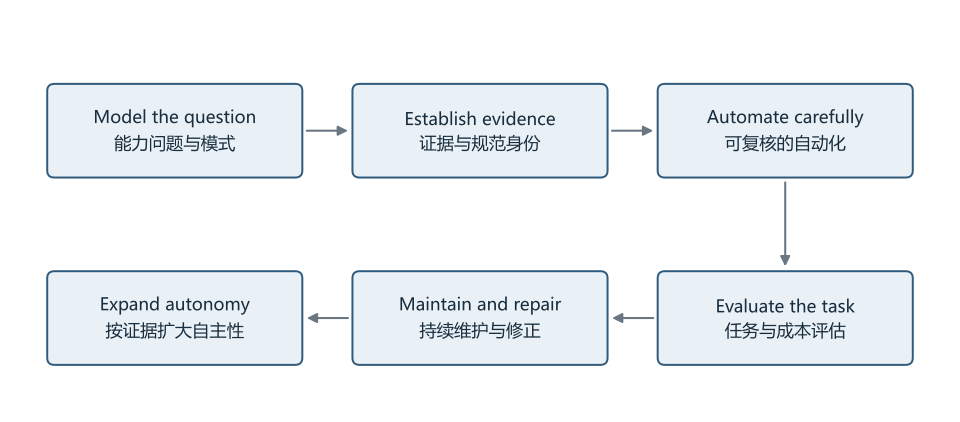
A dependency based implementation path. Greater autonomy follows measured evidence quality, maintenance capability, and task evaluation.
Original figures retain bilingual labels. Read alongside the explanation; open for a larger view.14.5 Final synthesis
A knowledge graph is most valuable when explicit identity and relationships make important questions answerable with clearer evidence. Its effectiveness depends on the entire lifecycle: schema commitments, faithful extraction, identity resolution, storage, computation, reasoning, and maintenance. Each stage contributes a different kind of guarantee. A reliable system preserves those guarantees and their limits as information moves toward an application or an agent.
The practical route is to begin with a bounded question set, model the evidence required to answer it, and build a small inspectable graph. Automated extraction and learned prediction can expand coverage, while validation and provenance keep the expansion correctable. Graph retrieval and agents can then provide flexible access to the knowledge, provided that they preserve uncertainty and operate through controlled tools. This approach makes knowledge graphs a durable component of research and organizational work rather than a one time visualization or an unexamined layer of generated assertions.