1.1 An operational definition
A knowledge graph is a structured representation of entities(实体)and the relationships(关系)among them, organized so that the representation can support interpretation, integration, querying, and inference. This report uses that operational definition rather than treating one storage format as the universal definition. A useful graph may describe people and institutions, components and dependencies, genes and biological processes, or documents and claims. Its subject matter can be concrete, abstract, changing, disputed, or only partially observed. The important requirement is that the graph communicate enough meaning for its intended users to interpret the connections consistently.
Hogan and colleagues survey graph data models, querying, validation, representation, and reasoning as connected aspects of knowledge graphs [1]. Ji and colleagues organize research around representation learning, acquisition and completion, temporal knowledge, and applications [2]. These surveys illustrate the field's breadth. Some research communities emphasize formal semantics and interoperability; others emphasize learned representations, large scale information extraction, or application performance. A report on the subject must make its assumptions explicit because the same phrase can refer to systems with very different guarantees.
Consider three records: a document lists “M. Chen” as an author, an institutional directory lists “Mei Chen,” and an experiment log identifies “researcher 042.” A knowledge graph can link these records to a shared person if sufficient evidence supports that identification. It can then connect the person to publications and experiments. The benefit is not that the information is drawn as circles and lines. The benefit is that the system can ask a question across the records while retaining the grounds for believing they concern the same person.
This definition does not require a graph to contain all human knowledge, to be automatically generated, or to use a specific database. A carefully maintained graph of several hundred research claims can be more useful for a focused task than a much larger collection of weakly identified entities. Scale changes engineering requirements, but it does not substitute for semantic clarity. Nor does a graph need every possible ontology feature. A modest vocabulary with consistent identity and provenance may provide a strong foundation for a practical application.
1.2 Entities relations and statements
An entity is something the system chooses to identify persistently. A node(节点)is a representation of an entity or another modeled object. These terms are related but not interchangeable: one entity may be represented by multiple unresolved nodes, while a node might represent a document fragment, an assertion, or an event rather than a physical object. A relation type states the intended meaning of a connection. A particular edge(边)instantiates such a connection, potentially with additional attributes.
The triple(主语谓语宾语三元组)is a familiar statement form: subject, predicate, object. For example, “Paper P uses Method M” identifies a subject, names a relationship, and identifies an object. In RDF, a graph is a set of triples; subjects are IRIs or blank nodes, predicates are IRIs, and objects may also be literals. Datasets can organize a default graph and named graphs [4]. This formal model is precise, but a real claim often needs additional context. “Method M improves accuracy” is incomplete without an evaluation, a baseline, a dataset, and a measure.
The Research Evidence Graph therefore represents a comparative result as an Evaluation entity. That entity connects a method, dataset version, metric, baseline, score, and source passage. This choice prevents two evaluations from being accidentally collapsed into a single timeless edge. It also exposes what is missing. If the source provides no baseline, the record can preserve that absence instead of implying that the method improved on every alternative. The graph becomes a structured account of evidence rather than a collection of disconnected slogans.
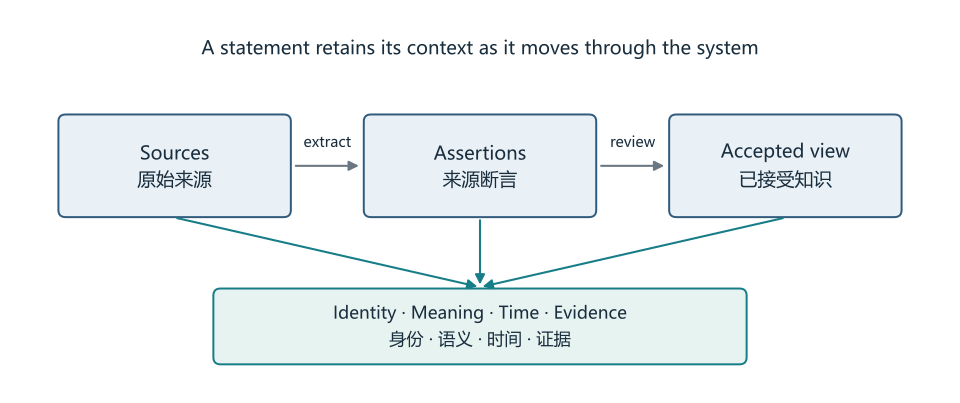
Knowledge representation retains identity, meaning, time, and evidence across source interpretation and acceptance. Original conceptual diagram.
Original figures retain bilingual labels. Read alongside the explanation; open for a larger view.1.3 Schema and instance knowledge
The schema(模式)describes available categories, relationship meanings, and constraints. Instance data(实例数据)describes particular things. A statement that every experiment has a dataset is a schema level commitment; a statement that Experiment E uses Dataset D is an instance assertion. The distinction allows a system to check whether particular records satisfy expectations. It also makes model changes visible. Adding a new dataset record usually does not require changing the schema, while introducing a new concept of dataset lineage might.
An ontology(本体)typically makes conceptual commitments more explicit than a lightweight application schema. It may define class hierarchies, property characteristics, equivalence, disjointness, or logical restrictions. A taxonomy(分类体系)primarily organizes categories hierarchically. A controlled vocabulary(受控词表)standardizes labels. These artifacts can coexist. For example, a research graph might use a controlled vocabulary for research methods, a taxonomy for scientific disciplines, and a small ontology for authorship and evidence. Calling every list of labels an ontology obscures these different functions.
A graph database is a storage and query system. A knowledge graph is the modeled body of knowledge and its associated interpretation. The same knowledge graph can be stored across several physical systems, and a graph database can contain information with little explicit semantics. Similarly, a relational database can support parts of a knowledge graph through tables, identifiers, and joins. Choosing a graph database is therefore an implementation decision; it does not by itself settle the conceptual design.
1.4 Knowledge is situated and incomplete
An assertion(断言)records that a statement has been made. Its existence does not establish its truth. A source may be mistaken, outdated, promotional, or describing a hypothetical situation. The graph should distinguish “Document D reports claim C” from “Claim C has been independently verified.” This distinction is especially important when language models extract confident prose. The surface certainty of a sentence and the reliability of the underlying evidence are separate properties.
Missing information also requires interpretation. Under an open world assumption(开放世界假设), the absence of a statement does not imply that it is false. RDF and OWL reasoning commonly operate with open world semantics [5, 7]. A local application can still define a closed and audited dataset for a specific purpose. For example, an experiment registry might promise that every completed experiment has been registered by the end of a reporting period. A query about that registry then has a narrower completeness assumption, which should be documented rather than silently generalized to the entire world.
Contradiction can be informative. Two papers may report different outcomes because they use different populations, dates, instruments, or definitions. An integration pipeline should first test whether the claims are actually about the same conditions. If disagreement remains, representing both claims with provenance can be more faithful than choosing one automatically. The graph can support investigation by exposing the point of conflict. A single resolved value should be treated as a governed view with a stated resolution policy, not as an inevitable consequence of collecting data.
1.5 When a graph is useful
A graph is particularly useful when questions repeatedly cross identities, relationship types, sources, or levels of abstraction. Examples include tracing a component failure through supplier dependencies, finding research claims supported by several independent studies, and identifying which internal procedures depend on an outdated regulation. In each case, explicit links allow the application to follow connections that are difficult to reconstruct reliably from isolated text fragments.
The investment is less compelling when the workload consists mainly of retrieving complete documents by keyword, calculating regular numeric aggregates, or maintaining a stable transactional form with few cross record relationships. Those tasks may be served well by search engines, analytical databases, or conventional application tables. A graph can coexist with those systems, but its additional schema, identity, and maintenance work should earn its place through measurable task improvements. This report treats that decision as an empirical design question rather than a commitment to one technology.