UNIVERSITY TEACHING / INTRODUCTION TO AI

GraphRAG & Multimodal Knowledge Graphs: A 90-minute Visual Course

22 slides, two classroom activities and evidence-checking exercises. For introductory university learners; no programming or paid account required.

90-minute lesson plan

Introduction 10m → GraphRAG 30m → Group graph construction 12m → Multimodal methods 26m → Transfer and review 12m.

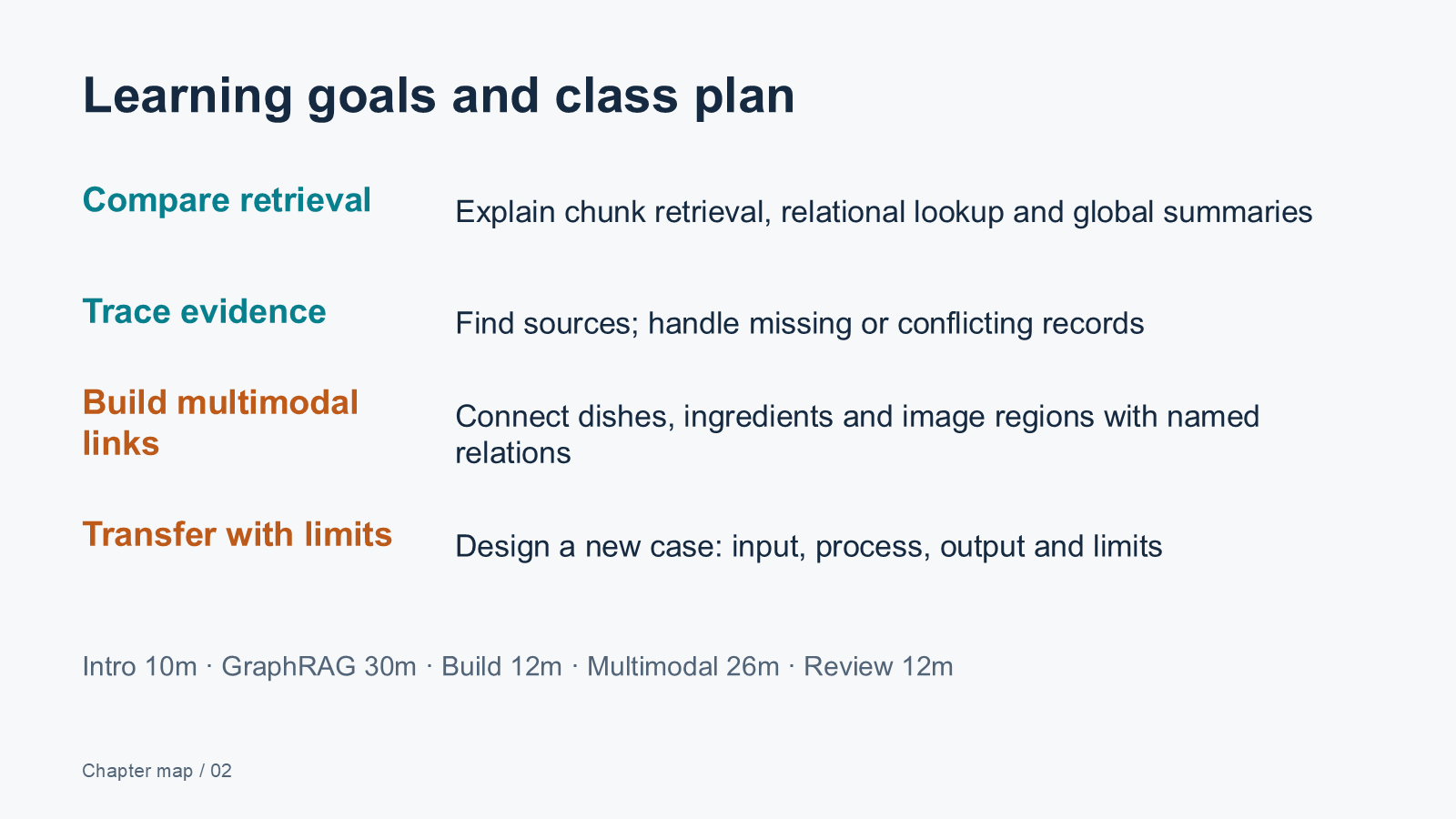
Learning goals: compare retrieval paths, trace evidence, build image–text relations, and explain unknowns and conflicts.

The Chinese PPT preserves the existing V4. The English PPT translates all slides and includes English teaching notes. Original Chinese case-image annotations are retained with English explanations.

Activities and assignment

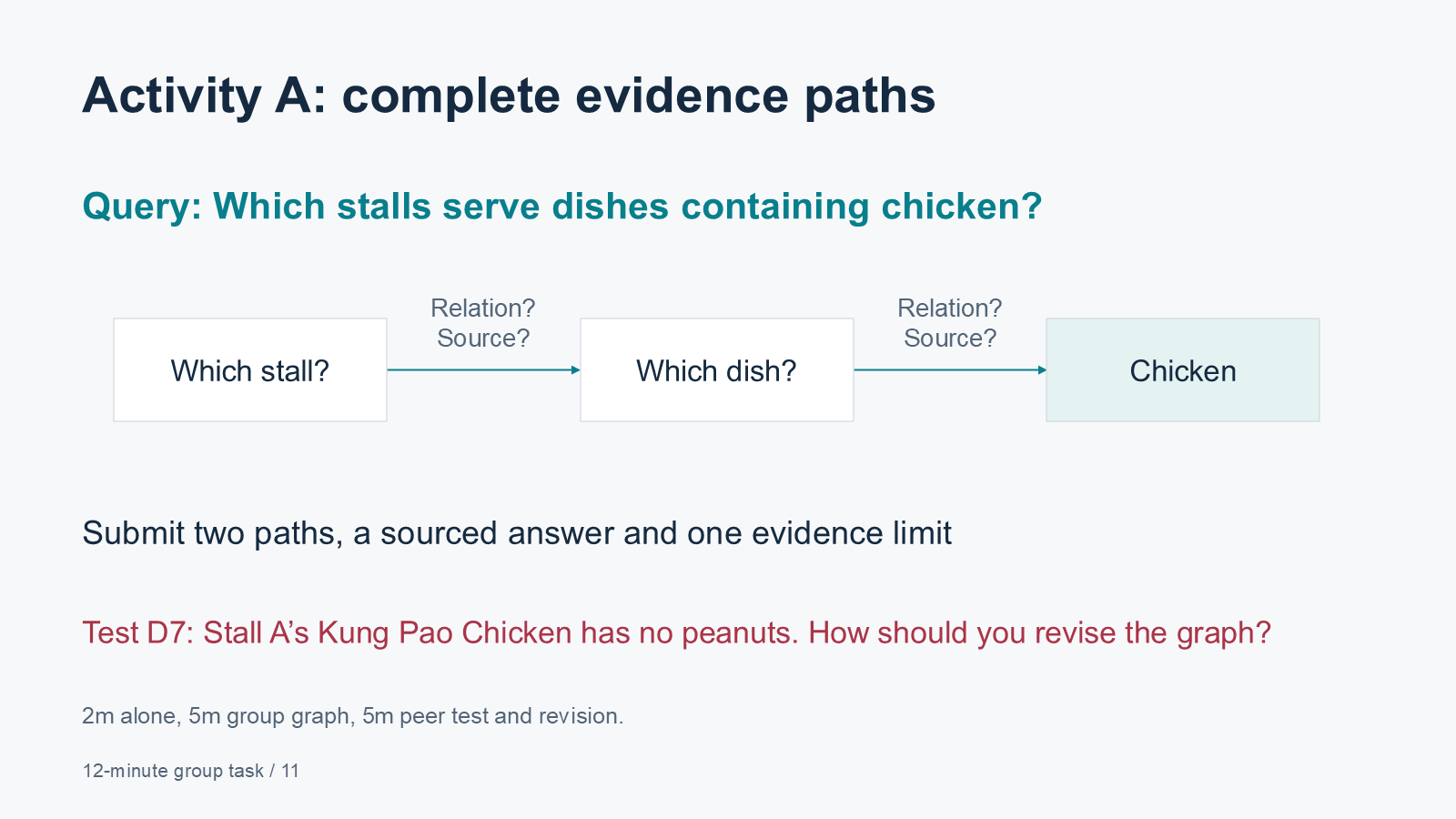
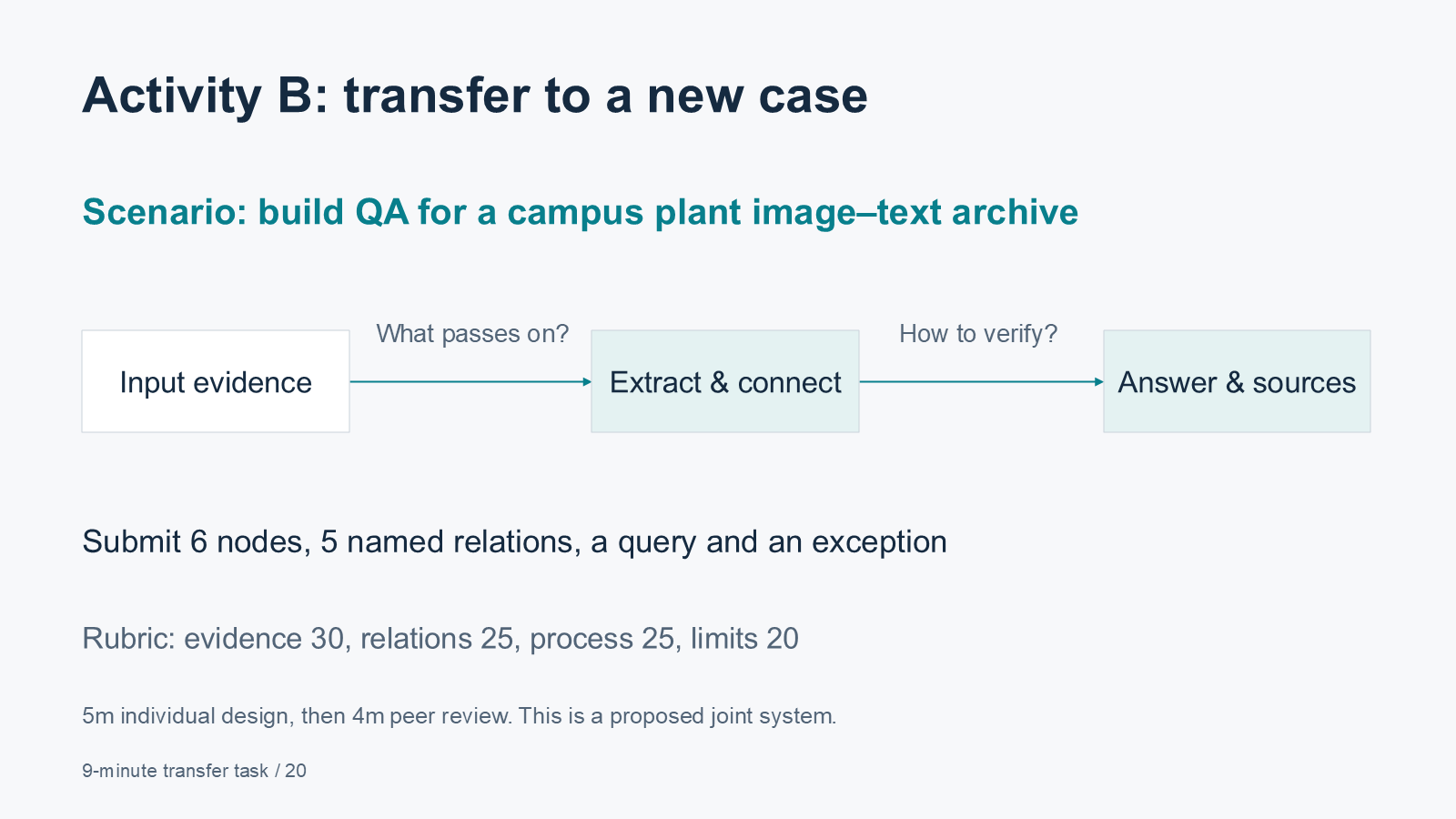
Activity A (12m): use D1 and D5 to complete two stall–dish–chicken evidence paths; preserve sources and revise when conflict record D7 is added. Activity B (9m): design 6 nodes, 5 named relations, a question and an exception for a campus plant archive.

Rubric: evidence 30, relations 25, process 25, limits 20. Submit one relationship diagram and 150 English words identifying sources, a normal result, and a missing-evidence or conflict branch.

Browse the slides

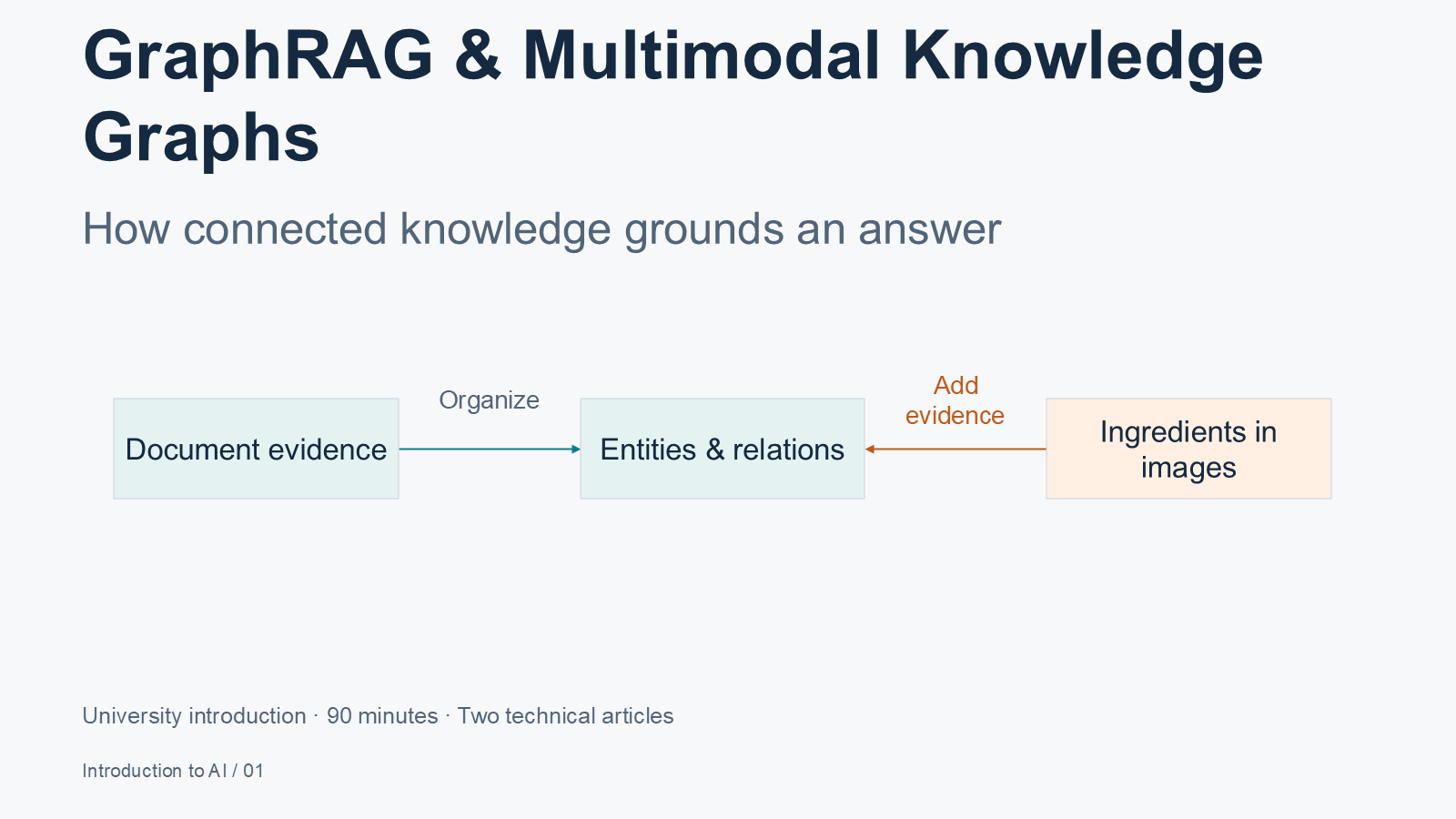
01 GraphRAG & Multimodal Knowledge GraphsGraphRAG & Multimodal Knowledge Graphs

Accessible slide text

University introduction · 90 minutes · Two technical articles

How connected knowledge grounds an answer

Document evidence

Entities & relations

Ingredients in images

Organize

Add evidence

02 Learning goals and class planLearning goals and class plan

Accessible slide text

Compare retrieval

Explain chunk retrieval, relational lookup and global summaries

Trace evidence

Find sources; handle missing or conflicting records

Build multimodal links

Connect dishes, ingredients and image regions with named relations

Transfer with limits

Design a new case: input, process, output and limits

Intro 10m · GraphRAG 30m · Build 12m · Multimodal 26m · Review 12m

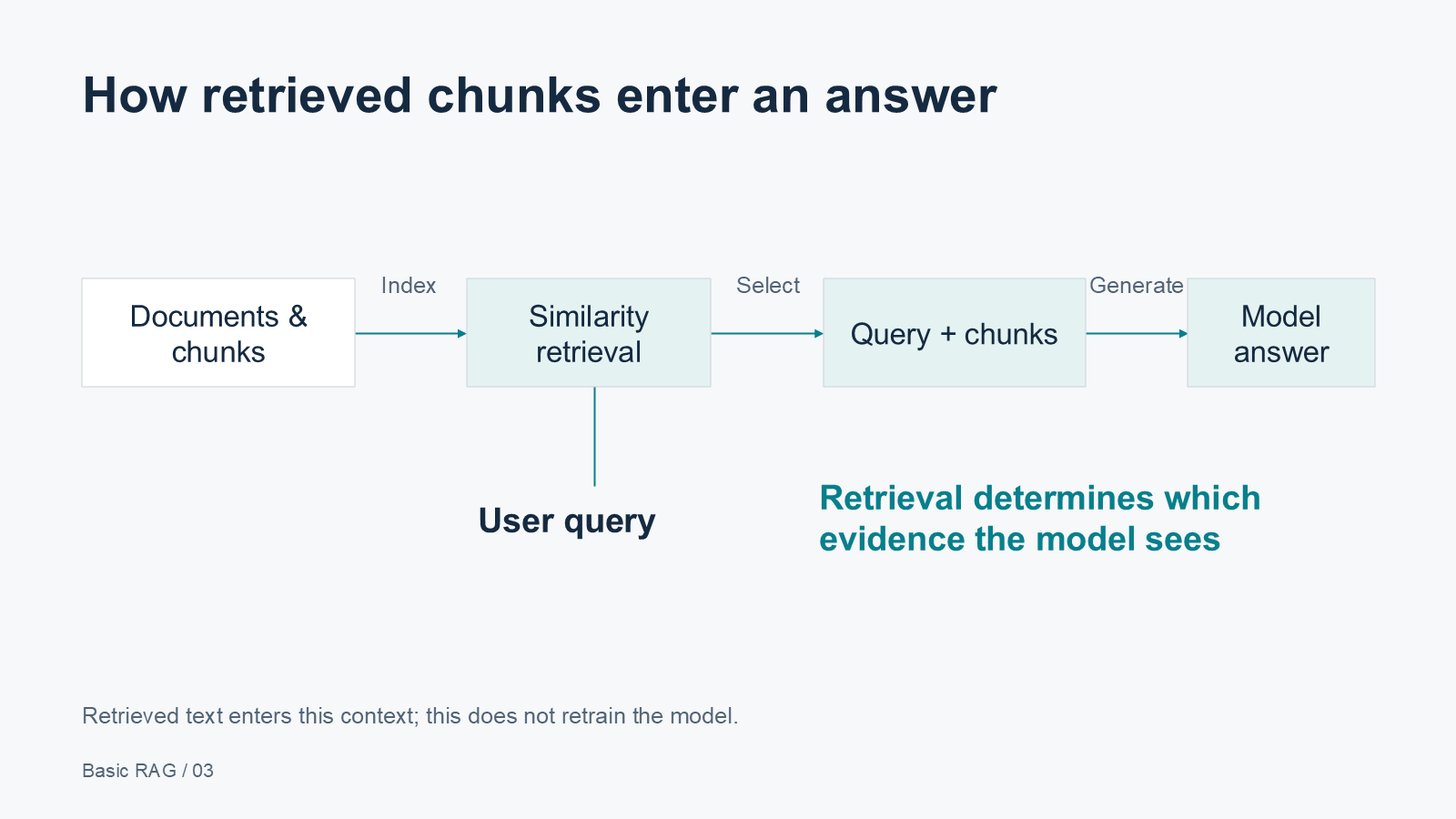
03 How retrieved chunks enter an answerHow retrieved chunks enter an answer

Accessible slide text

Retrieved text enters this context; this does not retrain the model.

Documents & chunks

Similarity retrieval

Query + chunks

Model answer

Index

Select

Generate

User query

Retrieval determines which evidence the model sees

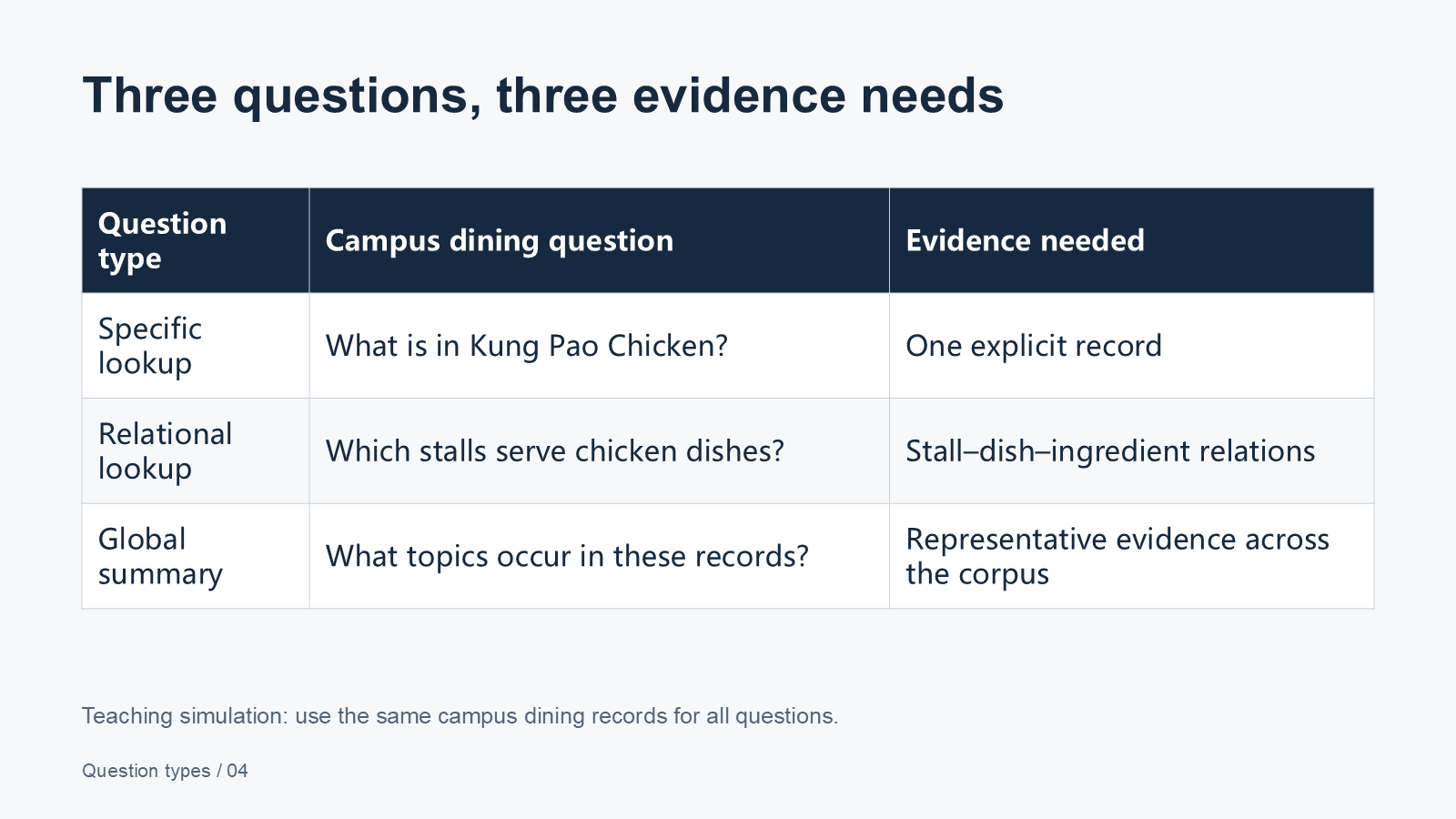
04 Three questions, three evidence needsThree questions, three evidence needs

Accessible slide text

Teaching simulation: use the same campus dining records for all questions.

Question type

Campus dining question

Evidence needed

Specific lookup

What is in Kung Pao Chicken?

One explicit record

Relational lookup

Which stalls serve chicken dishes?

Stall–dish–ingredient relations

Global summary

What topics occur in these records?

Representative evidence across the corpus

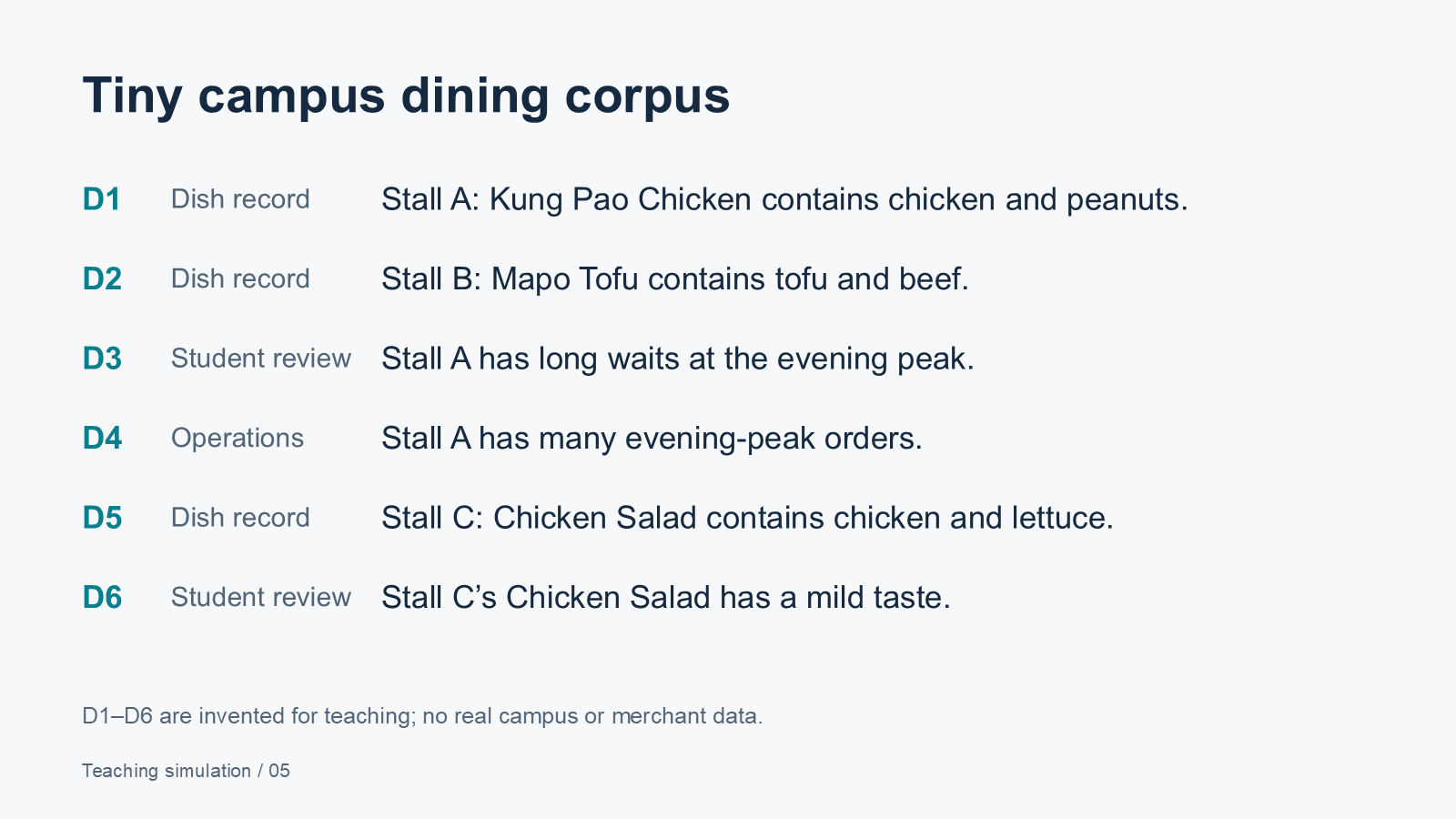
05 Tiny campus dining corpusTiny campus dining corpus

Accessible slide text

D1–D6 are invented for teaching; no real campus or merchant data.

D1

Dish record

Stall A: Kung Pao Chicken contains chicken and peanuts.

D2

Dish record

Stall B: Mapo Tofu contains tofu and beef.

D3

Student review

Stall A has long waits at the evening peak.

D4

Operations

Stall A has many evening-peak orders.

D5

Dish record

Stall C: Chicken Salad contains chicken and lettuce.

D6

Student review

Stall C’s Chicken Salad has a mild taste.

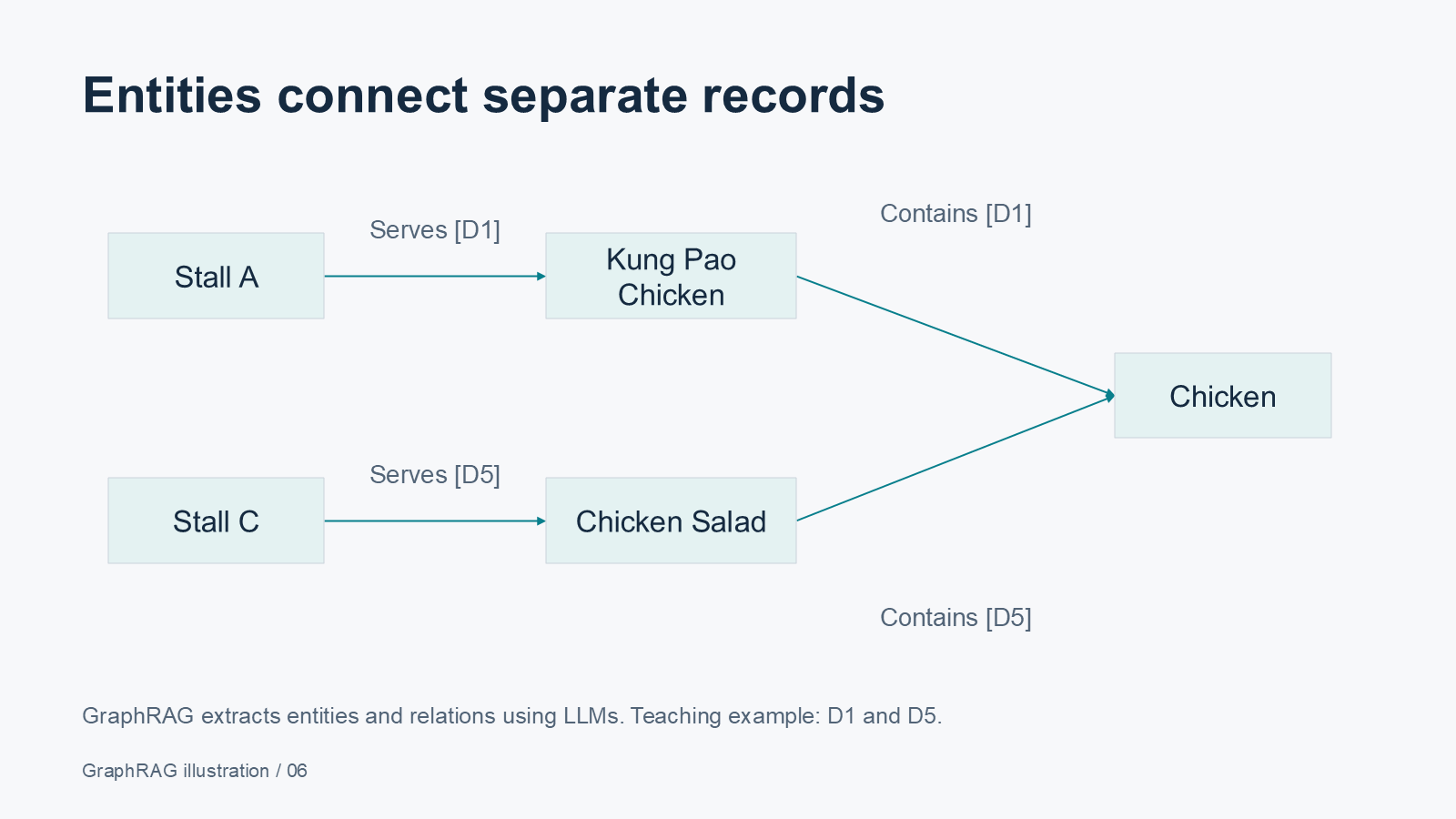
06 Entities connect separate recordsEntities connect separate records

Accessible slide text

GraphRAG extracts entities and relations using LLMs. Teaching example: D1 and D5.

Stall A

Stall C

Kung Pao Chicken

Chicken Salad

Chicken

Serves [D1]

Serves [D5]

Contains [D1]

Contains [D5]

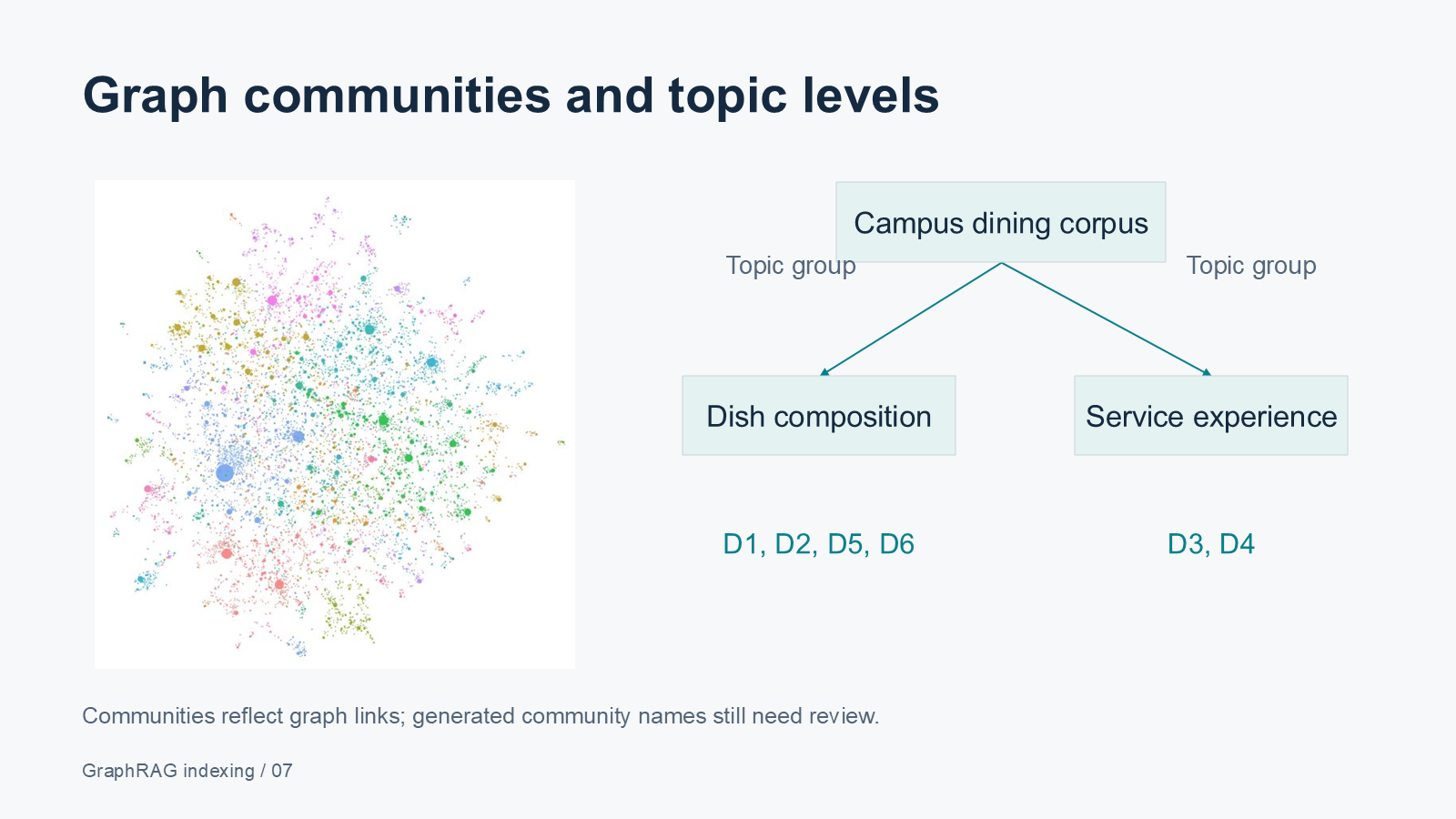
07 Graph communities and topic levelsGraph communities and topic levels

Accessible slide text

Communities reflect graph links; generated community names still need review.

Campus dining corpus

Dish composition

Service experience

Topic group

Topic group

D1, D2, D5, D6

D3, D4

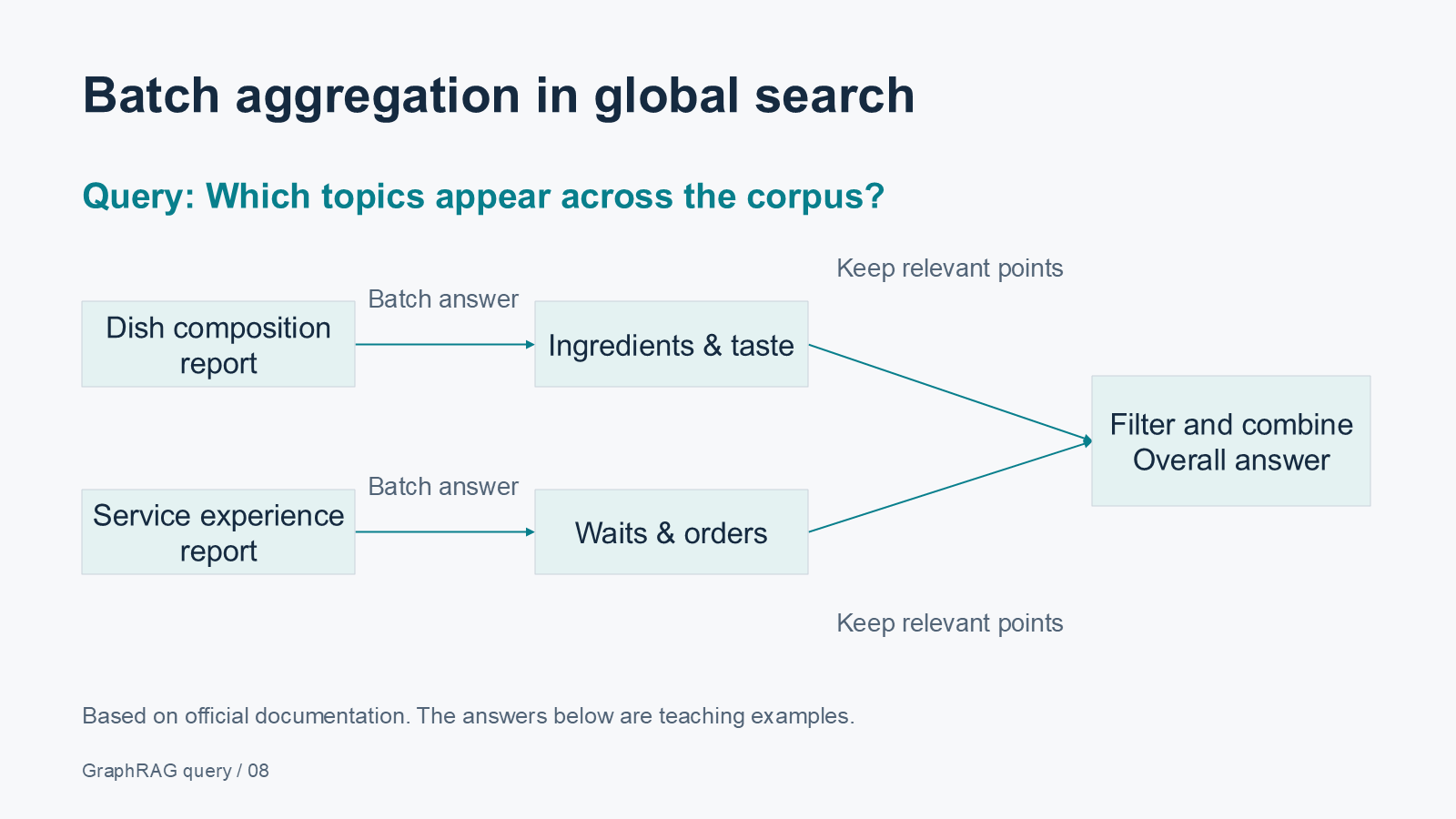
08 Batch aggregation in global searchBatch aggregation in global search

Accessible slide text

Based on official documentation. The answers below are teaching examples.

Query: Which topics appear across the corpus?

Dish composition report

Service experience report

Ingredients & taste

Waits & orders

Filter and combine

Overall answer

Batch answer

Batch answer

Keep relevant points

Keep relevant points

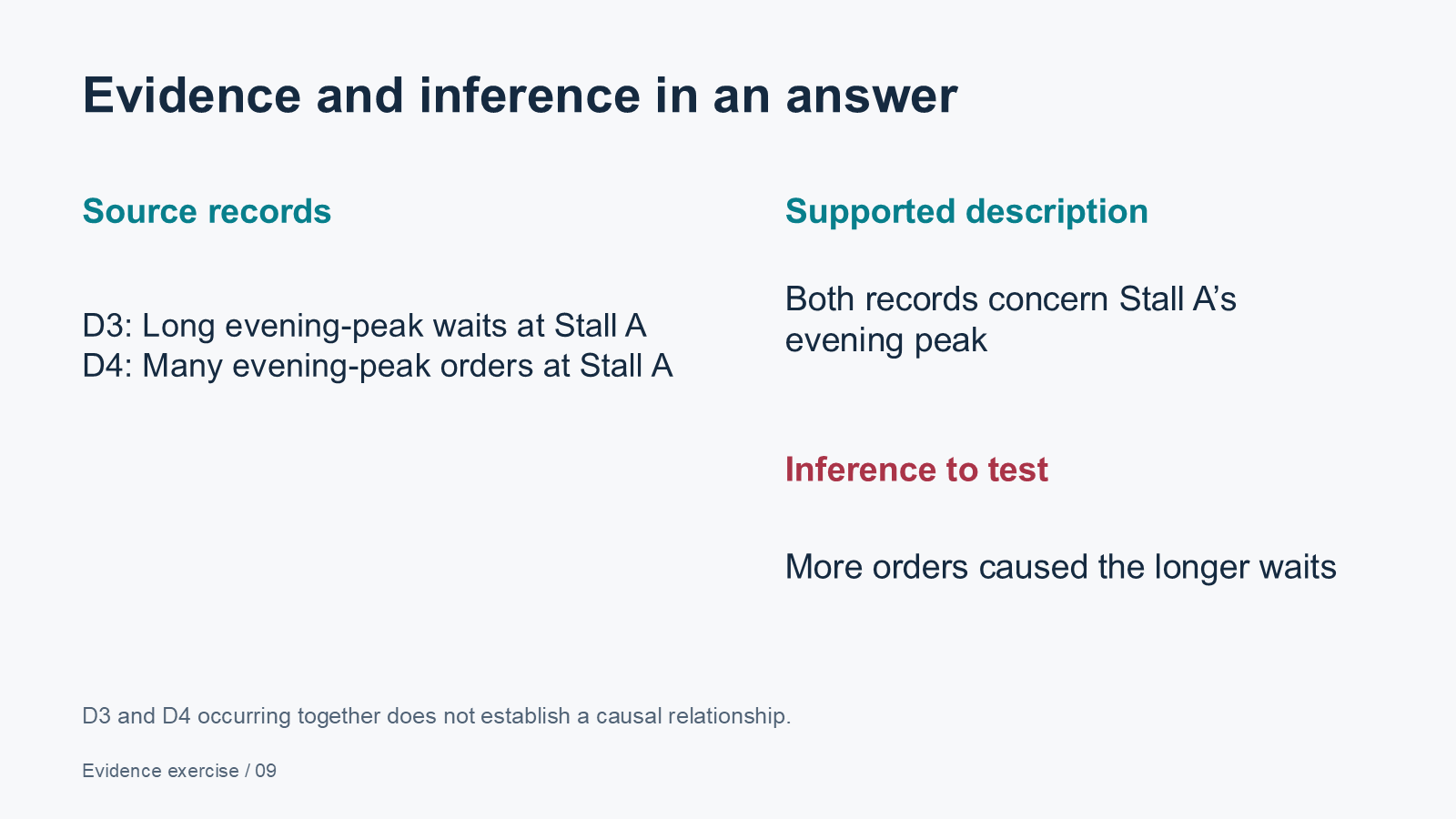
09 Evidence and inference in an answerEvidence and inference in an answer

Accessible slide text

D3 and D4 occurring together does not establish a causal relationship.

Source records

D3: Long evening-peak waits at Stall A

D4: Many evening-peak orders at Stall A

Supported description

Both records concern Stall A’s evening peak

Inference to test

More orders caused the longer waits

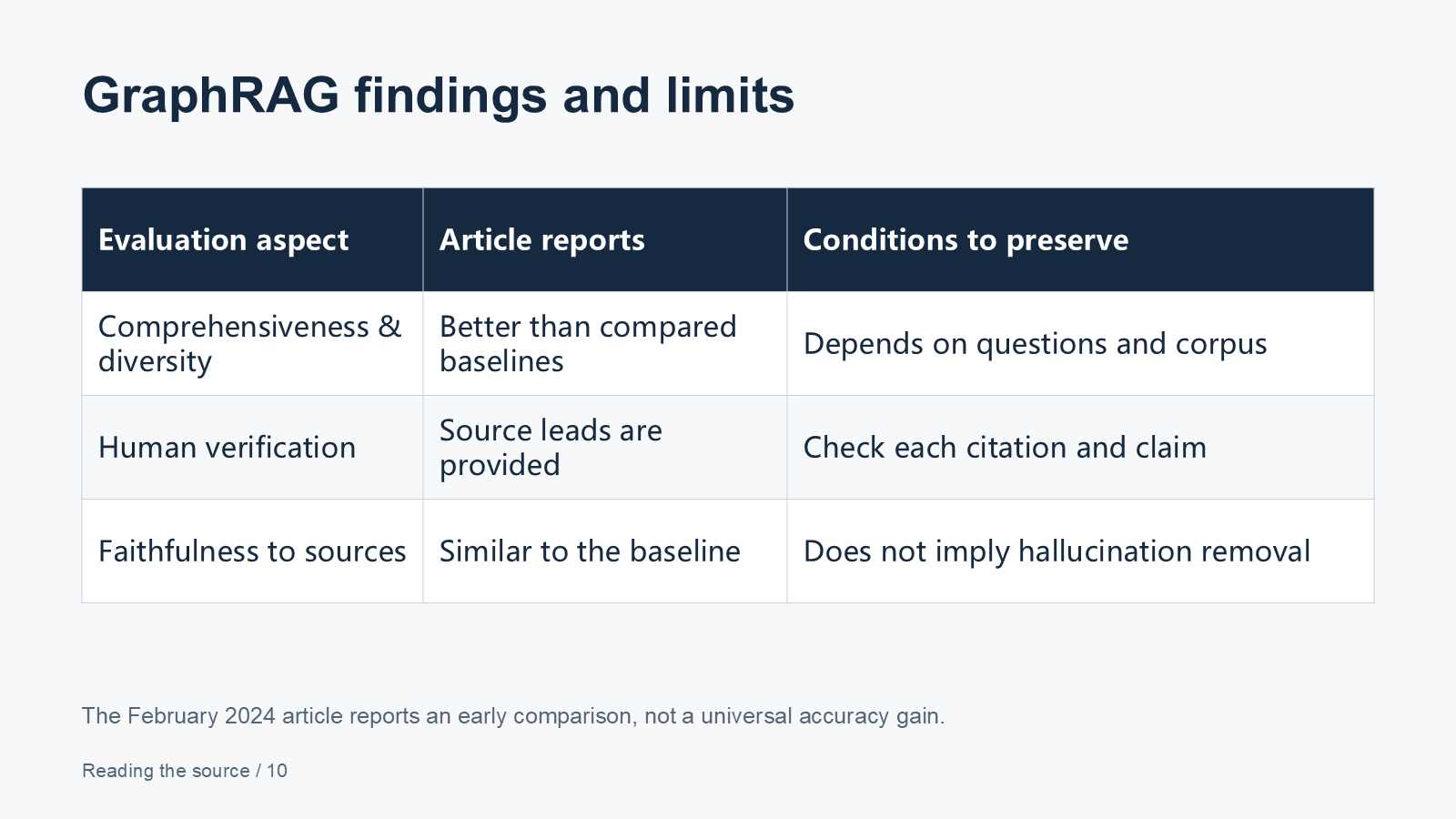
10 GraphRAG findings and limitsGraphRAG findings and limits

Accessible slide text

The February 2024 article reports an early comparison, not a universal accuracy gain.

Evaluation aspect

Article reports

Conditions to preserve

Comprehensiveness & diversity

Better than compared baselines

Depends on questions and corpus

Human verification

Source leads are provided

Check each citation and claim

Faithfulness to sources

Similar to the baseline

Does not imply hallucination removal

11 Activity A: complete evidence pathsActivity A: complete evidence paths

Accessible slide text

2m alone, 5m group graph, 5m peer test and revision.

Query: Which stalls serve dishes containing chicken?

Which stall?

Which dish?

Chicken

Relation? Source?

Relation? Source?

Submit two paths, a sourced answer and one evidence limit

Test D7: Stall A’s Kung Pao Chicken has no peanuts. How should you revise the graph?

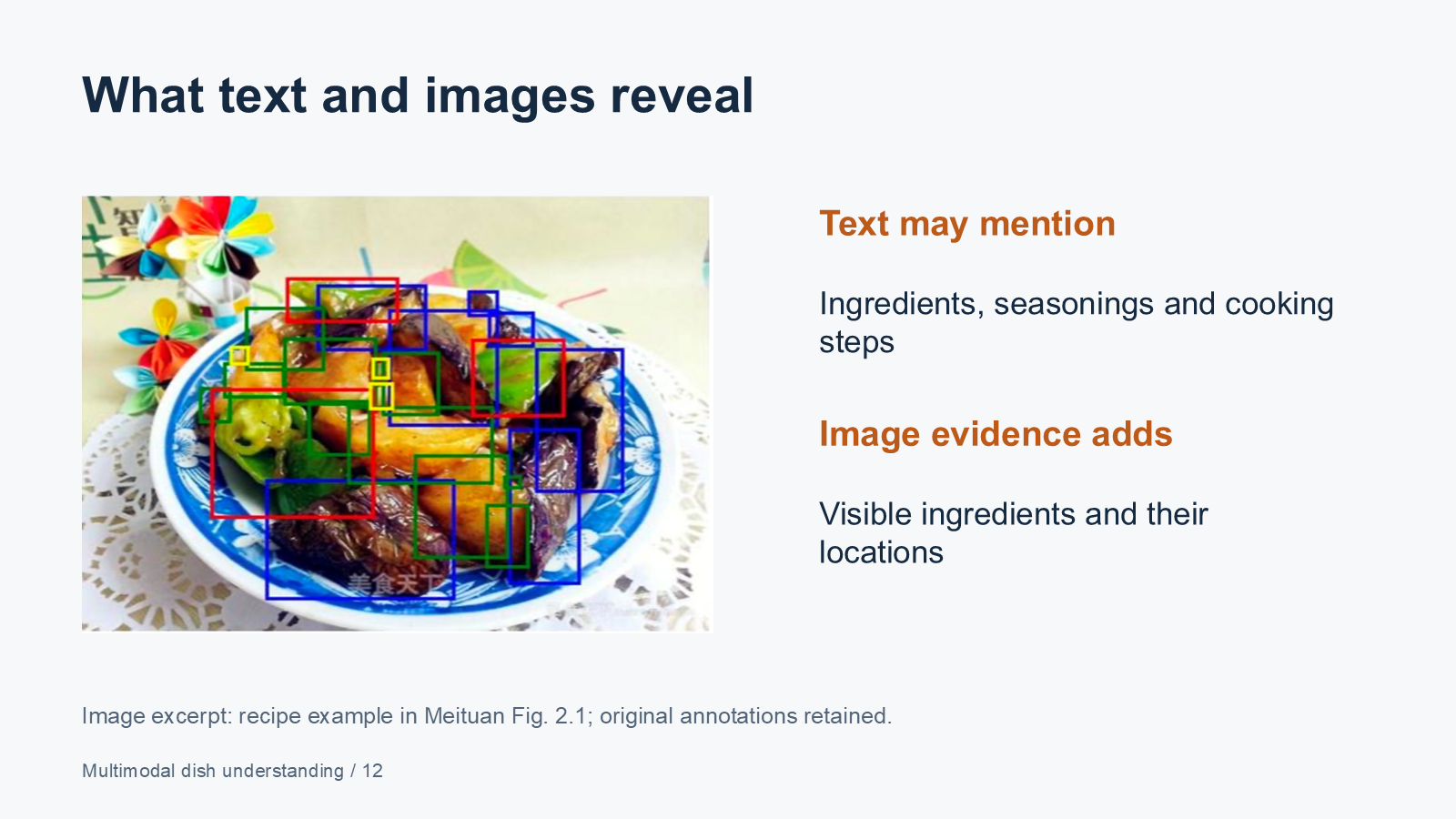
12 What text and images revealWhat text and images reveal

Accessible slide text

Image excerpt: recipe example in Meituan Fig. 2.1; original annotations retained.

Text may mention

Ingredients, seasonings and cooking steps

Image evidence adds

Visible ingredients and their locations

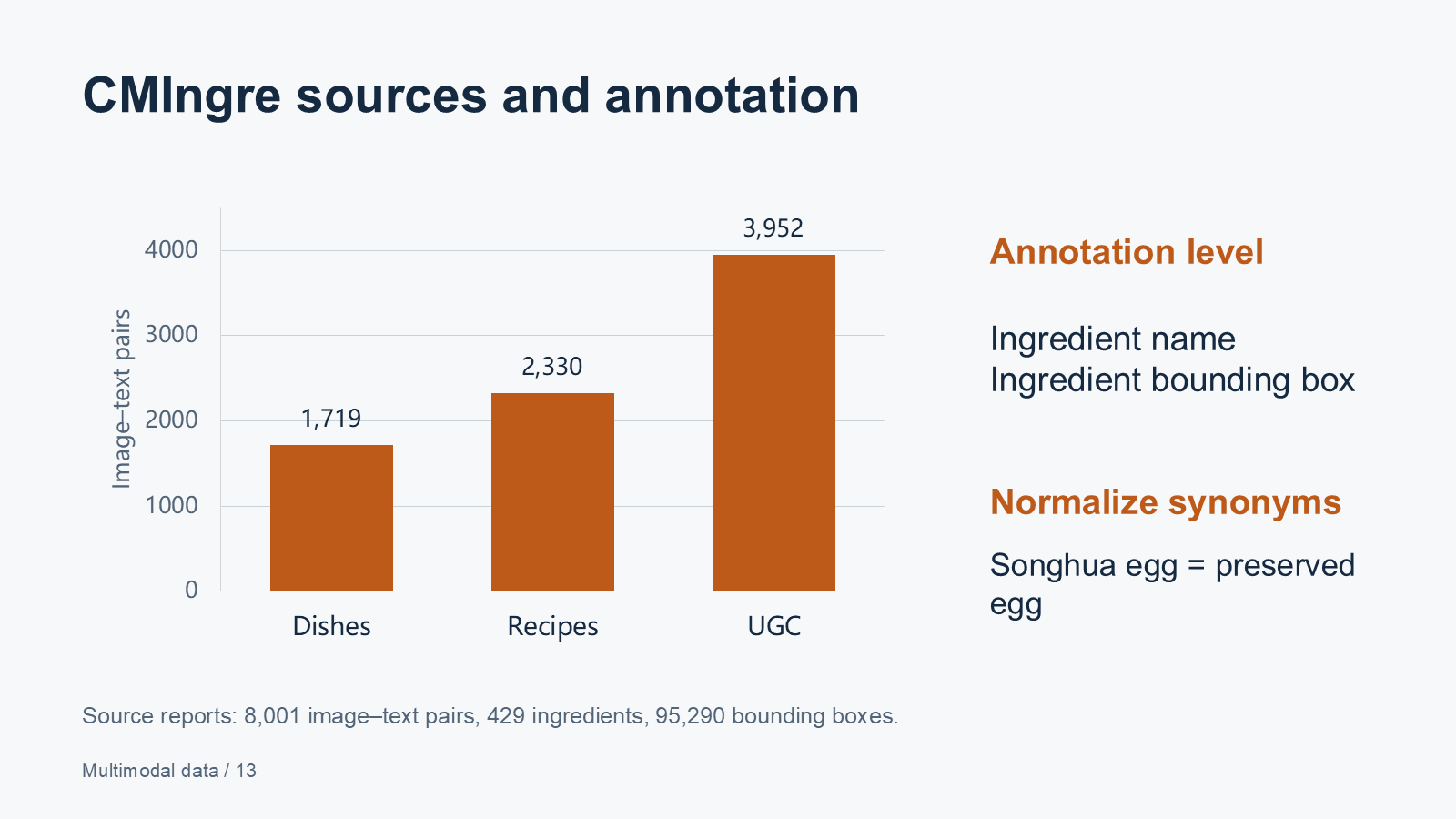
13 CMIngre sources and annotationCMIngre sources and annotation

Accessible slide text

Source reports: 8,001 image–text pairs, 429 ingredients, 95,290 bounding boxes.

Annotation level

Ingredient name

Ingredient bounding box

Normalize synonyms

Songhua egg = preserved egg

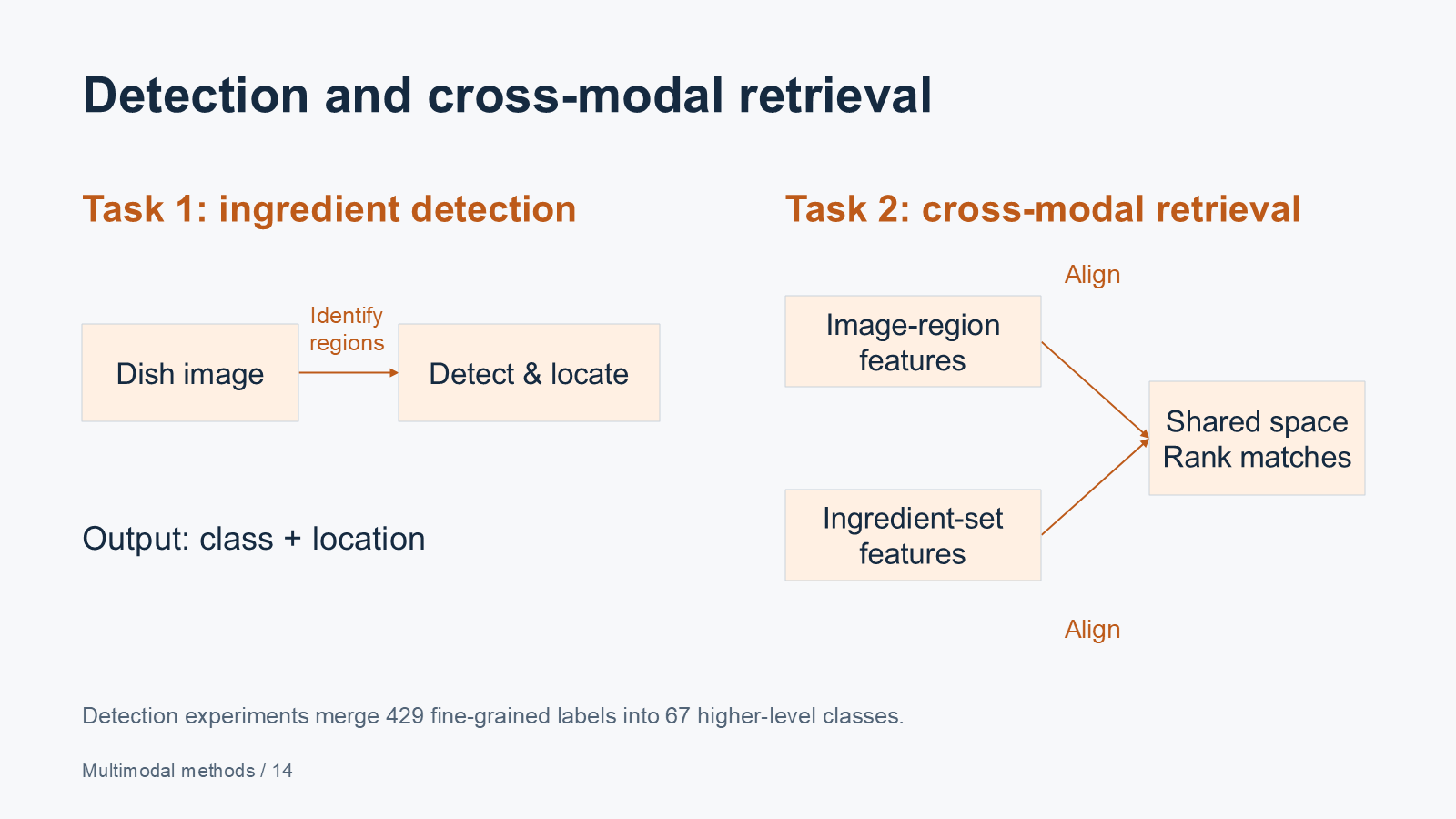
14 Detection and cross-modal retrievalDetection and cross-modal retrieval

Accessible slide text

Detection experiments merge 429 fine-grained labels into 67 higher-level classes.

Task 1: ingredient detection

Dish image

Detect & locate

Identify regions

Output: class + location

Task 2: cross-modal retrieval

Image-region features

Ingredient-set features

Shared space

Rank matches

Align

Align

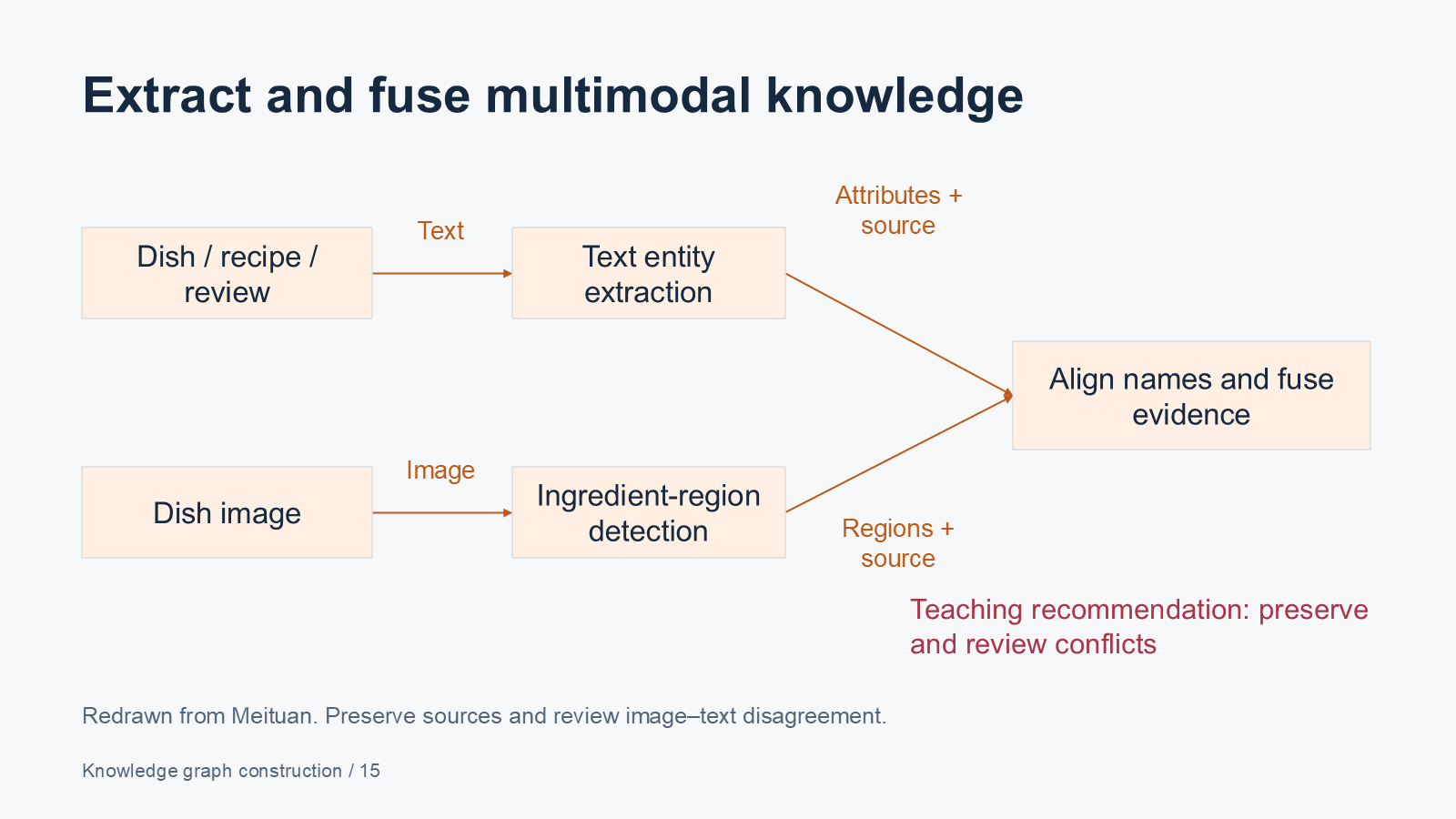
15 Extract and fuse multimodal knowledgeExtract and fuse multimodal knowledge

Accessible slide text

Redrawn from Meituan. Preserve sources and review image–text disagreement.

Dish / recipe / review

Dish image

Text entity extraction

Ingredient-region detection

Align names and fuse evidence

Text

Image

Attributes + source

Regions + source

Teaching recommendation: preserve and review conflicts

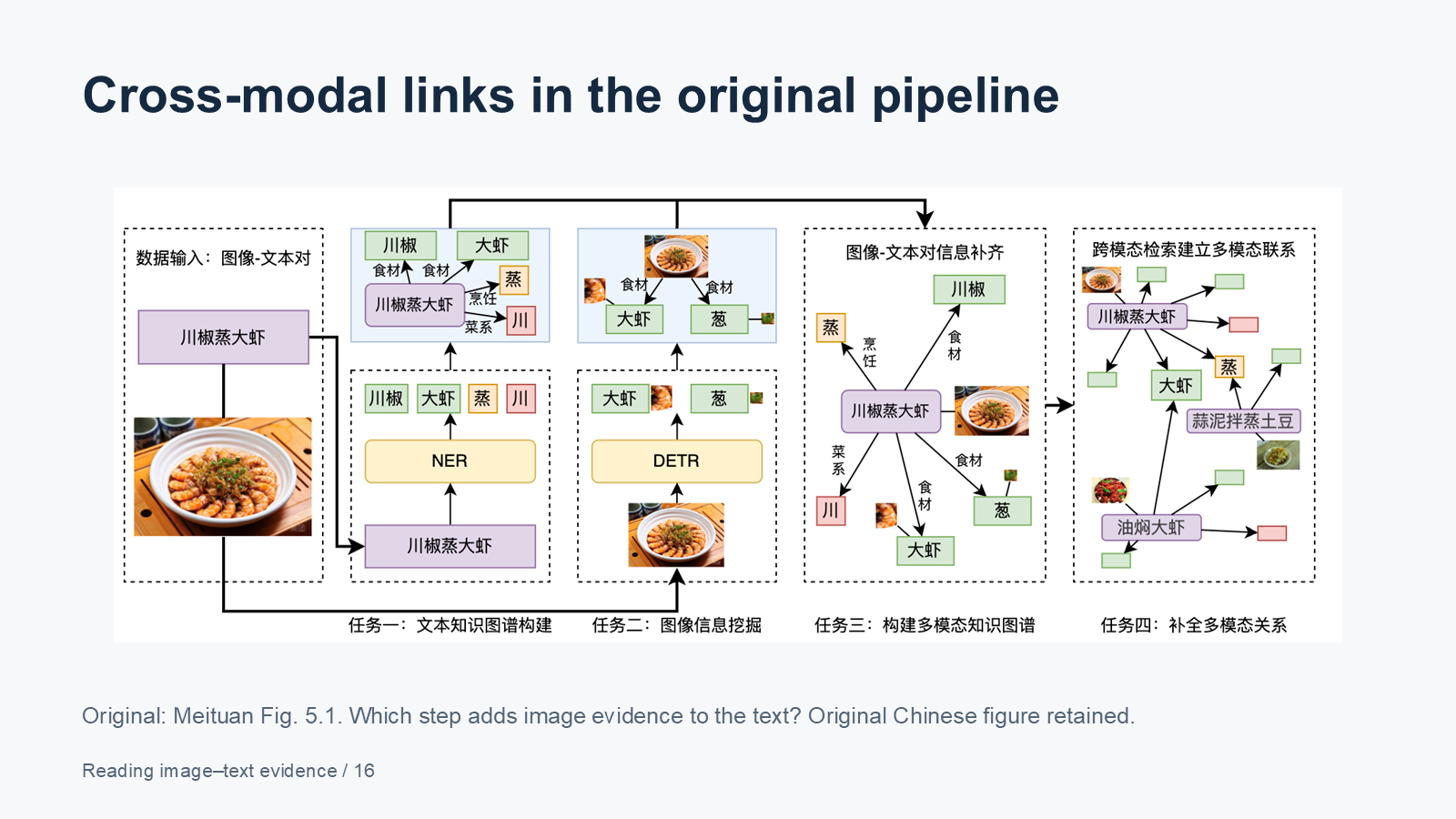
16 Cross-modal links in the original pipelineCross-modal links in the original pipeline
Accessible slide text

Original: Meituan Fig. 5.1. Which step adds image evidence to the text? Original Chinese figure retained.

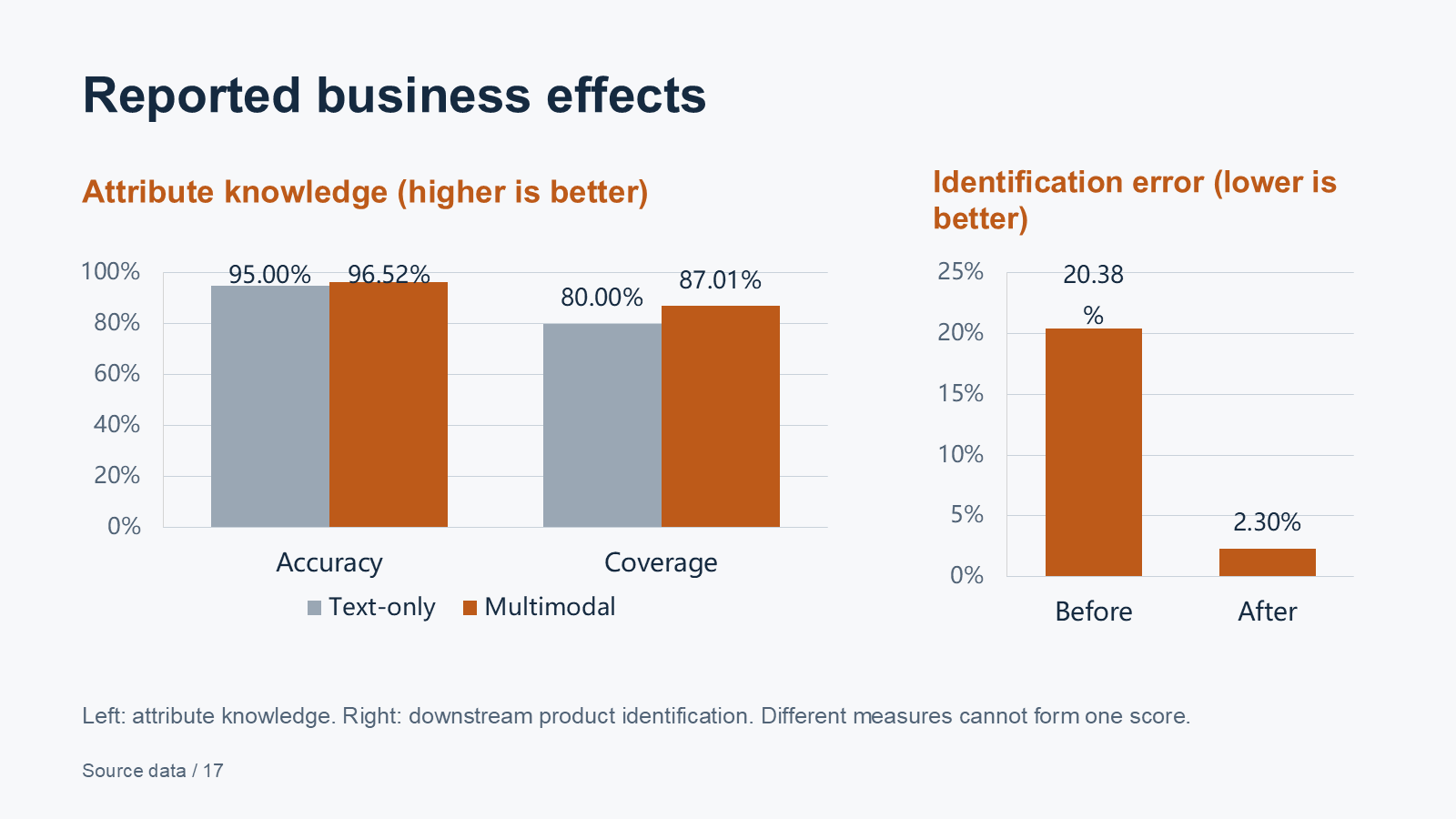
17 Reported business effectsReported business effects

Accessible slide text

Left: attribute knowledge. Right: downstream product identification. Different measures cannot form one score.

Attribute knowledge (higher is better)

Identification error (lower is better)

18 Visible ingredients and unknownsVisible ingredients and unknowns

Accessible slide text

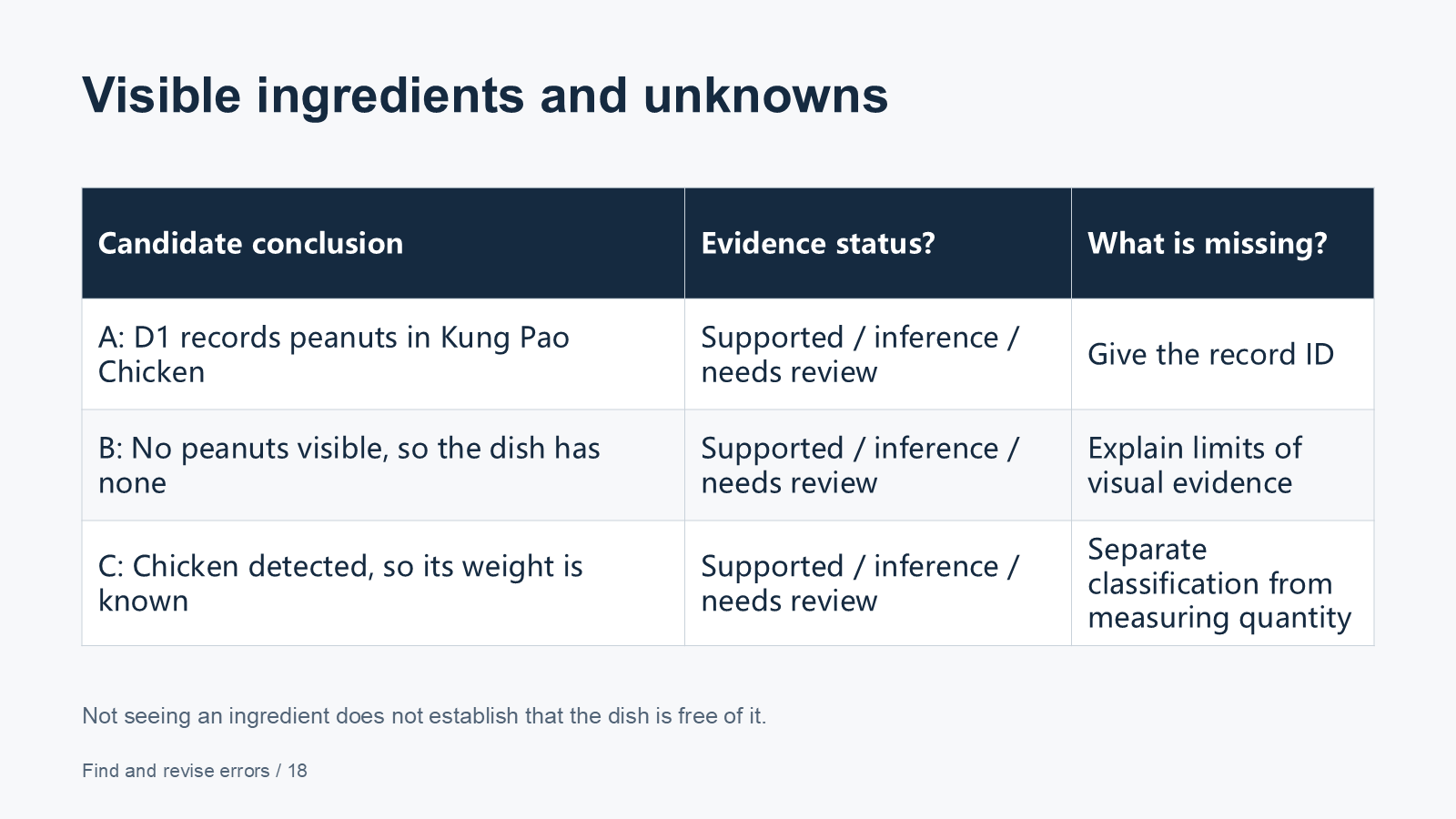
Not seeing an ingredient does not establish that the dish is free of it.

Candidate conclusion

Evidence status?

What is missing?

A: D1 records peanuts in Kung Pao Chicken

Supported / inference / needs review

Give the record ID

B: No peanuts visible, so the dish has none

Supported / inference / needs review

Explain limits of visual evidence

C: Chicken detected, so its weight is known

Supported / inference / needs review

Separate classification from measuring quantity

19 Where the two articles fitWhere the two articles fit

Accessible slide text

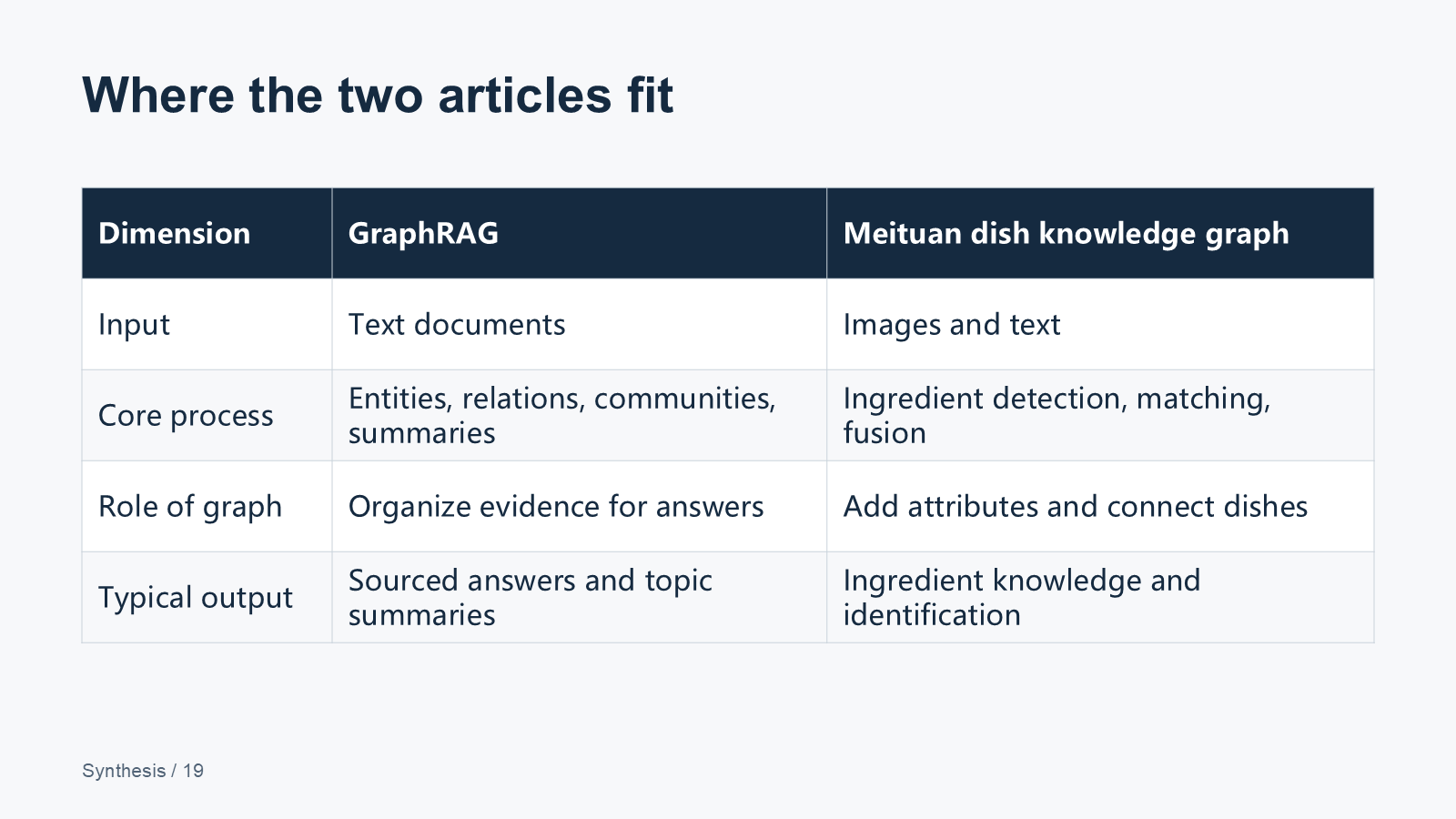
Dimension

GraphRAG

Meituan dish knowledge graph

Input

Text documents

Images and text

Core process

Entities, relations, communities, summaries

Ingredient detection, matching, fusion

Role of graph

Organize evidence for answers

Add attributes and connect dishes

Typical output

Sourced answers and topic summaries

Ingredient knowledge and identification

20 Activity B: transfer to a new caseActivity B: transfer to a new case

Accessible slide text

5m individual design, then 4m peer review. This is a proposed joint system.

Scenario: build QA for a campus plant image–text archive

Input evidence

Extract & connect

Answer & sources

What passes on?

How to verify?

Submit 6 nodes, 5 named relations, a query and an exception

Rubric: evidence 30, relations 25, process 25, limits 20

21 Exit check and assignmentExit check and assignment

Accessible slide text

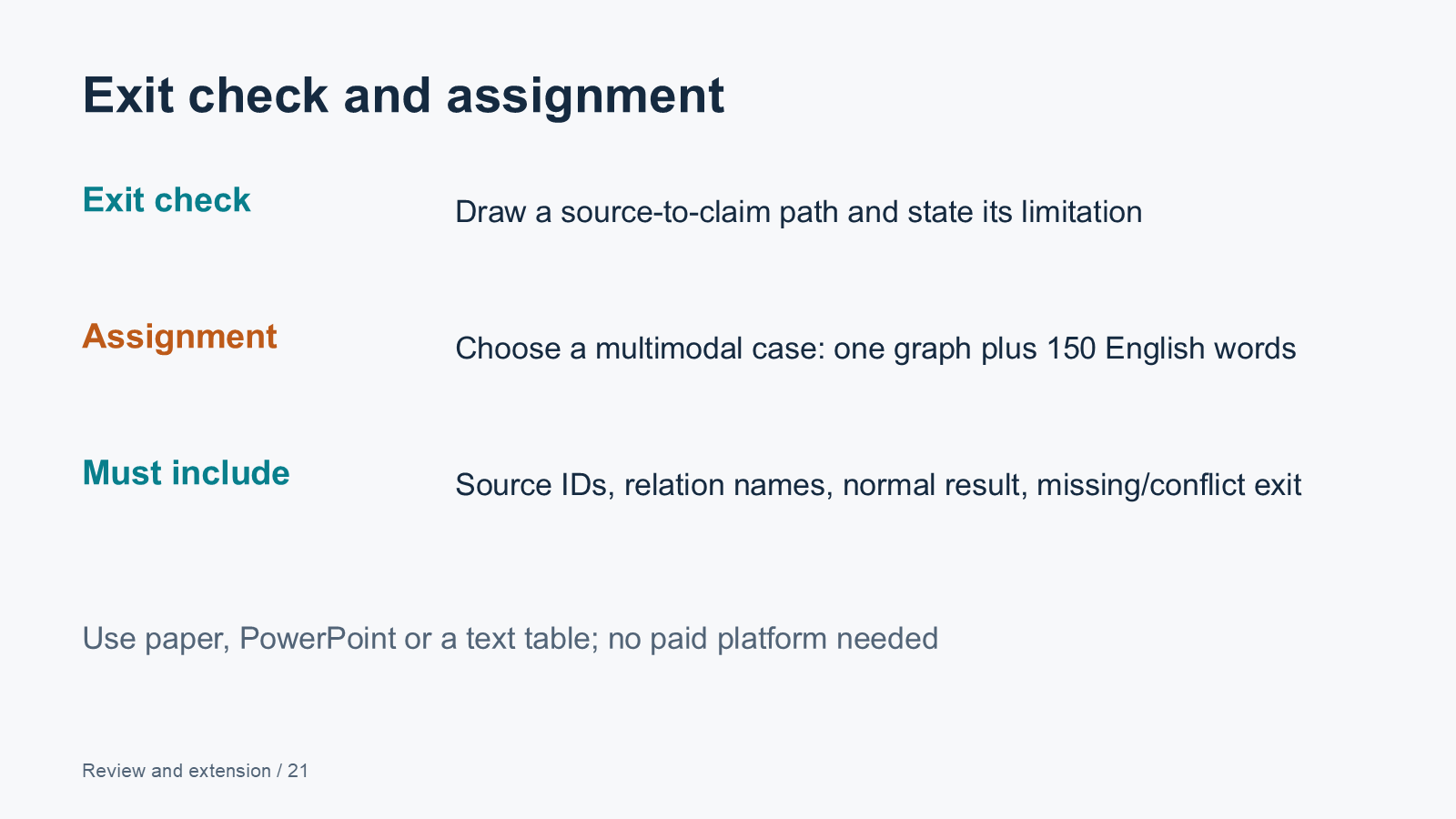
Exit check

Draw a source-to-claim path and state its limitation

Assignment

Choose a multimodal case: one graph plus 150 English words

Must include

Source IDs, relation names, normal result, missing/conflict exit

Use paper, PowerPoint or a text table; no paid platform needed

22 Sources and further readingSources and further reading

Accessible slide text

Course follows the 2024 articles; official docs clarify the workflow. Accessed 2026-10-18.

Microsoft Research article

GraphRAG: Unlocking LLM discovery…

GraphRAG documentation

Indexing and global search

Meituan technical article

Building a dish graph with multimodal extraction

Research dataset

CMIngre: annotations and retrieval examples

GraphRAG research paper

From Local to Global…

Principal sources

Microsoft Research: GraphRAG (2024-02-13)

Meituan: Building a Dish Knowledge Graph with Multimodal Information Extraction (2024-05-17)