Research Abstract
00.1
Research Abstract
This report studies GraphRAG and multimodal knowledge graphs by connecting Microsoft's article on discovery in private narrative data with Meituan's article on ingredient extraction and dish graphs, supplemented by later papers, datasets, and official documentation. It treats construction, evidence retrieval, and generation as distinct but interdependent stages and compares community summaries, associative memory, chunk organization, textual graph understanding, and multimodal retrieval. The objective is to identify conditions under which relationships and visual evidence provide verifiable value rather than select one universally optimal architecture.
The synthesis yields four judgments. Graph structure organizes cross passage connections, but value depends on identity, relation types, and tasks. Modalities complement observations without turning similarity into fact. Provenance, versions, permissions, and uncertainty must span construction through generation; adding citations afterward is insufficient. Adoption requires task benefits, failure analysis, and sustainable maintenance together. Outputs include an evidence architecture, layered evaluation, enterprise and teaching blueprints, a campus dish design, and a reproducible miniature experiment. The experiment verifies deterministic queries and arithmetic rather than large model performance. Chinese and English sections are paired, and figures distinguish source data, original designs, and assumed scenarios.
Research Questions and Evidence Method
01.1
Research Objects and Levels of Questions
This report examines how knowledge should be organized so that a generative system can locate supporting evidence, connect relationships across complex material, and make use of visual information. GraphRAG concerns the role of graph structure in retrieval and generation. A multimodal knowledge graph concerns how different modalities refer to shared entities, attributes, and relationships. The two subjects intersect, but they belong to different analytical levels. A system can contain a multimodal graph without offering generative question answering. It can also perform GraphRAG over a graph constructed entirely from text. The inputs, transformations, and outputs must therefore be identified before an improvement can be attributed to additional information, relational organization, retrieval strategy, or a change in the generator itself. [R07][R16]
We distinguish factual lookup, relational association, and understanding of a collection as a whole. Factual lookup typically seeks an explicitly recorded property. Relational association requires information from several records to be connected. Collection-level understanding requires a representative account of the main issues across a corpus. These tasks demand different evidence and can justify different indexes and evaluation methods. A single average score can conceal deterioration on one task while another improves. Consequently, the report examines the correspondence between tasks and technical choices rather than assuming that one architecture satisfies every requirement. At the application level, the central questions are whether an answer is applicable to the present request, whether its supporting material can be traced, and whether the cost of maintaining the system is justified by the benefit obtained. These questions determine the unit of analysis throughout the report.
01.2
The Distinct Roles of the Two Anchor Sources
Microsoft's February 2024 article describes using a language model to construct an entity and relationship graph and organize semantic groups, with the aim of improving association across dispersed information and summarization of corpus-wide themes. Its use of private data emphasizes material that the model did not encounter during training. It does not imply that every example is confidential. The article uses a news collection to illustrate retrieval difficulties and should be read as an introduction to a technical approach accompanied by preliminary evidence. A later research paper and official documentation provide additional implementation detail. Those later details should not be retrospectively presented as experiments already completed in the earlier announcement. [R01][R02]
The Meituan article follows a different line of inquiry: understanding Chinese food at the ingredient level. Images and text provide complementary evidence, and the work discusses annotation, ingredient detection, cross-modal retrieval, and fusion into business knowledge. Its academic benchmark and its business knowledge-graph measurements operate at different levels. An error rate for identifying equivalent products cannot be relabeled as ingredient-detection accuracy. Together, the two sources suggest that the value of a knowledge graph should be assessed against a specific information gap. This report treats the Microsoft work as a case of using organized knowledge and the Meituan work as a case of constructing knowledge from complementary observations. A unified system combining these ideas is an architectural proposal developed in this report, rather than a jointly validated outcome of the two sources. That distinction is retained in the diagrams, examples, and application recommendations.
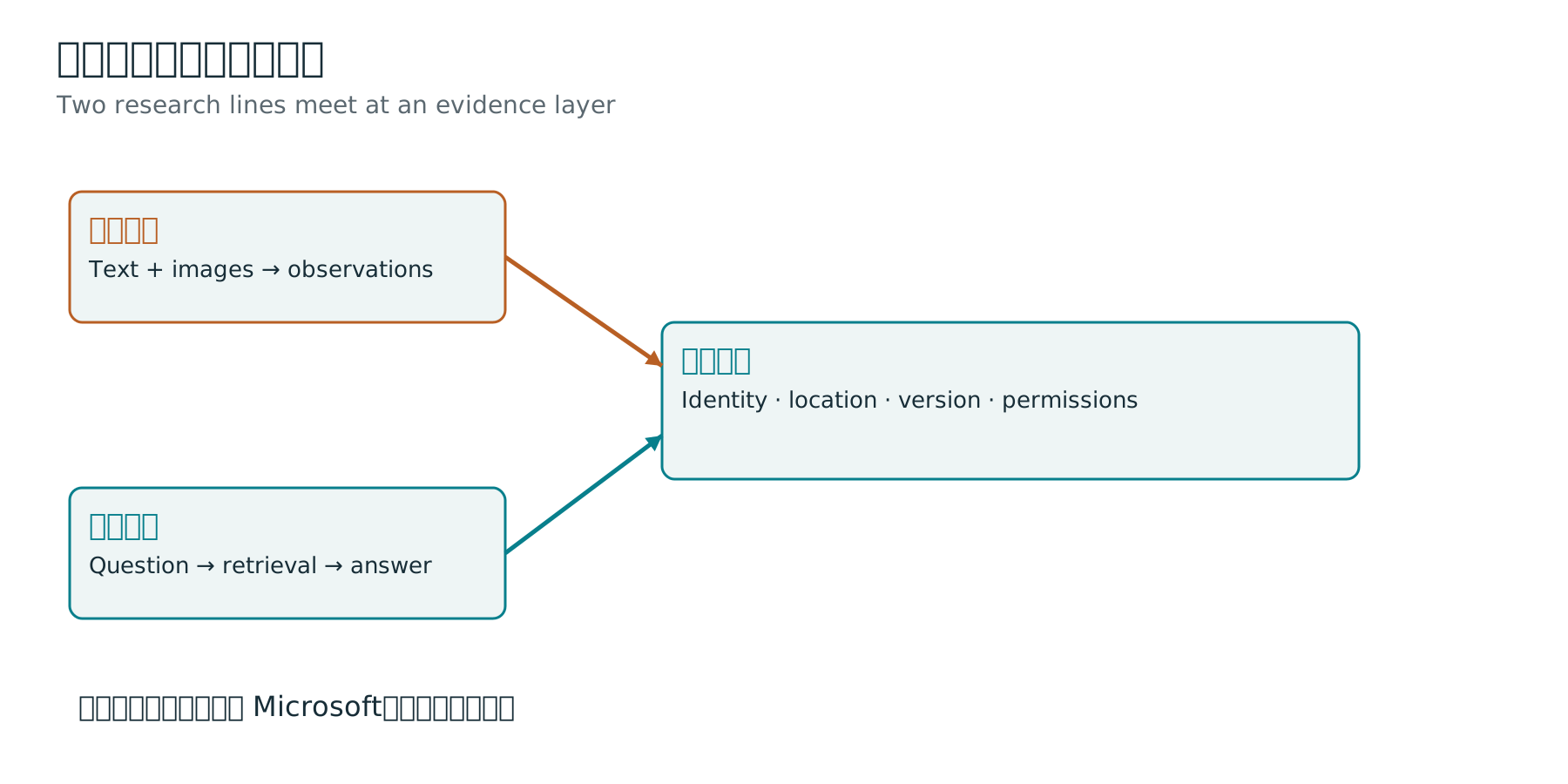
Original design
01.3
Search Routes and Inclusion Principles
The review uses a structured narrative-synthesis approach. Searches were organized around GraphRAG, evaluation of retrieval-augmented generation, multimodal knowledge graphs, cross-modal entity alignment, and ingredient-level food understanding. Consensus was used to discover graph retrieval and evaluation studies, and the corresponding paper records were fetched before any search result was cited. SciSpace supported semantic searches for multimodal work and supplementary methodological information. Items that affected technical judgments were then checked against author papers, publisher records, official project documentation, or dataset descriptions. Titles, years, and abstracts returned by a search interface are discovery aids rather than the final authority. Particular care is needed when an interface mixes the year of a preprint, a later journal volume, and subsequent revisions. [R07][R09][R26]
Studies were included when they directly addressed a research question, had a traceable source, and described an identifiable method or evaluation object. Material consisting only of promotional repetition, unsupported claims, or an unclear research object was not used as substantive evidence. When access was limited to an abstract or a publication record, the report uses only the high-level statements supported by that material. It does not infer unexamined ablations or preprocessing details. The search cutoff is 19 October 2026. This work did not conduct an exhaustive search of every database, independent screening by two reviewers, or a complete risk-of-bias assessment. It therefore does not claim to be a systematic review, and it does not invent screening counts or pooled statistical effects. The bibliography and recorded reading scope are retained so that the synthesis can be checked and extended.
01.4
Evidence Strength and Version Identification
The report distinguishes four categories of evidence. A reported research finding is a result stated by the authors under specified data, model, and evaluation conditions; its experimental scope is retained. An official implementation description concerns a publicly documented function or data structure and is associated with an access date. Analysis in this report consists of comparison, interpretation, and architectural reasoning developed from the sources; readers must assess the argument rather than treating it as an observed result. A reproducible simulation is an outcome calculated from explicit inputs and rules. It establishes that a calculation follows its assumptions, but does not establish that a real model will behave the same way in production. These categories are not arranged as a simple hierarchy, because they answer different kinds of questions.
A research announcement, initial preprint, revised manuscript, and formal publication can differ in authorship, title details, or experimental conditions. Where relevant, the report records both the first public date and the version being used. This prevents results added in a 2025 revision from being attributed to a February 2024 announcement. Similarly, a capability currently present in official software documentation does not establish that the capability was used in the paper's experiments. Relationships in figures also distinguish source-supported information, proposed design, simulation, and unresolved evidence. A sequential connection in a process diagram describes an order of processing. It does not by itself establish real-world causation. Two entities located in the same graph community do not necessarily have a direct business relationship. Such distinctions are essential when a visually persuasive diagram could otherwise make a qualified proposition appear settled.
01.5
Rules for Bilingual Alignment and Visual Representation
Chinese and English passages are paired around the same argument and evidence. Numbers, units, negative conditions, and degrees of uncertainty are preserved across the two versions. Grounding refers here to constraining an output by material that can be located and examined. Faithfulness refers to whether the answer accurately represents the supplied material. Factual correctness concerns whether a proposition agrees with reality or an appropriate factual standard. These properties are related, but they are not interchangeable. Incorrect source material can be reproduced faithfully, and an answer containing citations can still use those citations improperly. Translating all of these concepts as a broad guarantee of truth would strengthen the claims beyond their evidence.
Visual forms are selected according to the question being explained. Process diagrams represent sequence and the transfer of information. Labeled relationship graphs represent connections among entities. Matrices preserve common comparison dimensions. Quantitative charts display observations or calculations whose assumptions are stated. Color helps distinguish object types and does not carry the conclusion by itself. Every quantitative figure retains its inputs and measurement convention. Percentages from different tasks are not combined into an invented overall score. Explanations generated by a language model remain intermediate material requiring examination; placing them inside a diagram does not turn them into established facts. The figure sources and associated data are supplied with the report so that readers can revise the presentation and examine whether the underlying relationship still holds. These rules make the illustrations part of the argument rather than decoration added after the analysis.
01.6
Decision Uses and Boundaries of the Report
The report is intended for readers who need to understand, investigate, or design systems that augment generation with organized knowledge. It supports decisions at three levels. At the conceptual level, it separates graphs, retrieval, cross-modal alignment, and generation so that capability is not inferred from a product name alone. At the design level, it explains how sources, indexes, evidence organization, model calls, and maintenance interact. At the evaluation level, it proposes observable quality criteria and experimental controls that allow a design to be challenged rather than merely demonstrated. Application recommendations are research and engineering proposals. They do not replace investigation of a particular institution's data, staff, operational constraints, and acceptable risks.
The report does not claim to train a new model or reproduce the performance of every cited study. Executed work is limited to transparent miniature graph queries, verification of numerical metrics, and synthetic cost calculations. These activities make conceptual distinctions and computational constraints visible. Enterprise, educational, cultural, and food-service examples illustrate transfer to new settings. Except for explicitly attributed business measurements, the proposed systems in those examples are designs developed for this report. Readers can begin with a small but complete evidence workflow, establish that it handles ordinary, missing, and contradictory information, and then decide whether additional model complexity is warranted. Research value depends on whether assumptions can be tested, failures can be localized, and conclusions can be inspected by others. Graph size and the number of technical terms provide no substitute for those properties.
01.7
Reading Routes
Conceptual readers can follow Chapters 1 to 7, moving from sources and knowledge to methods and the dish case. Project teams can focus on Chapters 8 to 12 and 14 to combine architecture, evaluation, cost, and governance. Teaching can begin with Chapters 13 and 15, using evidence cards and the miniature experiment to introduce theory. Chapter 16 proposes testable research directions, and appendices provide operational worksheets and terminology. Every route shares one requirement: important conclusions should trace to evidence, and application promises should become inspectable tasks.
Semantic and Evidential Foundations of Knowledge Graphs
02.1
Graph Structure and Knowledge Claims
A graph consists of nodes and edges, but a knowledge graph must additionally explain what its nodes denote, what its edges mean, and in which context a record applies. A service counter, a dish, and an ingredient can be represented as different entities, while serves and contains can be directed relationships. A name is an attribute of an entity rather than a complete identity. Two dishes with the same name can belong to different merchants, recipes, or time periods. If identical names are treated as identical entities, an apparently plausible path can connect objects that should remain separate. Stable identifiers, types, and source constraints are prerequisites for useful graph retrieval. [R15][R16]
The claim represented by a record should also be distinguished from the form in which it is stored. A record stating that a dish contains peanuts is a source-attributed assertion. Encoding it as an edge changes its representation without verifying its truth. A graph makes connections queryable, composable, and inspectable; it does not automatically transform text into established knowledge. We therefore treat an entity relationship graph as a computational structure of claims and require supporting material for important edges. After retrieving a path, a generative system still has to determine whether the meanings of its relationships answer the question. Connectivity alone is insufficient. A path can be mathematically valid while being semantically irrelevant, temporally inconsistent, or supported by evidence that does not apply to the object under discussion.
02.2
Ontology and Relationship Granularity
An ontology provides shared conventions for entity types, relationship types, and applicable constraints. Its design should begin with the questions to be answered and then determine which objects need independent identity. Cuisine can be stored as an attribute when the only requirement is filtering dishes. If the system must maintain cuisine hierarchies, aliases, and research sources, representing cuisines as entities can be more useful. There is no task-independent optimal representation. Excessive detail increases annotation and maintenance costs, while excessive aggregation removes distinctions needed by the questions. Appropriate granularity depends on the relationship among queries, evidence, and responsibility for updates.
Relationships involving several participants are particularly vulnerable to distortion when compressed into a simple binary edge. A merchant serving a specific recipe on a particular date involves a merchant, a date, a dish version, and a supply status. Storing only merchant serves dish loses the period of validity. A supply record or menu version can instead be represented as an intermediate object to which time and provenance are attached. Likewise, a region belongs to an image and is classified as an ingredient by a particular model. That observation should remain distinct from an ingredient documented in the dish's actual recipe. This report recommends making observation, assertion, inference, and confirmation explicit in the relationship scheme. Doing so preserves an inspectable transition between visual recognition and business facts, rather than silently converting every model prediction into an authoritative property of the world.
02.3
Provenance Records and Traceable Chains
Provenance should explain where a piece of knowledge came from, how it was processed, which person or system produced it, and when it applies. The W3C PROV framework supplies concepts including entities, activities, and agents for describing production and derivation. An application need not adopt every element of a standard, but it should retain enough information for a conclusion to be traced to a document, page, image region, or original record. A link to a website's home page is usually inadequate for fine-grained verification. [R28]
In GraphRAG, source text, extracted relationships, community reports, and final answers form a chain of derived objects. When an answer cites a community report, the reader should be able to continue to the passages supporting that report. A multimodal system must additionally preserve image versions, crop coordinates, and recognition outputs. Otherwise an updated image can leave an old region reference without a meaningful target. We propose recording the input identifier, model or rule version, output identifier, and status for each processing activity. A withdrawn or corrected source can then be connected to the relationships, summaries, and caches that depend on it. Such a chain creates conditions for inspection; it does not establish that the original source is reliable. Independent factual verification and auditing the derivation process remain separate activities. A well-recorded transformation can faithfully preserve an unreliable claim, which is why both activities need an explicit place in the system.
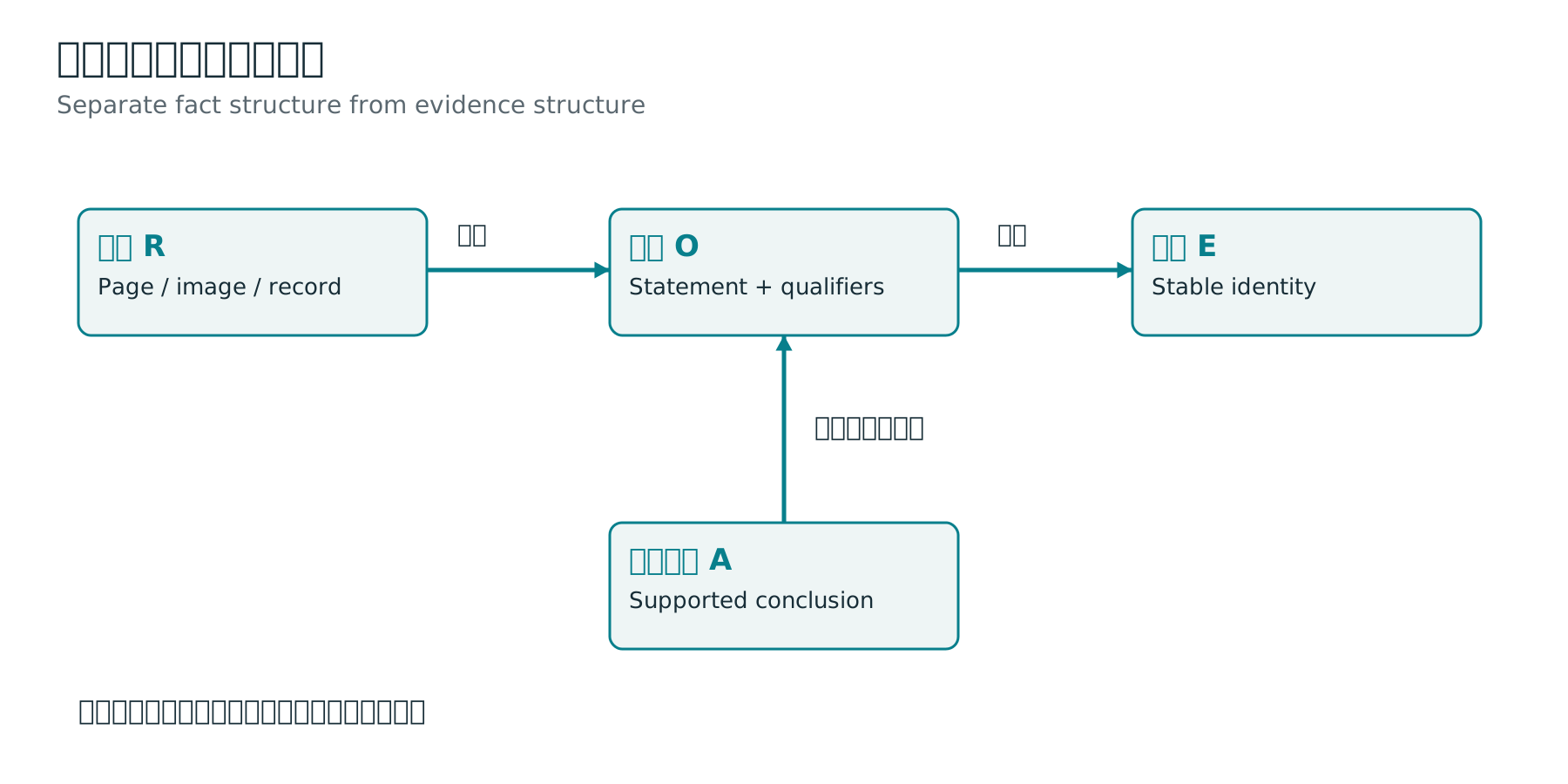
Original design
02.4
Entity Identity and Ambiguity Resolution
Entity alignment begins with an identity decision rather than with a similarity calculation. The same name can refer to different objects, and different names can refer to the same object. Ingredient aliases, abbreviated organization names, people sharing a name, and product versions create different ambiguity patterns. They should not be governed by one unvalidated merge rule. Candidate generation can use names, context, relationship neighborhoods, or visual features, but a merge decision should also satisfy domain constraints. Records with incompatible periods of validity should not be merged merely because their embeddings are close. Nor should an image labeled only as vegetables automatically be assigned a specific ingredient identity. [R16][R22]
We recommend separating confirmed identity, candidate association, and confirmed difference. Candidate associations can support recall, but should not silently support conclusions that require exact identity. A merge should preserve original identifiers and a reversible mapping rather than deleting the former records. Splitting and correction deserve equal attention, because an incorrect merge can propagate relationships through the wrong identity. Multimodal information offers additional clues and additional opportunities for ambiguity. An image may depict several objects while the accompanying text mentions only one. An illustration may be representative rather than a photograph of the exact item described. Consequently, an image-text pairing does not imply a one-to-one correspondence between every visual object and a textual entity. An alignment record should state the scope of the correspondence and retain unresolved cases for examination.
02.5
Storage Structures and Retrieval Interfaces
Graph storage, a vector index, and a repository of original assets can perform complementary functions. The graph preserves explicit relationships and constraints. The vector index generates candidates through semantic or visual similarity. The asset repository retains full documents and high-resolution images. Separating these responsibilities does not necessarily require three different products. It requires a clear account of ownership, update behavior, and query semantics for each category of data. A relational database can represent some graph structures, and a graph database can provide vector retrieval. Research comparisons should therefore examine models and query behavior instead of inferring performance from a database category alone.
A retrieval interface should ideally return typed evidence objects rather than only a concatenated block of prose. An evidence object can carry entity identifiers, relationships, source locations, time, permissions, and an uncertainty status. The generation layer can use this information to formulate a qualified conclusion, while the audit layer can determine whether the answer used applicable material. For an image requiring review, the interface should preserve the connection between a region and the original image instead of exposing only an opaque vector score. We treat this evidence interface as a stable architectural contract. Models and storage systems can change, but supporting information must continue to move in an inspectable form. If an interface converts structure into prose too early, downstream components may be unable to recover the constraints that were discarded. Keeping these constraints explicit makes both integration and debugging more reliable.
02.6
Graph Quality and Query Boundaries
Graph quality involves coverage, correctness, consistency, timeliness, and completeness of provenance. These dimensions can pull in different directions. Increasing the recall of automatic extraction may introduce additional incorrect edges, whereas strict filtering may remove rare but important relationships. A highly connected graph can also be dominated by overly broad labels that are unsuitable for specific questions. Node counts, edge counts, and connectivity can monitor changes in the data, but they cannot independently establish knowledge quality. Evaluation should begin with actual queries and examine whether the relevant objects, relationships, and evidence have been preserved at an appropriate granularity.
The interpretation of a missing edge is especially important. In an open collection of material, failing to find a relationship normally means that the system lacks sufficient records. It does not establish that the relationship is false in the world. Absence can be interpreted as negation only when the data scope, collection completeness, and domain rules justify a closed interpretation. Path length is likewise no substitute for reasoning quality. A short path can be semantically wrong, while a longer one may retain essential time or provenance conditions. We recommend that the query layer explicitly distinguish positive evidence, negative evidence, unknown information, and conflict, and that the answer layer preserve those distinctions. This enables a system to explain evidential insufficiency rather than filling gaps in its graph with confident conclusions. The ability to represent uncertainty is part of the knowledge model, not merely a wording preference at the end of generation.
Mechanisms and Limitations of Retrieval Augmented Generation
03.1
Parametric Knowledge and External Evidence
A language model's parameters encode statistical regularities acquired during training, whereas external material supplies task information that can be updated and located. RAG adds retrieved material to the generation context so that the model can answer with reference to it. The foundational work combines parametric generation with non-parametric memory for knowledge-intensive tasks. This does not imply that retrieved knowledge is permanently written into the model's weights, nor does it guarantee that the generator will use only the supplied evidence. [R06]
An application must distinguish what a model might know from what the system is permitted to use as the basis of an answer. Question answering over institutional documents often requires conclusions to follow a specified version of internal records, even when general knowledge would allow a plausible response. When the records are insufficient, the desired behavior may be to explain that insufficiency rather than fill the gap with common knowledge. We recommend expressing evidential requirements as testable rules. For example, a statement about an institution's procedure should cite a location in a currently applicable document. Compliance should be examined using missing material, obsolete documents, and contradictory records, not only demonstrated with ordinary questions. The central control problem in RAG is therefore the selection of evidence and the manner in which it is used. This framing also explains why a stronger generator alone cannot repair every retrieval failure.
03.2
Retrieval Units and Segmentation Strategies
Segmentation determines which objects a retriever can return. Fixed-length chunks are easy to implement, but they can separate a condition from its conclusion, a table heading from its values, or an image from its explanation. Segmentation by headings, paragraphs, or layout regions retains more structure, but still has to handle tables continuing across pages and references spanning paragraphs. Smaller chunks can provide more precise localization while lacking the context needed for independent interpretation. Larger chunks preserve more information but consume additional context and can introduce irrelevant material. We treat segmentation as the design of evidence boundaries rather than as a preprocessing step controlled only by length.
Retrievable objects should retain their parent document, neighboring passages, and structural location. When retrieval returns a number, the system also needs its metric, unit, period, and population. When it returns an image region, it needs the source page and version. Graph structure can connect these objects only if the identifiers required for those connections were preserved during ingestion. For procedures, clauses, and experimental material, a useful design is to combine fine-grained localization with retrieval of the surrounding structure. The system first identifies specific evidence and then adds the local context required to interpret it. The effectiveness of this design should be evaluated jointly through the support it provides for answers and the context resources it consumes. A segmentation method that improves one retrieval metric while repeatedly removing essential conditions may be unsuitable for the actual task.
03.3
Candidate Retrieval and Ranking Combinations
Different retrieval signals can complement one another. Lexical matching preserves names, identifiers, and explicit expressions. Vector similarity helps locate material phrased differently but related in meaning. Graph neighborhoods can expand retrieval to associated objects. Time and permissions constrain whether a candidate is usable. A hybrid design should specify the responsibility of each signal. Simply adding scores does not make them commensurable, because their scales, distributions, and calibration can differ. Fusion should be examined on a development set instead of manually tuned to make a small demonstration look favorable.
Reranking passes a smaller candidate set through a more detailed relevance model or rule. It can improve ordering, but it cannot restore necessary evidence that was never retrieved. If an answer depends on two dispersed records, scoring each passage against the question independently can also miss the value of their combination. We recommend recording where candidates came from, why they were filtered, and how their order changed. Evaluation should examine whether the selected set covers the complete evidence chain. It is insufficient to optimize only the similarity of the first result. Some questions require one explicit record, others require a relationship to be completed, and still others require coverage across several themes. Distinguishing these requirements allows retrieval design to remain aligned with the research question. Comparative GraphRAG studies and graph-guided expansion methods provide reasons to examine this alignment, without establishing one universally optimal fusion rule. [R09][R13]
03.4
Context Organization and Generation Constraints
Retrieval leaves a separate problem unresolved: how should material be organized so that the model uses it appropriately? Evidence order, duplication, conflicting sources, and long-distance dependencies can all affect the context presented to the generator. Research has observed that the position of relevant information changes performance for the models and tasks examined. The ability to fit material into a context window should therefore be evaluated separately from the ability to use it effectively. This observation is not a fixed performance claim about every later model, but it motivates controlled experiments involving position and length. [R29]
We recommend packaging context as a set of evidence objects with explicit sources and statuses. Original excerpts, machine-generated summaries, and speculative explanations should remain distinguishable. Questions requiring precise attribution should retain the passages directly supporting the conclusion. Questions requiring synthesis can use summaries while preserving routes back to their sources. Generation instructions should require appropriate qualification when evidence is missing, conditions do not match, or records conflict. The existence of such an instruction does not establish that it is effective; evaluation must inspect the actual answers. A particularly problematic practice is to reintroduce the model's previous answer as if it were independent evidence, creating a self-supporting loop. If earlier generated material is reused, its derived status and original basis must be retained. Otherwise repetition can make a claim appear corroborated when every instance ultimately comes from the same unsupported generation.
03.5
Multi Hop Questions and Query Routing
A multi-hop question connects several evidential steps, but the number of steps is not identical to reasoning difficulty. A two-step question may require difficult entity disambiguation, whereas a longer path may involve an explicit hierarchy. The system should identify the required relationships, object types, and conditions rather than mechanically increase traversal depth. Asking which counters serve dishes containing chicken requires connections among counters, dishes, and ingredients. Adding a date also requires the relevant menu version. If one condition is missing, a connected path is still an incomplete answer.
Query routing can assign a request to factual lookup, relational expansion, global summarization, cross-modal verification, or a combination of these operations. The router can itself fail, so fallback behavior and execution records should be preserved. A useful study compares fixed routing, rule-based routing, and model-based routing while holding the corpus and generation budget constant. An advantage obtained by using test answers or by manually selecting the best route after seeing the outcome does not represent online performance. We recommend classifying routing mistakes separately. A system can possess adequate evidence but choose an unsuitable way of organizing it for the question. Recognizing that failure prevents unnecessary reconstruction of the whole graph. It also supports a more precise experiment: improve route selection while keeping extraction and generation unchanged, then determine whether the affected question class improves without an unacceptable loss elsewhere.
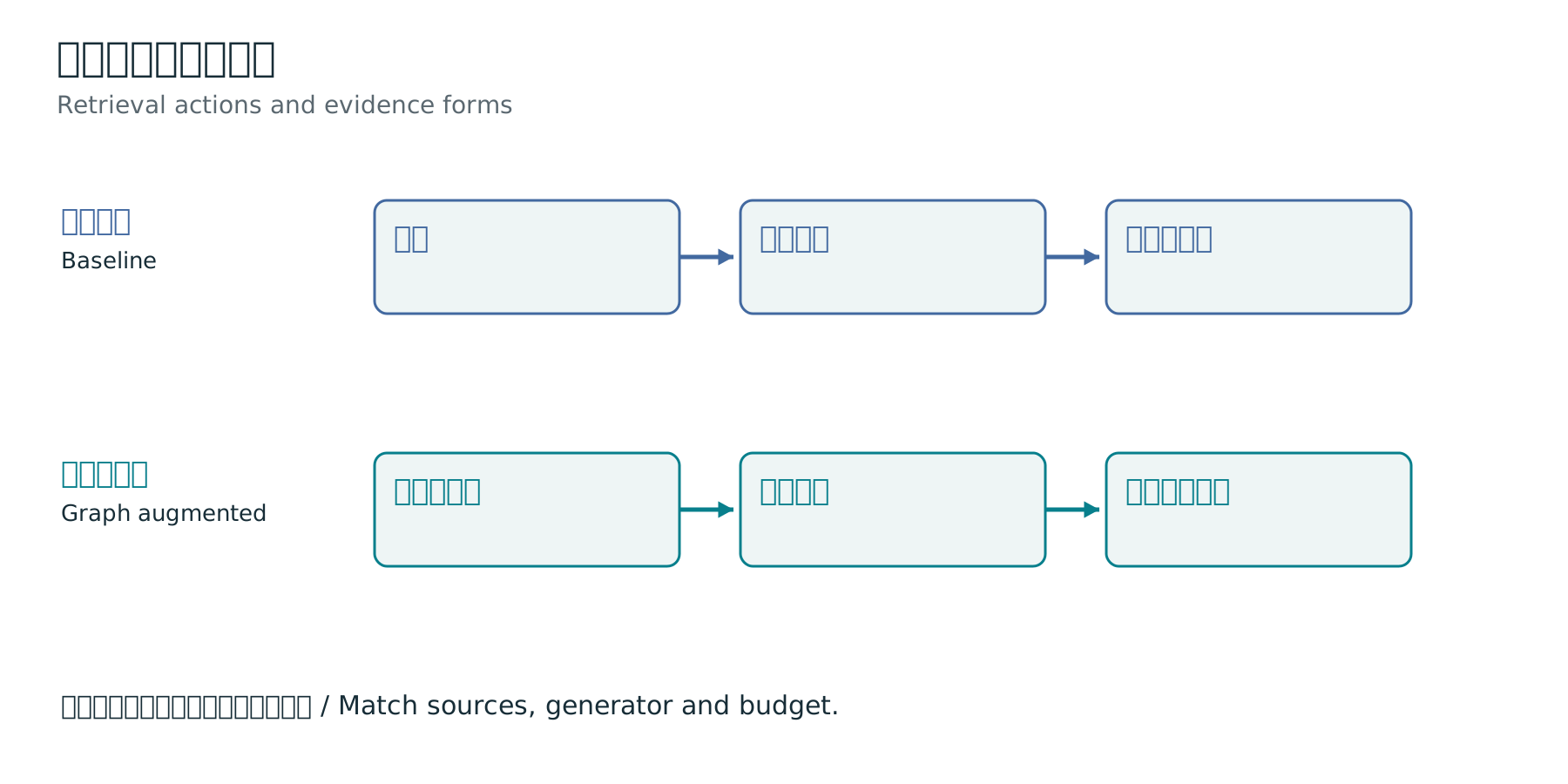
Original design
03.6
Decomposing End to End Failure
An incorrect answer can originate in the data, extraction, retrieval, organization, generation, or presentation stage. If the source lacks the required information, even an excellent retriever cannot supply genuine support. If entities were incorrectly merged, graph retrieval may accurately return an invalid path. If correct evidence was retrieved but excluded from the final context, organization or budgeting is responsible. If the model disregarded clear evidence, generation behavior requires examination. An end-to-end score alone cannot distinguish these causes. Evaluation should retain intermediate objects at each stage so that an outcome can be traced back to its inputs. [R25][R26]
We propose attributing errors to the earliest failure that can be located. First check whether the collection contains sufficient evidence, then whether the representation preserves it, then inspect candidate retrieval and ranking, and finally examine the conclusion and its citations. A condition that supplies the correct evidence can reveal whether the generator still fails under ideal retrieval. This condition is diagnostic rather than a measure of deployment performance, but it helps estimate the potential benefit of improving retrieval. Error analysis should also include answers that happen to be correct while relying on the wrong evidence. Text-only scoring can overlook such fragile successes. A dependable system must address both whether the answer is correct and why the available material authorizes that answer. This decomposition makes improvement more economical, because each intervention can target a demonstrated failure rather than changing several components at once and obscuring the cause of any gain.
Working Mechanisms of Microsoft GraphRAG
04.1
Objects Managed by the Graph Index
The official Microsoft GraphRAG dataflow distinguishes documents, text units, entities, relationships, communities, and community reports. These categories allow original material and derived structure to coexist. A graph index does more than replace a document with a few keywords: it links locatable passages to extracted objects and then organizes larger semantic structures. Figure 5 separates the source, structural, and summary layers so that the information added or potentially lost at each transformation can be examined. [R32]
In our analysis, preserving traceability among these objects is the first design requirement. An entity's name may change, and a document may later be segmented differently, but the evidence used by an earlier answer should remain interpretable. If an update overwrites the current graph without preserving versions, historical answers can become impossible to audit. A research experiment likewise needs a fixed corpus snapshot, segmentation scheme, and extraction version. Otherwise the supposedly identical collection used in a comparison may have changed. Evaluation of a graph index should therefore consider both query quality and the stability of identity across transformations. The latter rarely appears directly in a question-answering score, yet it determines whether the system can be maintained over time. A representation that produces an attractive demonstration but cannot explain which source version supports a relationship is incomplete for applications requiring accountability or reproducible analysis.
04.2
Entity Relationship Extraction and Information Compression
Language-model extraction provides a flexible entry point for unstructured material, but it is also a lossy transformation. Conditions, modality, exceptions, and time can disappear when a passage is compressed into a short relationship. Converting a report suggesting that a project might be delayed into a statement that the project was delayed removes the source, the inferential status, and the uncertainty at once. We recommend preserving the status of a proposition and its supporting passage, and testing extraction with negation, conditional statements, and reported speech. Compliance with an output schema does not establish semantic correctness. [R02][R32]
Extraction granularity should serve the query task. Retaining only frequent entities may remove a rare object that determines an answer. Turning almost every noun into an entity can instead produce a noisy graph that is costly to maintain. A study can vary the permitted entity types and relationship constraints, then examine their effects on recall, error propagation, and indexing cost. A generator may also insert general knowledge into an extraction output, so important relationships should be checked for support in the current collection. We argue for storing model-proposed candidates separately from relationships that have passed an evidence check. Extraction then becomes an auditable process of knowledge construction rather than an irreversible rewriting of text. This distinction enables targeted correction and lets an application use more permissive candidates for exploratory retrieval without representing them as confirmed facts in a final answer.
04.3
Community Hierarchies and Theme Representation
Community detection organizes nodes according to graph connections, producing groups that can be summarized. The Leiden study addresses structural properties such as community connectivity, while Microsoft GraphRAG uses communities and their hierarchy to organize summaries. A structurally well-formed community is not automatically a correct business topic. Community names and reports require linguistic interpretation, and their quality depends jointly on extraction and summarization. The graph partition, the naming of a theme, and the usefulness of that theme to a user are separate evaluation questions. [R27][R32]
We recommend retaining community membership, hierarchical relationships, and the evidence underlying each report. Changing granularity can produce a broader account or merge distinctions that matter. A topic appearing in only a few passages may not form a prominent community while remaining essential to a particular user's question. Global understanding should therefore not be equated with selecting the largest statistical groups. Evaluation should examine both topic coverage and small but relevant bodies of evidence, and state which hierarchy level supplied the reports. Community structure is a means of organizing material rather than a uniquely correct taxonomy inherent in the data. Different partitions may support different questions. Recording the chosen partition and its limitations makes the resulting analysis easier to interpret and avoids treating an algorithmic grouping as if it were an independently established organizational or causal relationship.
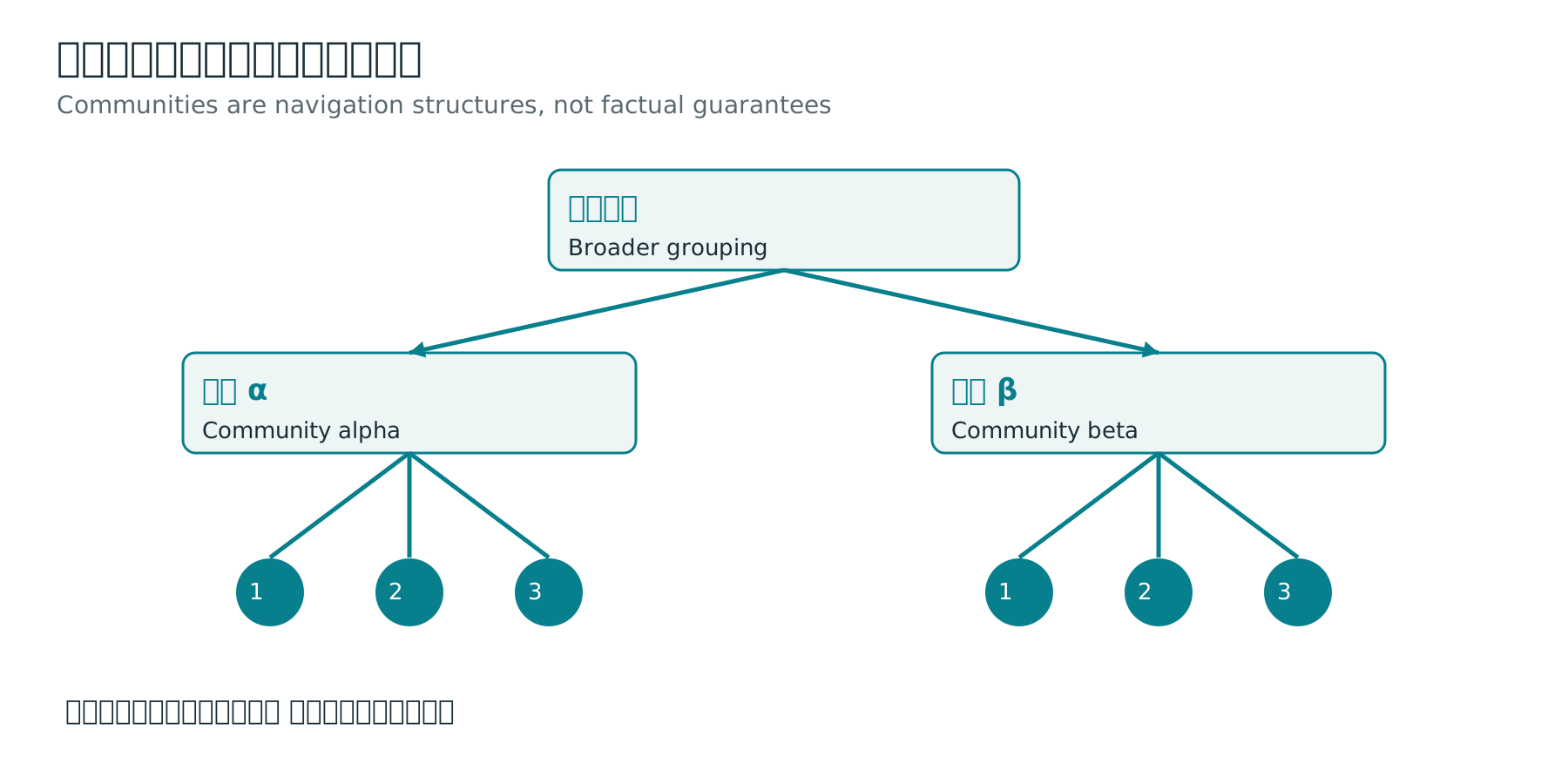
Schematic, no clustering run
04.4
Global Search and Batched Synthesis
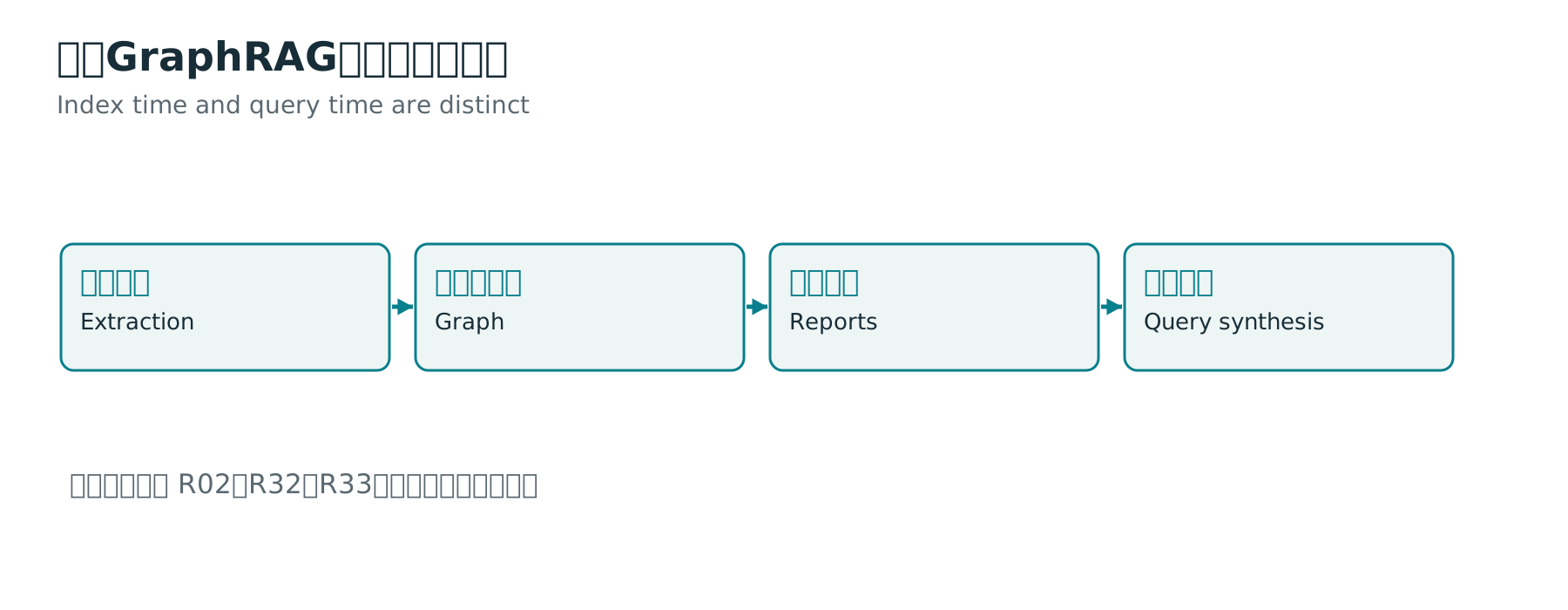
Global search uses community reports as context, generates question-specific intermediate responses in batches, and filters and aggregates them into a final response. This involves summaries created at two different times: community reports produced during indexing and intermediate answers generated for a particular query. Confusing them can create the impression that the system anticipates every future question. The official workflow explains batching and aggregation, but their effectiveness still depends on whether reports retain relevant information and whether aggregation handles repetition and differences appropriately. [R33]
We analyze global synthesis as evidence compression under a resource budget. Each layer can lose minority views, exceptions, or conflicting statements. The final answer should therefore avoid converting a summary into an unconditional claim about every item in the collection. A study can follow an important proposition through the source passage, community report, intermediate answer, and final response, examining whether its degree of certainty grows during transformation. Reports from different batches may also cite the same original source. Counting their repetition as independent corroboration overstates evidential strength. Aggregation should identify overlapping provenance and preserve meaningful disagreement rather than merge content solely for fluency. These checks explain the reliability of global summarization more effectively than answer length alone. They also make it possible to locate a failure at the layer where a qualification was lost, rather than blaming the final generator for an omission that occurred earlier.
Original design
04.5
Combining Local and Global Questions
Questions centered on a particular entity generally need detailed relationships and direct evidence. Questions about a collection as a whole require a broader account spanning several groups. An application may alternate between these requests within one conversation, for example asking about one project's partners and then asking about risks common to all projects. The design should allow local evidence and wider summaries to complement one another while preserving their distinct levels of provenance. A user who sees a global conclusion should be able to ask which specific records support it.
We recommend selecting retrieval modes according to evidential requirements rather than question length or a few keywords. An apparently specific question may require comparison across documents, while a request containing the word overall may concern only a small, identifiable set of records. Researchers can annotate the necessary evidence set and examine whether different modes cover it. If several modes run together, their costs and the rule for selecting evidence should be recorded. Passing every retrieved result to the generator may introduce conflicts and context noise rather than improve the answer. The value of a combined mode should be demonstrated through more appropriate evidence selection, not through a larger number of retrieval calls or a longer response. Comparative work motivates examining such combinations, but a routing or fusion policy still requires validation for the intended corpus and workload. [R09][R33]
04.6
Findings in the Anchor Article and Their Conditions
The early Microsoft article reports favorable comparisons on comprehensiveness, diversity of viewpoints, and support for human inspection, while reporting faithfulness to the source at a level similar to the baseline. These findings should not be rewritten as elimination of hallucination or as a universal percentage increase in accuracy. The later paper offers a more systematic analysis of global sensemaking questions, but it should be cited separately from the initial demonstration. Interpretation must retain the corpus, question-generation procedure, evaluator, and comparison system involved. [R01][R02]
The most useful implication, in our view, is a change in the unit of evaluation. When a question concerns an entire collection, similarity between the question and a few retrieved passages is insufficient. This does not remove the value of vector retrieval for explicit factual lookup. Graph construction introduces cost, latency, and additional opportunities for error, and community reports require maintenance. Adoption should depend on how often users ask associative or collection-level questions and whether the system can maintain the derived evidence. The appropriate conclusion is conditional suitability rather than treating one research method as the default answer to every knowledge task. A credible evaluation should include questions where a simpler baseline is expected to work well, as well as questions designed to expose the limitations that graph organization is intended to address. Such balance makes the boundary of a method's benefit visible and prevents selective demonstrations from becoming an exaggerated capability claim.
Comparing and Selecting Graph Augmented Retrieval Methods
05.1
Compare Knowledge Organization and Retrieval Actions
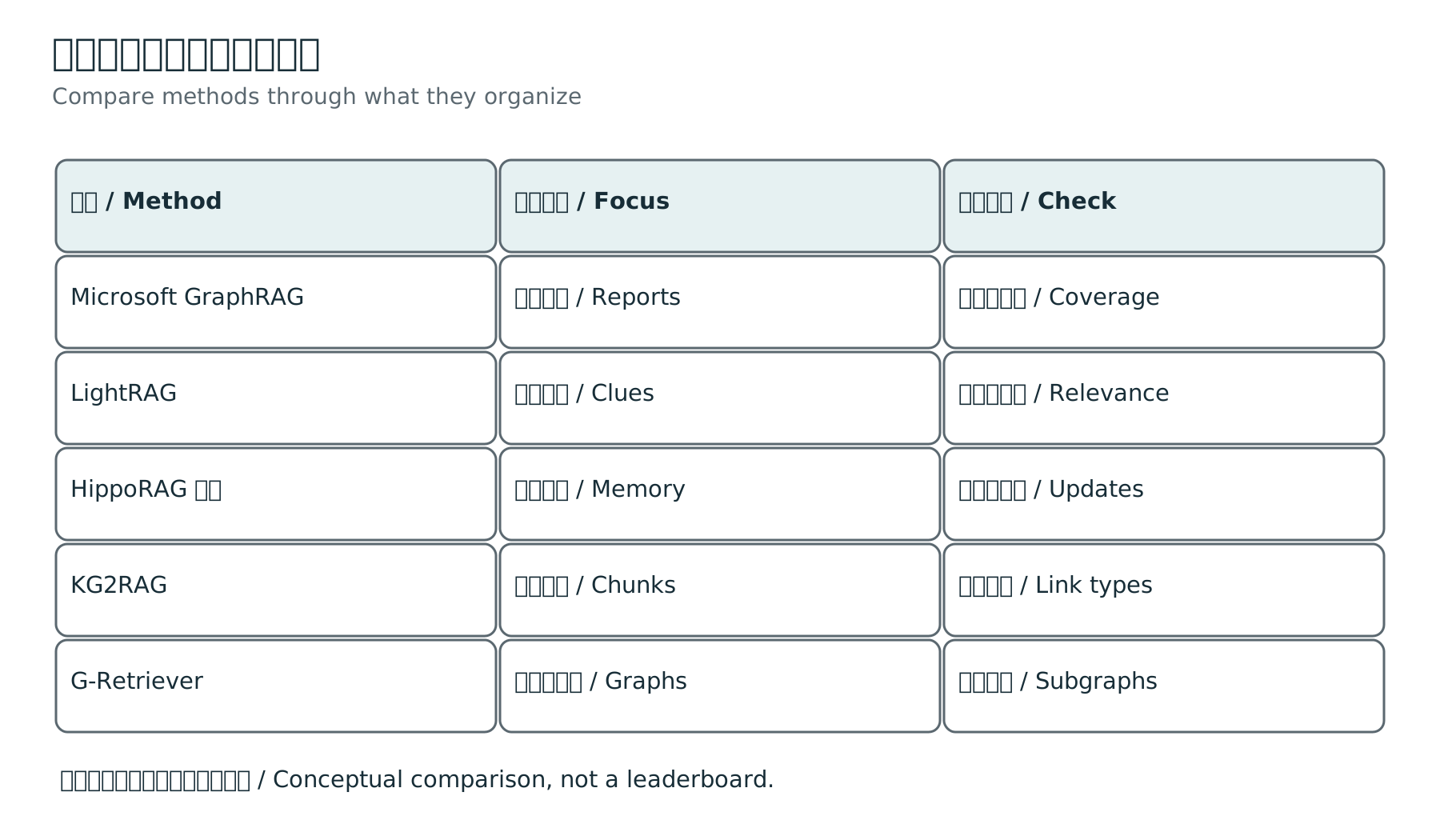
A method name is not a procurement checklist. A system called GraphRAG may extract an entity graph from text, traverse an existing business graph, or connect a graph encoder to a language model. This report proposes four concrete comparison questions: what is stored during indexing, where a query starts, which relations support expansion, and what evidence reaches the generator. These questions reveal when differently named systems perform similar work and when implementations sharing a name follow incompatible technical routes. The two surveys provide entry points into this diversity, while implementation decisions still require the corresponding paper and version.[R07][R08]
The comparison unit should be a complete configuration covering preprocessing, models, retrieval budgets, prompts, caching, and access scope. Suppose system A uses a stronger generator, more source material, and a longer context. Better answers cannot then be attributed directly to its graph. A practical selection process first establishes a reliable vector and keyword hybrid baseline, changes only evidence organization, and subsequently introduces other improvements. This sequence identifies the additional value of the graph. If the graph does not improve the target questions, the supported conclusion is that the current configuration has not demonstrated value. It does not establish that the data can never benefit from any graph method.
05.2
LightRAG and Retrieval Clues at Different Granularities
LightRAG combines graph structure with retrieval and emphasizes information retrieval at different levels. A useful reading distinguishes clues about specific objects from more abstract thematic clues. The former help locate an entity and its neighborhood; the latter help find information connecting multiple objects. Its emphasis differs from the Microsoft community report route, so these approaches should not be treated simply as faster and slower versions of one index. The words simple and fast in a paper title also cannot replace local measurements. Text length, extraction models, graph density, and update procedures all affect actual cost.[R10]
Consider an enterprise question asking why equipment A repeatedly stopped. It names an identifiable machine while also requiring an explanation of a fault pattern. A system might retrieve equipment records, fault categories, and associated work orders in parallel, then organize them by time and source. A common mistake is treating thematic similarity as event identity. Two machines experiencing high temperatures do not necessarily share one incident. Retrieval clues therefore need event, location, and temporal boundaries to prevent uncontrolled expansion. Evaluation should measure object identification, relationship coverage, and irrelevant expansion separately, and record whether the clues recover previously missing evidence. The algorithm supplies an organization of clues; the task boundaries determine whether that organization is useful.
05.3
The HippoRAG Family and Associative Memory
HippoRAG starts from a research analogy with long term memory and uses graphs and associative retrieval to organize external knowledge. HippoRAG 2 extends the discussion toward memory systems for nonparametric continual learning. Memory here is primarily an engineering organization; it does not imply human experience or a biological mechanism. The important research idea is that local similarity between a question and a single passage may miss necessary material, while association across a graph offers another discovery route. Improved long term knowledge use must still be demonstrated through explicit update and query tasks.[R11][R12]
An operational memory design needs rules for retention and forgetting. When a new report arrives, the system must determine whether it supplements an earlier conclusion, contradicts it, or describes a different period. Continually adding edges can make outdated associations easier to retrieve. Evaluation of continual learning should therefore extend beyond a static test set. It should introduce new knowledge over time, corrected facts, withdrawn sources, and repeated descriptions, then check retention of earlier tasks, acquisition of new tasks, and cessation of invalid information use. These tests turn memory into observable behavior. An auditable external memory should explain when an association entered the system, which sources support it, and when it ceased to apply.
05.4
KG2RAG and the Organization of Evidence Chunks
KG2RAG uses a knowledge graph to guide chunk expansion and organization, offering a useful example of retrieving material and then connecting it. Its broader lesson is that a graph can improve the evidence context without requiring a generator to read one large graph directly. One passage may describe equipment, another maintenance records, and a third a replacement component. Shared entities and relations can organize them into more coherent answer material. This report summarizes that methodological direction without extending particular experimental findings into a universal advantage.[R13]
Evidence organization must preserve the type of logical connection. Two passages mentioning the same supplier share an entity. A record explicitly citing another file establishes a document dependency. One incident following another establishes a temporal order. These connections support an answer in different ways. Collapsing them into untyped adjacency encourages a generator to interpret relatedness as explanation. An evidence package should therefore include the reason for each connection, source locations, and a maximum traversal depth. Direct evidence should appear before inferred paths, allowing readers to see what the sources actually state before examining how the system connects them. Even when the organization strategy fails, this arrangement makes the specific erroneous connection identifiable.
05.5
G-Retriever and Questions about the Graph Itself
Some tasks begin with an existing network whose nodes and edges carry text, and users ask directly about its objects and connections. G-Retriever studies understanding and question answering over textual graphs, reminding us that graph augmented generation is broader than Microsoft style community summaries. Existing equipment networks, citation networks, or product graphs may require selecting a relevant subgraph and presenting both structure and text to a model. Training and inference requirements for this route should be distinguished from pipelines that only call an external language model.[R14]
A larger selected subgraph is not automatically better. A connected region with thousands of nodes may contain only two relations necessary for a question, while introducing many ambiguous names and peripheral descriptions. Engineering can treat subgraph selection as evidence coverage under a budget: prioritize paths connecting key objects, sources supporting those paths, and necessary counterexamples. If a path permits several interpretations, return alternative subgraphs rather than forcing the model to choose one story. Graph distance is also not equivalent to real world importance. A short path from a weak source may be less useful than a longer chain with explicit records. Structural information must be judged together with evidence quality.
05.6
Build a Portfolio from a Task Matrix
This report recommends a task matrix rather than a brand matrix. Explicit factual questions prioritize precise localization and provenance. Relationships across documents require entity disambiguation and complete paths. Questions about corpus wide themes require coverage, synthesis, and preservation of minority views. Visual questions require checking whether image evidence is indispensable. For every task row, record the minimum viable method, the expected benefit of a graph, additional failure modes, and acceptable cost. Comparative research emphasizes that RAG and GraphRAG performance depends on task conditions; one average score cannot establish complete replacement of one approach by another.[R09]
The final system may combine several retrieval routes, but their orchestration needs an interpretable router. Determine whether a question requires global synthesis, relational reasoning, or visual identification before allocating retrieval budgets. When classification is uncertain, inexpensive candidate routes can run together and their evidence can be merged. Routing itself needs evaluation: an incorrect global route may matter more than a small improvement in the retriever. Preserve routing reasons, candidate counts, evidence origins, and fallback explanations for each request. Procurement and deployment decisions should follow utility under the real distribution of questions, rather than demonstrations on unusually complex cases. Complexity is justified when it consistently improves important tasks and the organization can maintain its additional responsibilities.
Synthesis of method directions
Representation and Alignment in Multimodal Knowledge Graphs
06.1
Modalities as Attributes Nodes or Observational Evidence
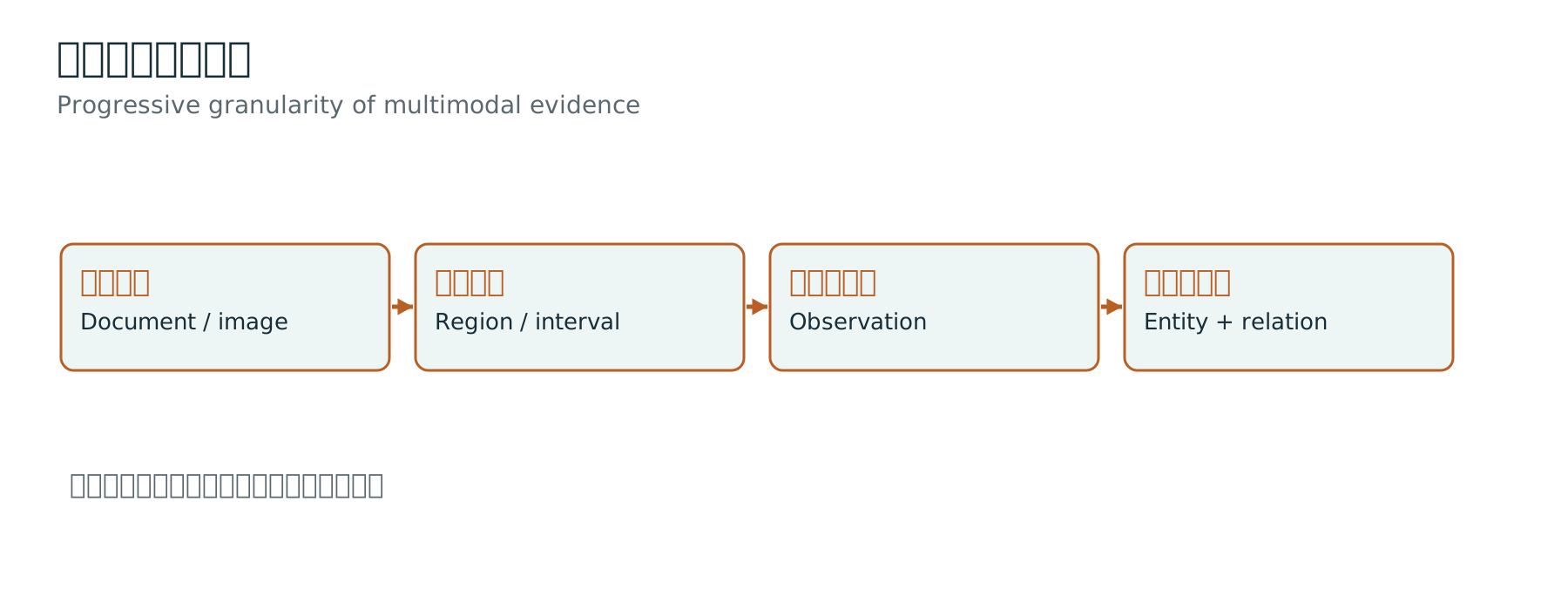
A multimodal knowledge graph organizes information in different forms, but inclusion can happen at several depths. The simplest approach attaches an image to an entity. A richer approach makes the image an independent node with capture time, provenance, and licensing information. A finer representation makes image regions, text boxes, audio intervals, or video segments into locatable evidence objects. Each has a role: a display catalogue may need only attributes, identification across documents requires independent resources, and fine grained questions usually require local evidence. Surveys cover different construction and learning tasks; attaching pictures to a database does not by itself establish semantic alignment.[R15][R16]
Design should work backward from questions. Asking where a dish ingredient list appears requires a resource and document location. Asking what the green leaves in the upper left of an image are requires region coordinates and identification evidence. Asking when seasoning enters a cooking video requires a time interval. Finer granularity raises annotation, indexing, and maintenance costs. A progressive strategy therefore preserves complete original resources first and adds local structure when queries justify it, instead of densely annotating every image without a defined purpose. Local structures must also preserve transformations back to the original resource. Otherwise, a correct bounding box can point to the wrong location after resizing or cropping.
Original design
06.2
Shared Embedding Spaces Supply Similarity Clues
CLIP demonstrates transferable visual representation learning from paired images and text and provides an important foundation for cross modal retrieval. A shared space makes similarity between a text query and image candidates computable, but it does not automatically give that similarity factual meaning. A picture close to the phrase kung pao chicken may match through colour, presentation, or training cooccurrence. It does not independently establish that the image shows a particular restaurant product, and it cannot establish the absence of invisible ingredients. Embedding scores should first be treated as candidate ranking signals and combined with product identifiers, context, and provenance.[R17]
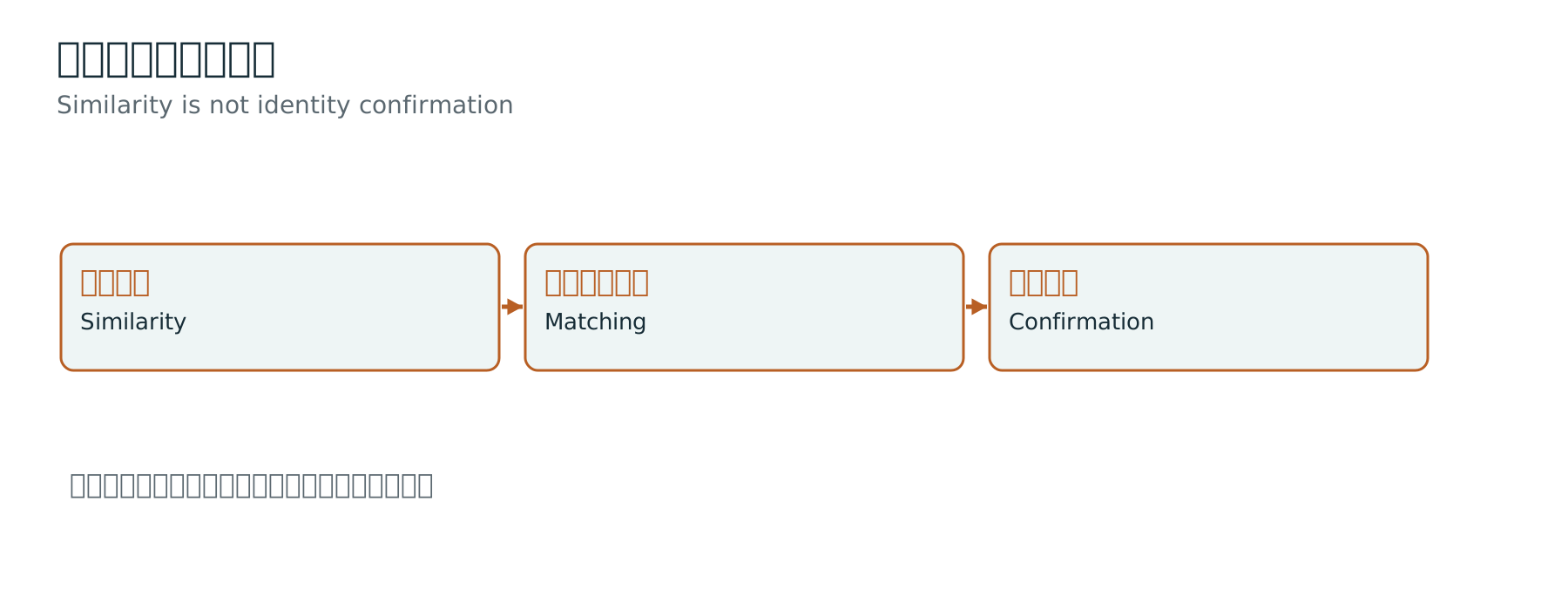
Applications should distinguish similarity, matching, and confirmation. Similarity means a model recommends inspection. Matching means a candidate passes specified business conditions. Confirmation means it satisfies an explicit review rule. Recording evidence for each transition prevents visual outputs from silently becoming knowledge facts. Ambiguous details should permit multiple candidates or an unknown answer, accompanied by an explanation of the missing evidence. Evaluation should include more than overall retrieval success. Hard negatives include visually similar but distinct items, different restaurant versions of a dish with the same name, different products in similar packaging, and photographs with matching backgrounds but different subjects. Such cases expose the shortcuts on which a model relies.
Original design
06.3
Entity Linking Is a Cross Modal Identity Decision
Entity linking asks which existing entity a mention, image region, or product record refers to. This differs from recognizing a category. Identifying a chicken dish is classification; linking it to a restaurant menu item on a particular date requires identity conditions. Multimodal entity linking research combines visual, textual, and graph clues, but sparse evidence, ambiguous names, and domain changes require testing on the actual data. This report uses KGMEL as an entry point into that direction without inferring complete implementation details or deployment performance from material beyond the inspected abstract.[R22]
A practical linking process needs candidate generation, condition checking, and rejection. Aliases, identifiers, and vectors first retrieve candidates. Restaurant, time, packaging text, and neighboring relations then help distinguish them. If two candidates remain plausible, preserve an unresolved observation instead of forcing a merge. Separate relations for same entity and same category allow the system to say that an image appears to show a category of dish while the specific product remains unidentified. Incorrect merges are often harder to repair than missed links because they mix evidence from different objects and contaminate downstream summaries. High impact entities therefore justify prioritizing a low false merge rate and providing efficient human inspection. Correct rejection is a valid linking outcome.
06.4
Preserve Local Evidence and Document Layout
Figures and document layout carry relations. Which column header governs a number, which object a caption describes, and which steps an arrow connects may all disappear during plain text conversion. ColPali studies document retrieval using vision language representations, offering a route that uses visual document information directly. This approach can complement an explicit knowledge graph but is not equivalent to one. Preserving page images may recover information lost by text parsing; explaining an answer still requires identifying the relevant page, region, and text.[R23]
Research reports and equipment manuals should preserve both logical structure and visual coordinates. Table cells should link back to row and column headers, figure labels to legends, and continued tables to a stable table identity. Answers can state a conclusion in text and attach a local image for verification. A new failure needs attention: cropping away units, axes, or a qualifying note may make a local image look clearer while changing its meaning. Local evidence should therefore include necessary context and provide access to the full page. Image contribution can be tested by comparing conditions with and without images. A more attractive answer page alone does not demonstrate a substantive benefit from multimodal retrieval.
06.5
Missing Conflicting and Unreliable Modalities
Multimodal fusion should not assume that every modality is complete and reliable. A product may have text but no image, a photograph may be outdated, audio may be misaligned with video, and a review may describe an earlier version. Treating missing modalities as ordinary zero vectors can encourage patterns unrelated to content. Forcing agreement across modalities can conceal real conflicts. Each observation should therefore retain availability, quality, time, and scope, and retrieval should use these explicitly. Missing information should change what the system can answer instead of inviting the model to silently fill factual gaps.
Conflict diagnosis must identify the relevant level. Text stating that peanuts are present and an image detector finding none are not necessarily contradictory because peanuts may be invisible. An explicit claim of no peanuts and an ingredient record asserting peanuts for the same version create a statement conflict. Systems can distinguish contradictory content, uncertain identity, temporal mismatch, and limited observability, then request appropriate additional evidence. Training and testing should deliberately mask modalities, substitute outdated images, and introduce incorrect pairings to check whether confidence decreases appropriately. Mature fusion is not the ability to turn every input into one fluent answer. It is the ability to recognize which inputs cannot jointly support that answer.
06.6
From Multimodal Graphs to Multimodal GraphRAG
A multimodal graph addresses representation, association, and updating. Multimodal GraphRAG must additionally select evidence for a question and generate a verifiable answer. MuRAG offers an early example of external memory containing images and text. MMGraphRAG, mKG-RAG, and RAG-Anything illustrate later attempts to combine multimodal information with structured organization. These names refer to different research systems, not interchangeable components of a standardized architecture. They are treated here as evidence of a design space rather than entries in one performance ranking without matched reproduction.[R18][R19][R20][R24]
A transferable principle is to share evidence identifiers across the graph, retrieval, and generation. An image region should connect to the observation it supports, the entity linked by that observation, the reason it was retrieved, and the answer sentence relying on it. If the graph stores only concepts, retrieval returns only image filenames, and generation produces only a summary, all three components may run successfully without jointly supporting traceability. A minimum output can instead contain an answer claim, evidence location, relation path, and uncertainty statement. Questions that do not need visual information should not incur visual processing automatically. Questions that require images should not depend entirely on automatically generated captions. Evidence needs should determine modality selection.
The Meituan Dish Graph and CMIngre Case Study
07.1
From Dish Names to Ingredient Level Understanding
The Meituan article focuses on ingredient level understanding and introduces the CMIngre benchmark alongside a business application for dish knowledge graphs. Published on May 17, 2024, it relates to the paper Toward Chinese Food Understanding: A Cross-Modal Ingredient-Level Benchmark. Online publication and journal volume dates differ, so the bibliography records them separately rather than treating one project as two independent studies. The article explains business motivation and workflow, while the paper and dataset support examination of benchmark definitions and experimental settings.[R03][R04][R05]
A dish name is a highly compressed label. The same name can refer to different ingredients, cooking methods, and regional versions, while similar ingredients can become visually different dishes. A mapping from name to category alone therefore offers limited support for detailed product understanding. This report proposes reading the case with names as entry points and ingredients, preparation, taste, and restaurant versions as separately verifiable attributes. These relations should be supported by menu text, visual observations, or other records rather than inferred automatically from the name. The distinction determines whether a graph repeats general expectations or describes a specific product. The first lesson of the case is the value of moving the research question to a finer level.
07.2
Dataset Scale Sources and Label Hierarchy
CMIngre contains 8,001 image and ingredient pairs, 429 ingredient labels, and 95,290 bounding boxes. Its sources comprise 1,719 dish pairs, 2,330 recipe pairs, and 3,952 user generated pairs. Ingredient detection experiments map fine labels to 67 coarser categories. These counts describe different levels and are not interchangeable. Cleaning includes treatment of infrequent labels and semantic merging, so the final label space reflects both domain concepts and available evidence.[R03][R05]
The analytical issue is the evaluation boundary behind these numbers. Sources can differ in clarity, camera angle, and textual completeness. A random mixed split may make transfer appear easier because training and testing share source styles. Coarsening labels reduces recognition difficulty while potentially hiding fine category errors. Educational and operational use should therefore report label level, per category distributions, and source splits together. Reproduction requires fixed dataset versions and split manifests, including checks for near duplicate images. Total sample size alone does not characterize difficulty, especially when many bounding boxes belong to a few common ingredients. Aggregate scores can conceal weaknesses on rare categories.
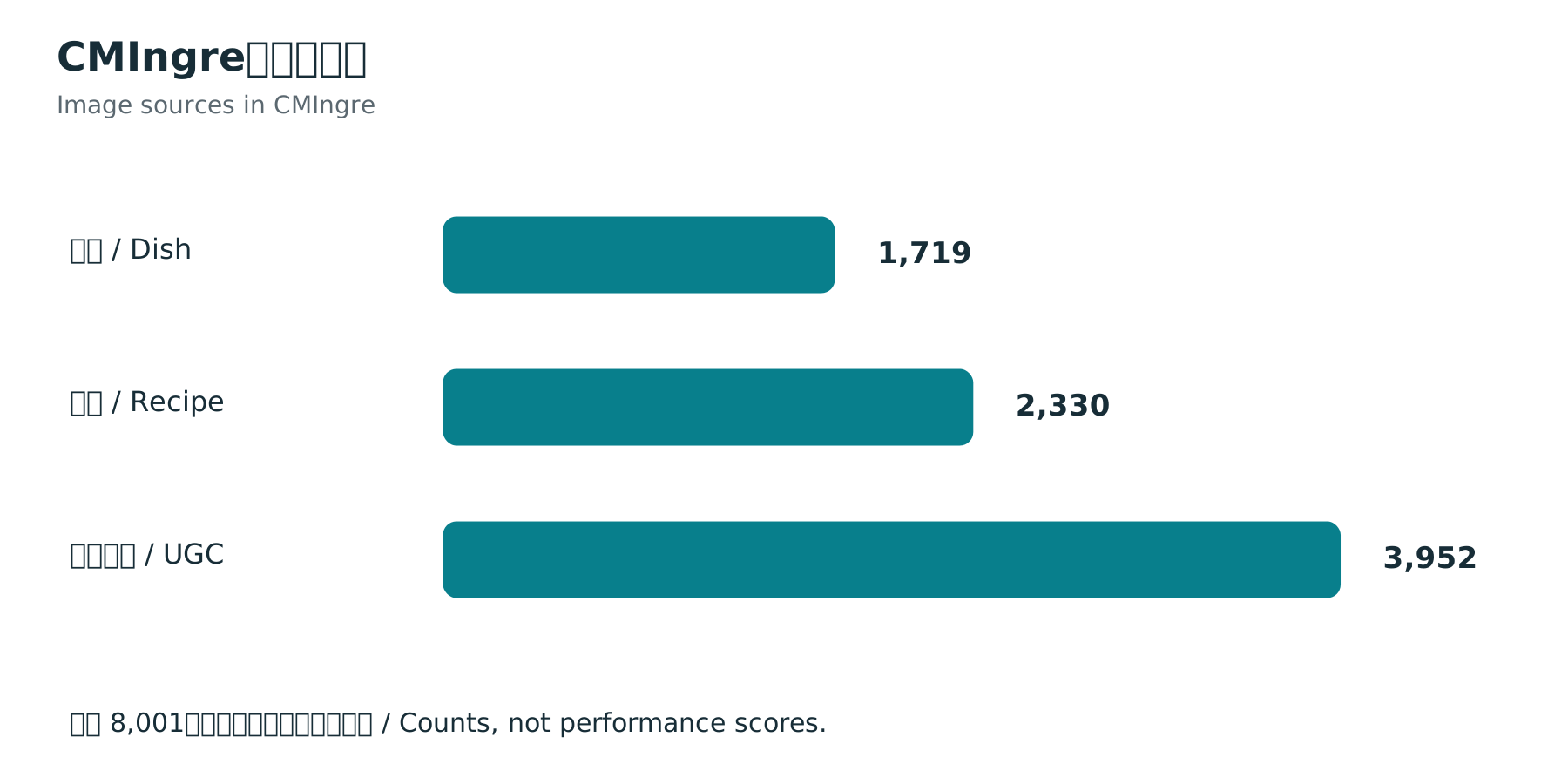
Redrawn from source counts
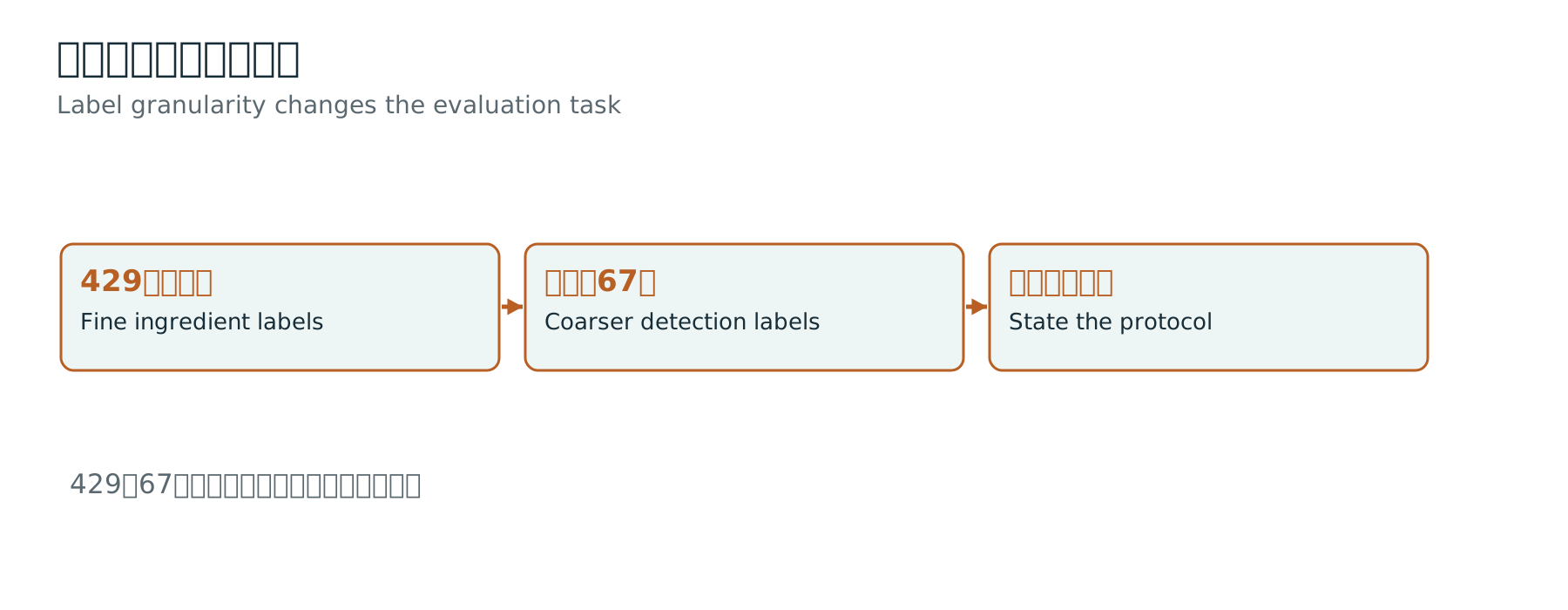
Original design
07.3
Detection and Cross Modal Retrieval Are Different Tasks
Ingredient detection concerns categories and locations within images. Cross modal retrieval concerns the ranking of matches between images and ingredient combinations. The article compares detection baselines and discusses a two stage retrieval approach using region features and adaptive pooling. Detection average precision, retrieval recall, and ranking measures must be distinguished. Better boxes can help retrieval, but the relationship is not one to one. This report does not extrapolate comparisons between particular configurations into a permanent ranking of all visual models.[R03]
In an image containing mixed ingredients, a detector may identify large meat regions but miss small additions, while a retriever still finds a suitable recipe from the overall combination. Conversely, well positioned boxes with confused categories can direct retrieval toward the wrong candidates. Improvement studies should vary localization, classification, and fusion separately before examining downstream changes. Final retrieval scores alone cannot identify which component improved. Query direction also matters: retrieving ingredients from an image and retrieving images from ingredients have different candidate sets and ambiguities. For combinations, relevance must specify whether all ingredients, some ingredients, or compatible hierarchy levels must match. Model performance becomes interpretable only after the task is defined clearly.
07.4
How Text and Images Enter the Dish Graph
The business workflow extracts ingredients, taste, texture, cuisine, and cooking methods from text, supplements ingredient and region information through image detection, and then fuses knowledge. Its connection to Microsoft GraphRAG lies in creating retrievable relationships, not in already implementing the same community summary mechanism. The Meituan case primarily demonstrates construction and product understanding, whereas the Microsoft case emphasizes discovery and synthesis using structure. Their combination is an application design proposed by this report.[R03][R01]
That combination needs an additional evidence layer. Text outputs should link to exact passages and visual outputs to regions. Fusion should occur only after product identity, version, and semantic conditions agree. If a review says that chilli was omitted last time while a photograph contains red objects, merging both into a permanent chilli attribute ignores temporal scope and visual ambiguity. Observation nodes should retain model candidates and review status before producing a query oriented attribute view. This supports complementary coverage without removing disagreement between modalities. Fusion should make evidence easier to judge rather than compress every input into an attribute table without provenance.
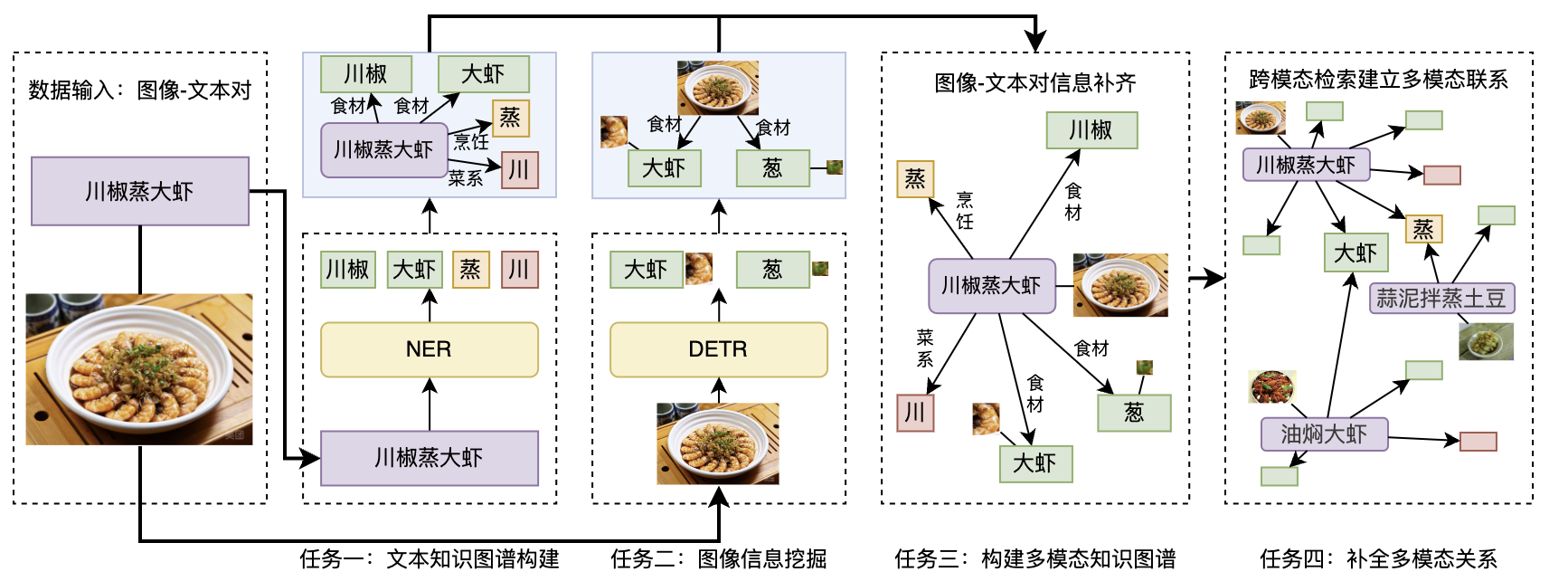
Original source labels retained
07.5
Interpreting Business Numbers Correctly
The article reports knowledge accuracy changing from 95% to 96.52%, coverage from 80% to 87.01%, and identical product recognition error from 20.38% to 2.3%. These correspond to increases of 1.52 and 7.01 percentage points and an error decrease of 18.08 percentage points, or approximately 88.71% relatively. They are reported project evaluations, not independently reproduced findings or CMIngre detection scores. Wolfram and local arithmetic were used to cross check the conversions.[R03]
Interpretation requires evaluation units, sample selection, review standards, and comparison conditions. Where inspected material does not establish these fully, confidence intervals should not be invented and transfer to new restaurants should not be promised at the same rate. Accuracy and coverage may also trade off. If newly covered attributes mainly concern easier products, an aggregate increase does not show improvement for every category. Business error changes can include system factors beyond the graph and cannot automatically establish the causal contribution of one visual model. New projects should borrow the discipline of a verifiable baseline, fixed evaluation set, and staged ablations rather than copy a percentage as a commitment. The case demonstrates feasibility; deployment benefits still need local evidence.
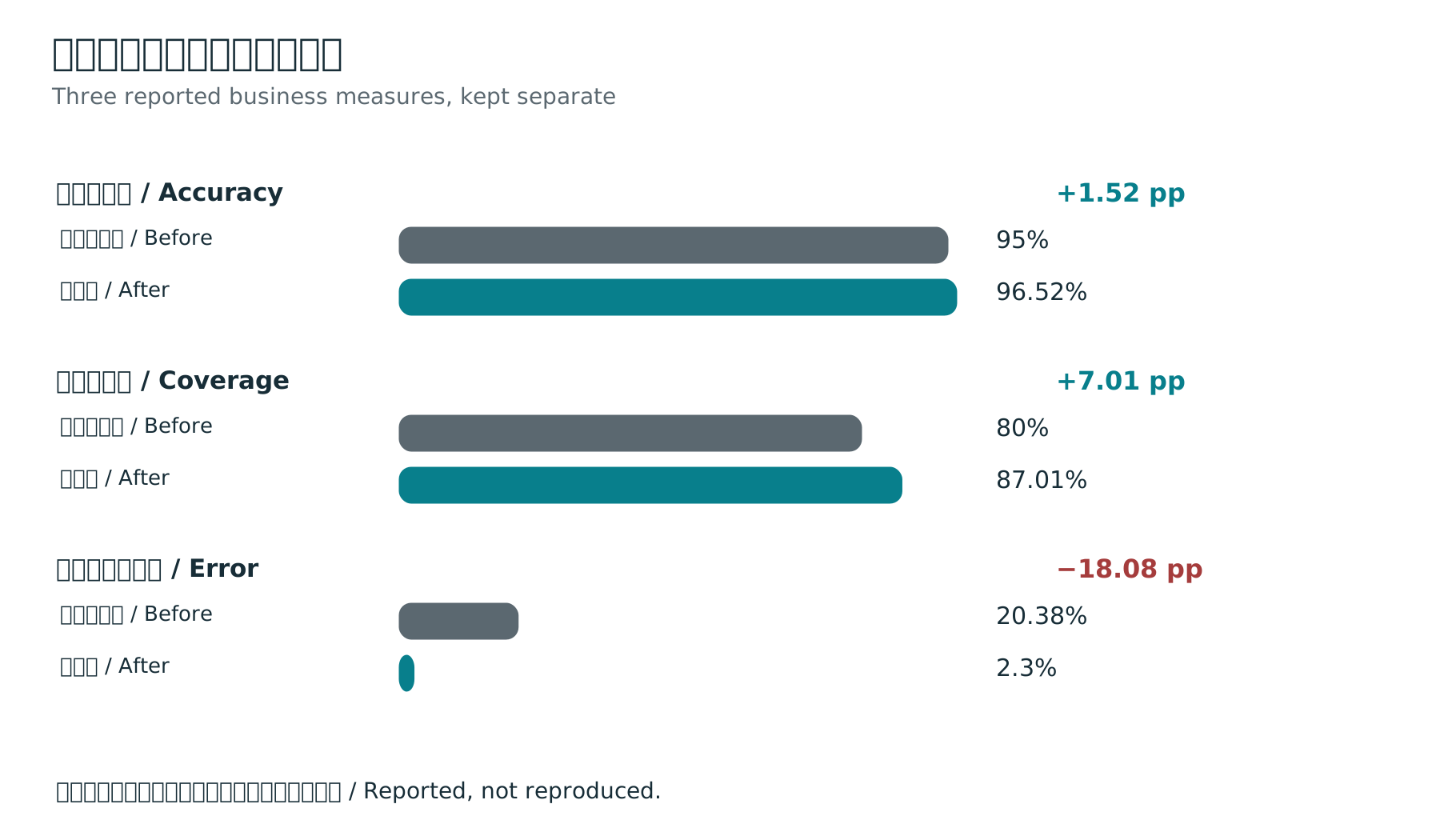
Arithmetic cross checked
07.6
Transferable Lessons and Assumptions That Need Retesting
Three design lessons can be drawn from the case: choose a business object granularity that answers real questions, use multiple sources to address gaps in a single source, and evaluate construction capabilities through actual tasks. Transfer still requires redefining data and tasks. Ingredient hierarchies can inspire component or cultural object classification, but the category system should not be copied directly. Local food detection can inspire industrial evidence modeling, while camera conditions, visibility, and error costs remain different. What transfers is a problem solving structure; specific assumptions must be tested again.
Visual ingredient recognition should especially not be presented as an allergen or nutritional safety guarantee. Invisible seasonings, processing, and cross contact are not fully represented in a photograph, and a dish name does not reliably establish absence. A system receiving such questions should return confirmed ingredient sources, applicable versions, and remaining unknowns, and identify who can verify the information. The later canteen blueprint addresses information organization and confirmation procedures rather than clinical or individual dietary decisions. This boundary enables the graph to perform appropriate work: reveal information gaps, locate evidence, reduce mistaken product matches, and clearly identify matters requiring human confirmation.
A Unified Evidence Architecture and Engineering Design
08.1
Preserve Original Resources and Versions at Ingestion
This chapter proposes an implementable reference architecture as an original design synthesis, not a claim of deployment in an enterprise. Ingestion accepts text, page images, tables, and business records and first creates a resource inventory rather than immediately extracting knowledge. Each resource needs a stable identifier, content checksum, origin, collection time, applicable time, permissions, and processing status. Changed content at one URL should create a new version. Repeated uploads of one file should be recognized while retaining upload events. These foundations determine whether evidence can later be located, errors repaired, and derived data removed.
Parsing should preserve mappings between original resources and normalized outputs. PDF pages, image coordinates, table cells, and video timestamps need different locators but a consistent evidence interface. Failures should record their type and affected scope instead of silently skipping content, and partial success should be allowed. OCR text is a derived observation; the scanned page remains the verification reference. Evolving business systems also require receipt time to be distinguished from effective time so late arriving records do not appear to describe newly occurring events. Ingestion quality limits the system: later models cannot recover pages, units, or version conditions already discarded at the entrance.
08.2
Maintain Observation and Entity Layers Separately
Extraction should produce typed observations instead of directly overwriting entity properties. An observation needs at least a subject candidate, relation or attribute, value, qualifiers, evidence locator, extraction method, and review status. The entity layer manages stable objects and identity resolution; the observation layer records what different sources state. Separation permits multiple supporting or conflicting observations without forcing one truth value at write time. Confirmed application attributes can be derived from reviewed observations while retaining their support sets.
Ontology and extractor versions need an explicit contract. If an ontology divides cooking method into preparation and heating method, old outputs cannot automatically be interpreted under the new structure. Preserve ontology versions, model versions, and mapping rules, then recompute affected data or provide explicit compatibility. Entity resolution should also avoid a single irreversible batch operation. Generate candidates, record merge decisions and evidence, and update query views afterward. A discovered error should permit reversal of one merge without losing original observations. This design adds storage and management work but provides repairability. Automatic graph construction without a repair route lets early errors propagate through later community reports and answers.
08.3
Coordinate Graph Vector and Resource Indexes
A unified architecture does not require every object to reside in one database. A resource store holds original files and images, a graph store represents entities, events, and evidence relations, a vector index supplies similar candidates, and a keyword index supports exact names and identifiers. Stable identifiers connect them. Graph databases serve relationship constraints and neighborhood access, while vector indexes serve approximate similarity. Deployment can start with a simple combination and introduce sharding or dedicated services when measured latency, scale, or operational requirements justify them.
Consistency across indexes is the central engineering issue. If a withdrawn resource loses its graph edges but its old vectors remain retrievable, invalid content can still appear in answers. Maintain index status by resource version with explicit states for pending, queryable, invalid, and rebuilding, and check evidence versions at query time. Updates can build a new index before switching a version pointer, avoiding partially built views. Deletion should first block retrieval, then clean derived stores asynchronously while recording completion. Unification primarily concerns identity, version, and evidence contracts, rather than one storage technology. This interpretation keeps architecture understandable and allows individual components to be replaced.
08.4
Query Planning Produces an Inspectable Evidence Package
The query service identifies objects, time, scope, and answer type before choosing retrieval actions. Exact identifiers may use direct lookup, relational questions constrained neighborhoods, thematic questions community reports, and visual questions regions or pages. Routing should record triggering conditions and fallback behavior when uncertain. A request with several subquestions can use an explicit plan stating which evidence each part requires instead of asking a model to guess the entire answer at once.
The evidence package supplied to generation should contain source passages, locators, relation paths, temporal conditions, permission checks, and conflict notices. Original material and summaries need different labels, as do facts and inferences. Claim level verification after generation checks whether each sentence has sufficient support and whether its citation points to relevant content. If evidence supports only part of a request, answer that part and explain the gap. The package can be an independent interface for different language models or for human reviewers. The durable asset becomes a reviewable, comparable, and regenerable evidence collection rather than one fluent answer. Model upgrades can then be assessed for changes in expression separately from changes in retrieval.
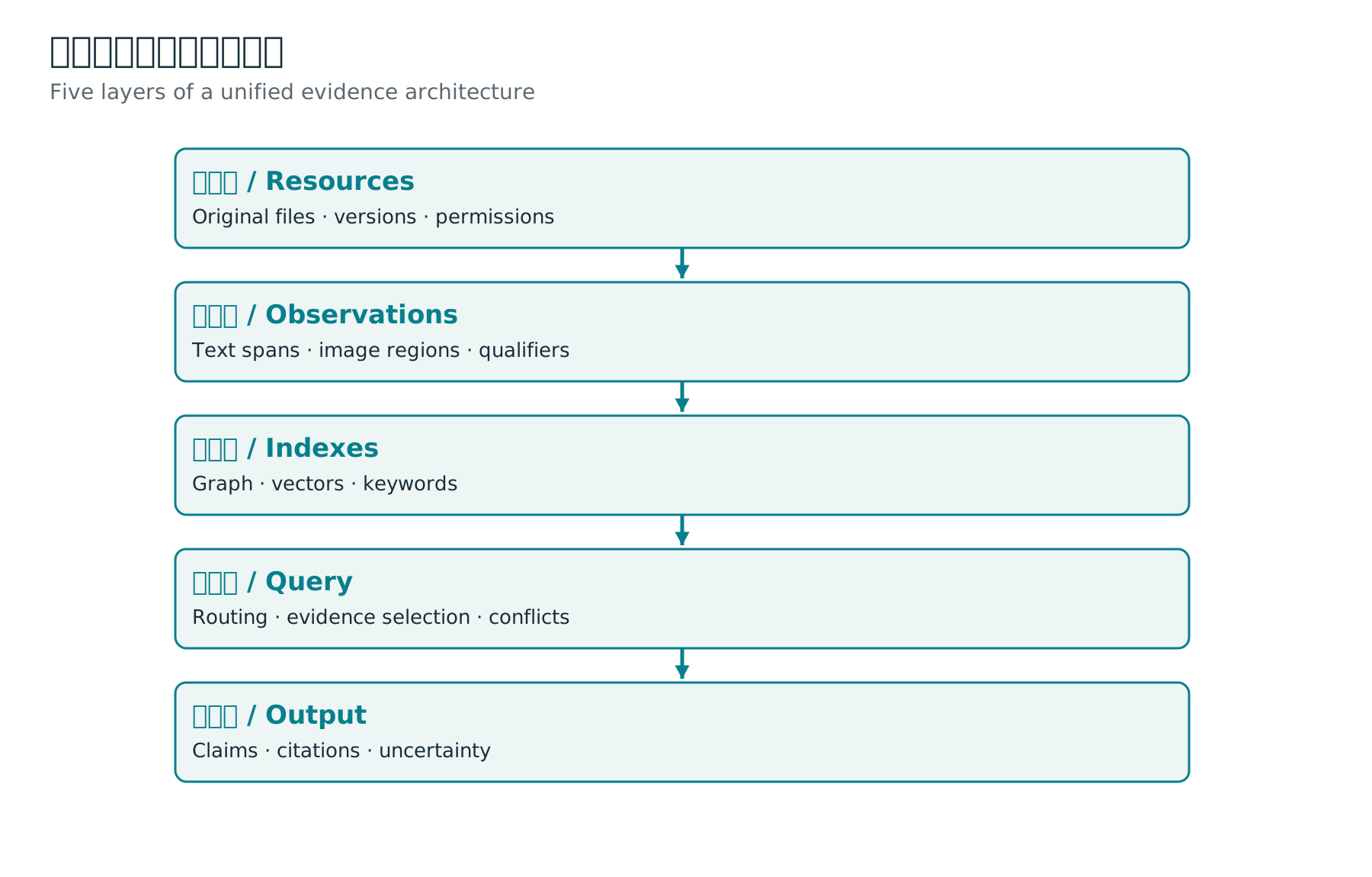
Original design
08.5
Incremental Updates Summary Invalidation and Rollback
Updating a document can affect more than one chunk. It may change entity identity, relation weights, community membership, multiple summaries, and cached answers. Derived dependencies should therefore form a graph of their own: which observations generated a summary, which resources generated an observation, and which summaries a cached answer used. Changes can then invalidate dependent objects rather than triggering either an indiscriminate rebuild or an insufficient file only update. Community recomputation may affect a broad region, so local index updates should be distinguished from structural repartitioning.
Rollback should be an ordinary capability. If a model upgrade doubles extracted statements, recall may have improved, or negations and hypotheses may have become facts. Compare changes on fixed samples, inspect high impact differences, and switch gradually. Preserve configuration, versions, input manifests, and quality summaries for each release so the previous usable state can be restored. Historical answers may retain evidence snapshots explaining their original output, while clearly indicating whether that evidence remains current. Correctness in an evolving system is temporal. One offline evaluation cannot prove it permanently. Operations must manage the entry of new knowledge, invalidation of old knowledge, and reversal of errors.
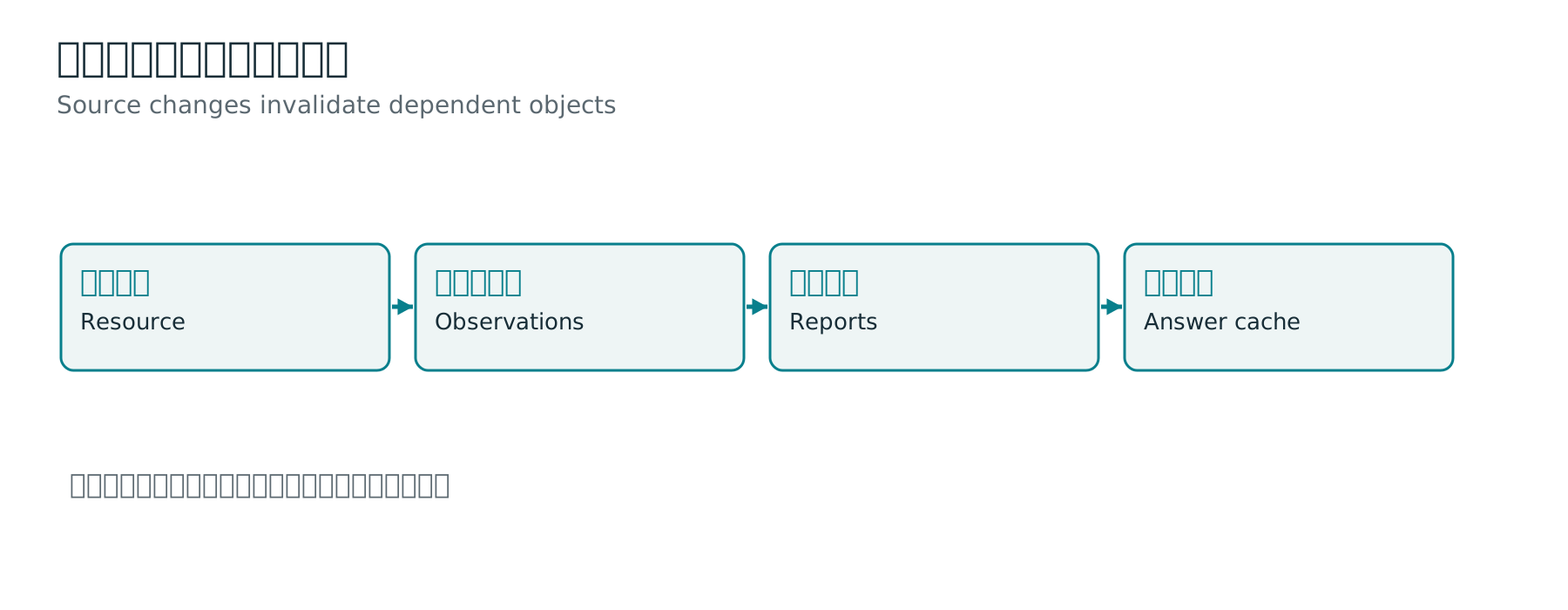
Original design
08.6
Minimum Delivery Contracts from Prototype to Service
A demonstration may only upload documents and return answers. A usable service must define failure behavior. Unsupported formats, insufficient permissions, absent evidence, conflicting evidence, and temporary model unavailability should produce distinct states instead of one blank response or an invented answer. Interfaces should include a request identifier, knowledge version, citation list, and observable processing stages. Users can then decide whether to retry, add material, or seek human verification. Internal logs may be detailed, while user explanations should focus on the task rather than implementation terms that do not help decisions.
Acceptance testing should cover an ordinary query, an unanswerable query, a version conflict, permission isolation, and resource deletion. Each case examines what the user ultimately sees rather than only whether one module succeeds. Operational measures include error types, evidence coverage, latency, and cost, with attention to slow requests hidden by averages. Service contracts also define who owns source data, reviews entity merges, and handles corrections. Architecture becomes sustainable only when connected to these responsibilities. The reference diagram therefore includes both data flow and feedback: the system transforms documents into answers and returns discovered problems to source and knowledge maintenance processes.
Layered Evaluation Experimental Design and Uncertainty
09.1
Define Tasks and Data Splits First
Evaluation begins with who needs help and what work they need to complete. Factual lookup, relationships across documents, thematic synthesis, and visual localization require different success criteria. One generic question answering score is insufficient. Each question should specify intent, acceptable answers, necessary evidence, forbidden inferences, and conditions for no answer. Annotators need these rules and should record reasons for disagreements. Open synthesis can be evaluated through required themes and preserved disagreements without assuming one uniquely correct paragraph. Evaluation surveys and RAGAs offer useful approaches, while local tasks still require adapted rubrics.[R25][R26]
Splits should prevent leakage inconsistent with deployment. New restaurant use can require restaurant based splits, future use temporal splits, and new entity generalization entity separated near duplicates. Training, prompt development, and final testing should be distinct. Questions generated from community summaries and evaluated using those same summaries may overreward their wording. Independently authored and real user questions should be included, with question origin retained as an analysis variable. The evaluation set defines the range of use supported by a conclusion. Transfer beyond that range requires further testing.
09.2
Match Retrieval Metrics to Relevance Definitions
Precision measures relevant items among returned results, while recall measures recovered items among all relevant evidence. Both require a defined relevance set. With incomplete annotation, an unjudged result should not automatically count as irrelevant. Graded relevance can use nDCG to assess whether more important evidence appears earlier. Its gain function, discount, and cutoff must be stated. The demonstration here uses exponential gain, two raised to the relevance grade minus one, and a base two logarithmic discount on rank plus one. The ideal ranking uses all judged candidates, not only a reordering of retrieved results. Scores with different definitions should not be combined in one comparison table.
Graph retrieval also requires path completeness. Finding both endpoints without connecting evidence does not solve a multihop question. Finding a path while omitting a critical negation does not provide complete support. Questions can have a minimum evidence set or several interchangeable sets, with success requiring coverage of at least one. Global themes additionally require source and viewpoint coverage so repeated high frequency passages do not occupy every top position. Duplicate rate, source diversity, and irrelevant expansion should accompany ranking measures. Metrics aligned with evidence needs explain why apparently extensive retrieval can still produce poor answers. Ranking is an intermediate objective; evidence must ultimately support the task.
09.3
Assess Answer Quality and Citation Quality Separately
An answer can be correct while citing the wrong material, or faithfully repeat a source that is itself mistaken. Evaluation should distinguish factual correctness, faithfulness to supplied evidence, question coverage, and citation support. Break answers into verifiable claims and classify each as directly supported, partially supported, contradicted, or unsupported. Citation precision asks whether cited material supports the associated claim. Citation coverage asks whether claims requiring evidence receive support. A working link alone does not establish support. Answers generated through summaries should remain traceable to original material rather than ending at another model summary.
Uncertainty handling also needs assessment. Admitting missing evidence may be better than giving a complete unsupported response. Conflicting sources may require separate statements with temporal scope rather than forced synthesis. Count justified abstention and excessive abstention separately so refusing everything does not earn a misleading quality score. Bilingual reports and cross language answers should compare numbers, negations, quantifiers, and conditions because fluent translation can change factual boundaries. An effective review sample includes answerable, partially answerable, conflicting, and unanswerable questions. These conditions reveal whether a system recognizes when inference should stop.
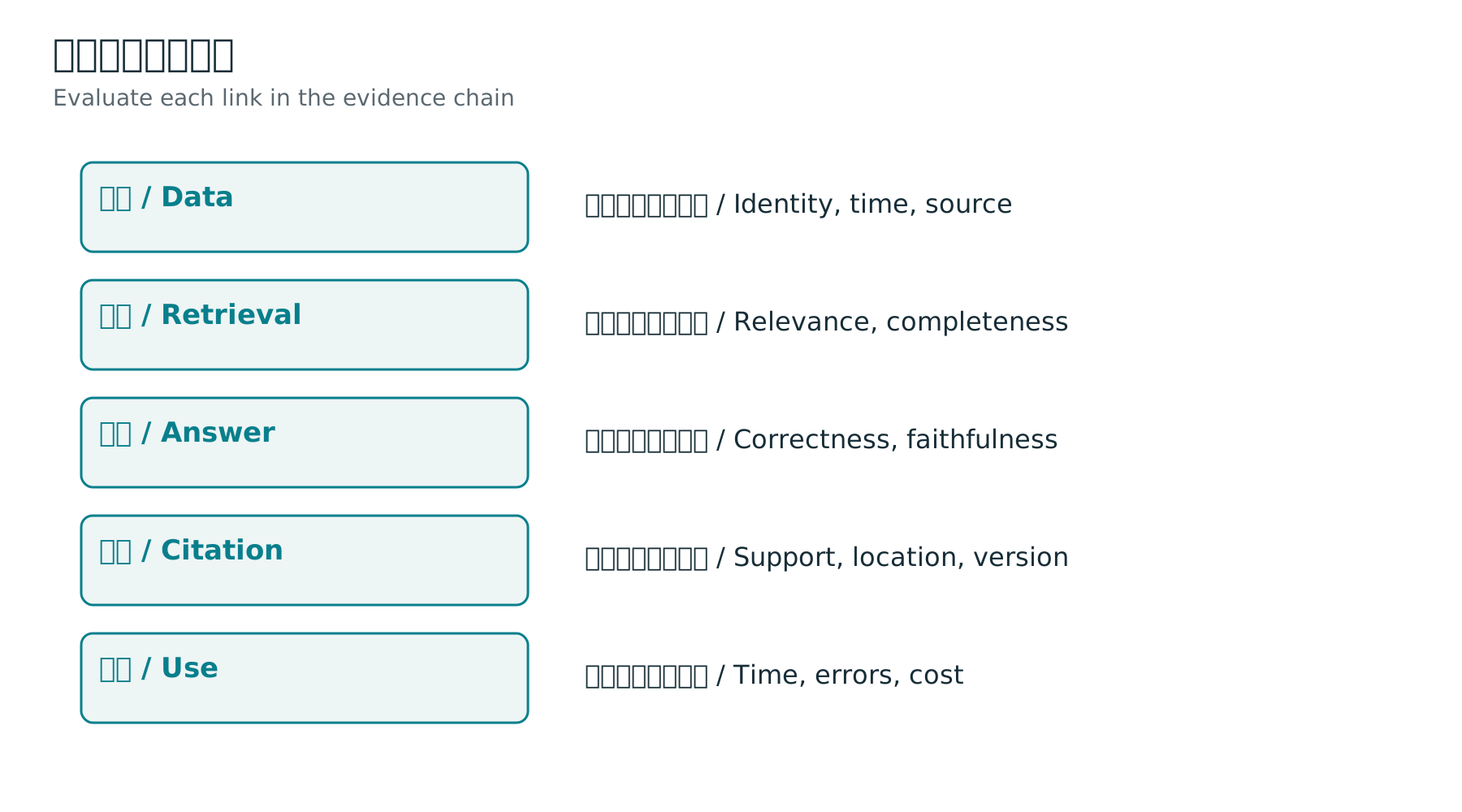
Original design
09.4
Demonstrate Multimodal Contribution through Controls
Multimodal evaluation must establish that questions actually require multiple modalities. Some nominally visual questions can be guessed from titles or text alone. High scores then do not prove image understanding. MultiModalQA and WebQA offer research examples of complex multimodal questions, while Visual-RAG examines visually knowledge intensive queries. Using these benchmarks still requires checking versions, tasks, and evidence annotations; a dataset name does not guarantee visual necessity.[R30][R31][R21]
Useful conditions include text alone, image alone, complete fusion, and incorrect pairings, with comparable generators and budgets. If fusion improves on individual modalities and incorrect pairings damage the relevant questions, there is stronger evidence of cross modal use. Masking answer regions, removing headers, and substituting similar images can test whether answers change appropriately. Graph controls can compare no graph, random edges, real edges, and entity names alone. Every ablation should distinguish executed components from planned ones. This report supplies experimental templates rather than scores for model ablations that were not run. Explicit hypotheses without results are more useful than invented performance bars.
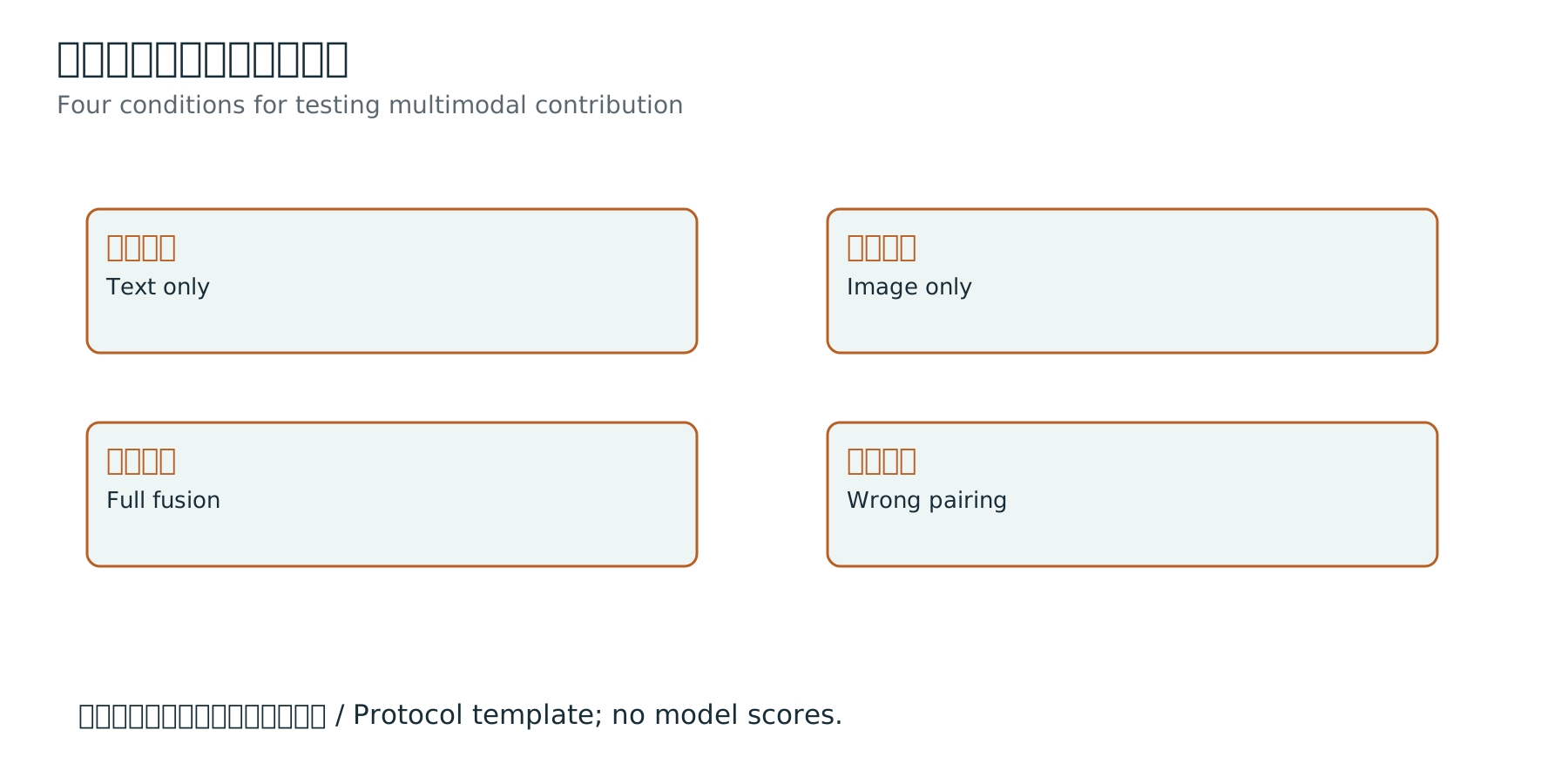
Original design
09.5
Calibrate Automated Judges and Retain Human Review
Language model judges can reduce large scale review effort, but they are measurement instruments requiring validation. A judge may prefer longer, more fluent answers or wording resembling its own, and may be persuaded by citations that only look convincing. Human judgments on a sample should first establish a reference, followed by agreement analysis across error types rather than only overall correlation. Low agreement categories may need revised rubrics, better evidence locations, or continued human assessment. RAGAs supports automated feedback, but an automated score alone cannot prove final correctness.[R25]
Judge instructions should permit uncertainty, require supporting locations, and conceal system names or author identities. Pairwise comparisons can randomize answer order and test order effects. Human annotation is not absolute truth either. Independent judgments, disagreement discussions, and rule revision are especially important for importance judgments in open summaries. High impact errors should retain cases rather than only scores so teams can inspect how failures occur. Results can report automated measures, human sampling rates, and major disagreement types together. Readers can then assess measurement reliability and understand why one score change may not justify deployment or replacement.
09.6
Report Distributions and Differences beyond Averages
Results should be grouped by question type, source, entity frequency, and evidence length. Average gains can arise from easy questions while hiding regressions on important categories. Systems evaluated on the same questions should use paired differences and report sample size and uncertainty. Resampling intervals require an explicit sampling unit. Treating every question as independent when several share a document can underestimate uncertainty. Reporting only the best of many attempts also exaggerates stability. Model randomness, indexing randomness, and annotation differences should be considered separately.
Statistical significance and practical value are different judgments. A small stable score gain may not justify additional construction cost, while an uncertain average change may matter for a small set of valuable relational tasks. A decision table should combine effect size, cost, error severity, and maintenance burden. Insufficient data should lead to an explicit uncertainty statement and a more discriminating next experiment rather than elaborate statistics over weak samples. The demonstration ranking in this report explains calculation only and does not estimate system effectiveness. Business percentages also receive no invented intervals without original samples. Reporting these boundaries enables further verification.
Cost Performance and Continuous Operation
10.1
Separate Construction Query and Maintenance Costs
The cost of a graph augmented system extends beyond model calls for one answer. Construction includes parsing, extraction, entity resolution, graph processing, and summaries. Querying includes routing, retrieval, reranking, generation, and verification. Maintenance includes updates, corrections, permission changes, and human review. Record all three over a defined period, distinguishing one time expenditure from costs growing with documents or requests. This makes it possible to judge whether an expensive index can be reasonably amortized across many queries.
A simple period cost equals construction, updates, query count multiplied by average query cost, and operations. Every quantity needs units and measurement boundaries. Model usage, compute time, storage, and human hours cannot be added without conversion. Monetary estimates require dated prices and their sources. This report instead uses explicitly assumed cost units for demonstrations, avoiding unstable external quotations. Query cost also varies by task. Thematic synthesis may require many reports while precise lookup may require one passage. Cost analysis should follow the task distribution rather than treating a complex query as representative of all requests.
10.2
Allocate Latency Budgets across the Query Path
Users experience end to end waiting time rather than one retriever's isolated duration. Permission checks, network transfer, graph expansion, image loading, and generation can all become bottlenecks. Measure stage distributions before selecting optimization targets. If generation dominates, improving a millisecond graph query may not change the experience. If rare large traversals create a long tail, average latency hides the issue. Record medians and higher percentiles by task type, and define whether timeouts produce partial results or explicit failure.
Budgets can be assigned before execution or adjusted as evidence appears. An exact identifier yielding one current authoritative record may not require further network expansion. A relational question missing one crucial connection may justify more directed retrieval. Stopping rules should reflect evidence sufficiency rather than only a fixed number of steps. Candidate limits, allowed relation types, and temporal scope prevent unbounded expansion. When a budget is exhausted, explain the evidence coverage achieved instead of treating unsearched regions as absent. Performance optimization therefore selects answer scope and reliability together, rather than merely accelerating text production.
10.3
Bind Caches to Knowledge and Permission Versions
Caching reduces repeated work but can also repeatedly distribute outdated or unauthorized information. Identical query text does not guarantee answer reuse because permissions, knowledge versions, and temporal conditions may differ. Cache keys should include normalized questions, resource scope, knowledge version, model configuration, and permission scope. Cached objects should retain evidence dependencies for invalidation when sources change. Global summaries require special care if they combine access levels. Filtering original passages at the final answer stage cannot remove information already exposed inside a summary.
Different layers can cache parsing by content, embeddings by model and content version, retrieval candidates by scope, and answers under stricter conditions. Their invalidation rules should not collapse into one expiration period. Tightened permissions may leave parsing reusable while requiring answer revalidation. A model upgrade may require new embeddings without duplicating original resources. Tests should cover these combinations. High hit rates do not automatically indicate a better system: cached stale or incomplete answers can produce errors consistently. Cache correctness, cost savings, and invalidation delay should accompany hit rate as measures.
10.4
Preserve Critical Exceptions during Compression and Pruning
Reducing context and storage can involve compressing chunks, merging repeated observations, pruning edges, or selecting coarser communities. Frequency and length are poor substitutes for importance. A short exception can reverse a rule, and a rare relation may be the only evidence for an incident. Compression should identify negation, quantities, units, time, and exceptions, then verify their preservation. Material that cannot be safely summarized can retain original wording while less important background receives lower priority. Compression quality requires both task outcomes and constraint preservation.
Graph pruning also needs evidence roles. Peripheral nodes absent from a shortest path may contain counterexamples or identity distinctions. Removing them can make a graph visually cleaner but answers more one sided. A compact navigation graph can support fast discovery while a linked evidence graph retains verification material. Stable identifiers connect them without placing every object in model context. Repeated sources can be combined in presentation while preserving counts and independence assessments, so republication does not masquerade as independent support. Useful compression removes redundancy while retaining differences capable of changing a conclusion, rather than merely minimizing nodes or prompt length.
10.5
Observe Quality Drift and Operational Feedback
Data and user questions change after deployment. New terminology, cameras, and document formats can degrade extraction or retrieval while model services continue returning successful responses. Periodic sampling and fixed sentinel questions can monitor unresolved entities, unsupported answers, invalid citations, and missing modalities. Changes need interpretation alongside input distributions rather than automatic attribution to models. More complex user questions can lower average success because the task changed. Monitoring should distinguish data drift, task drift, and system failures.
Feedback should let users identify a problematic claim or source rather than only rate an entire answer. Corrections enter a maintenance queue classified by source errors, extraction errors, identity merges, retrieval omissions, or generation overreach. Repeated failures can become regression cases, while user feedback should not automatically become a correct label. Disputed feedback needs both the original comment and review outcome. Teams should measure correction time and recurrence, since detecting problems without repairing them does not make a system reliable. The improvement loop connects visible errors to editable components and confirms repairs through independent checks.
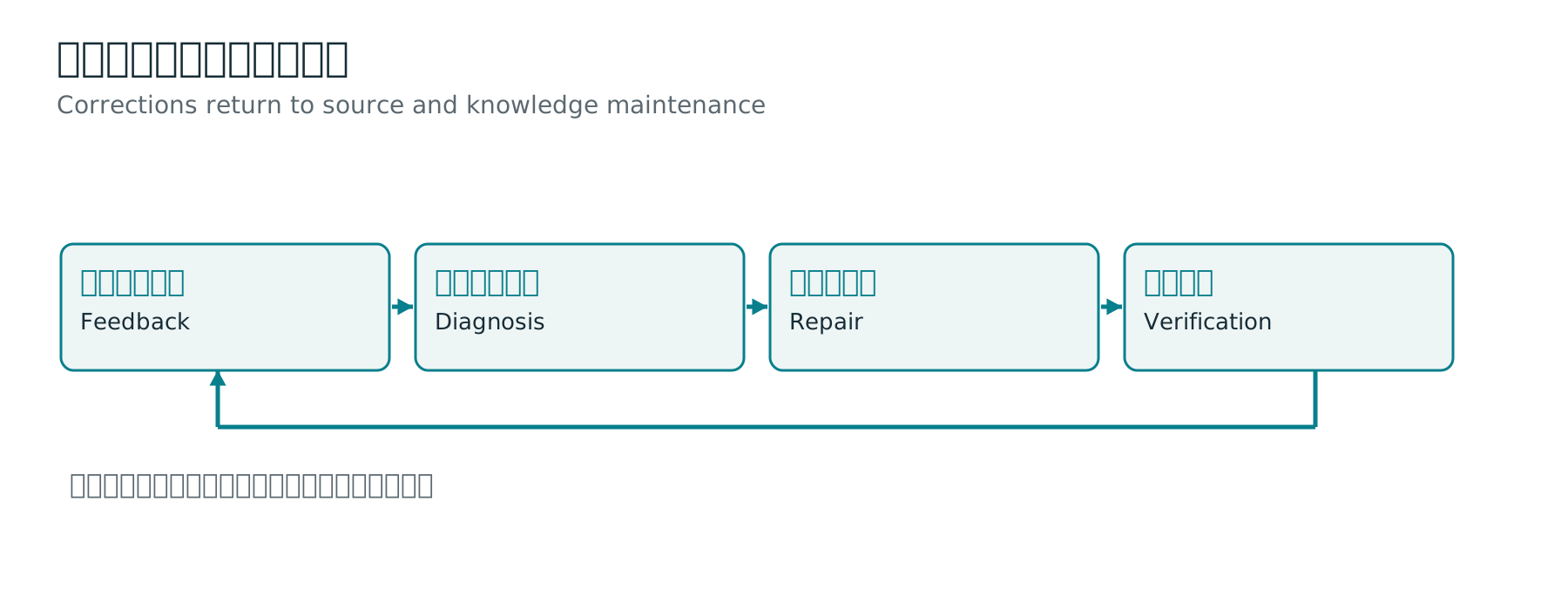
Original design
10.6
Match Adoption Thresholds to Value and Maintenance Capacity
GraphRAG adoption need not begin with every document and feature. Choose a bounded scenario with recurring questions and available evidence, then test whether graph structure reduces important errors or improves search efficiency. Define success beforehand through necessary evidence coverage, review time, and error severity. Selecting only questions a demonstration handles well cannot establish real value. Pilots should include updating and correction because static demonstrations conceal maintenance burdens. A small graph that can be repaired continuously is closer to a usable service than a huge unmanageable graph generated once.
Adoption can proceed through evidence that data can be organized, retrieval gains are real, user tasks benefit, and operations are affordable. Each stage permits stopping or simplifying. If hybrid vector retrieval meets the goal, graphs may remain only for explanations or selected relational queries. Visual processing can be invoked only where necessary. Team capabilities in ontology maintenance, data review, and incident handling are part of cost. Pilots should define exit routes for exporting evidence, changing models, and restoring earlier workflows. Replaceability allows decisions to follow new evidence rather than becoming locked into early architectural commitments.
Permissions Governance Security and Responsibility
11.1
Separate Source Authority from Knowledge Status
Knowledge in a graph should have more states than present or absent. Original records, model observations, reviewed confirmations, disputed claims, and withdrawn claims can retain reasons for state changes. Source authority is also question dependent. A manufacturer manual may support specifications, maintenance records actual replacements, and reviews user experiences. Ask which claims a source is qualified to support and whether it covers the current object and period. Reputation does not replace claim level verification, and several poor republications do not establish independent confirmation.
Provenance design can draw on W3C PROV relations among entities, activities, and responsible agents to describe how data was processed and who produced it. This does not require implementing the entire standard at once. A minimal system can first record resources, processing steps, and responsibility, then extend detail.[R28] The essential property is an explainable history rather than only a final attribute. Conflicts should expose sources and scope and, when necessary, request human judgment. Governance should allow uncertain information to remain useful while ensuring its status affects retrieval, generation, and interpretation explicitly.
11.2
Propagate Permissions through Derived Information
A graph can connect scattered records into information more sensitive than any individual document. Unremarkable edges may jointly reveal relationships, plans, or undisclosed projects. Permission checks should therefore cover nodes, observations, paths, summaries, and answers, not only file downloads. A sound starting rule is that retrieval sees only evidence the current user may use, while the visibility of derived objects depends on their source dependencies. Actual policy requires organizational decisions rather than one public flag.
Community reports are easy to overlook. A summary containing restricted sources can leak their substance even if original citations are hidden. Possible strategies include generating summaries within permission partitions or synthesizing filtered evidence at query time, each with different costs. Tests should use paired users asking the same question under different permissions. Both should receive only allowed evidence without revealing the substance of hidden records. Permission changes also require cache and historical link checks. Governance should examine direct leakage and risks arising from combined relations, with domain staff deciding which associations require restricted display.
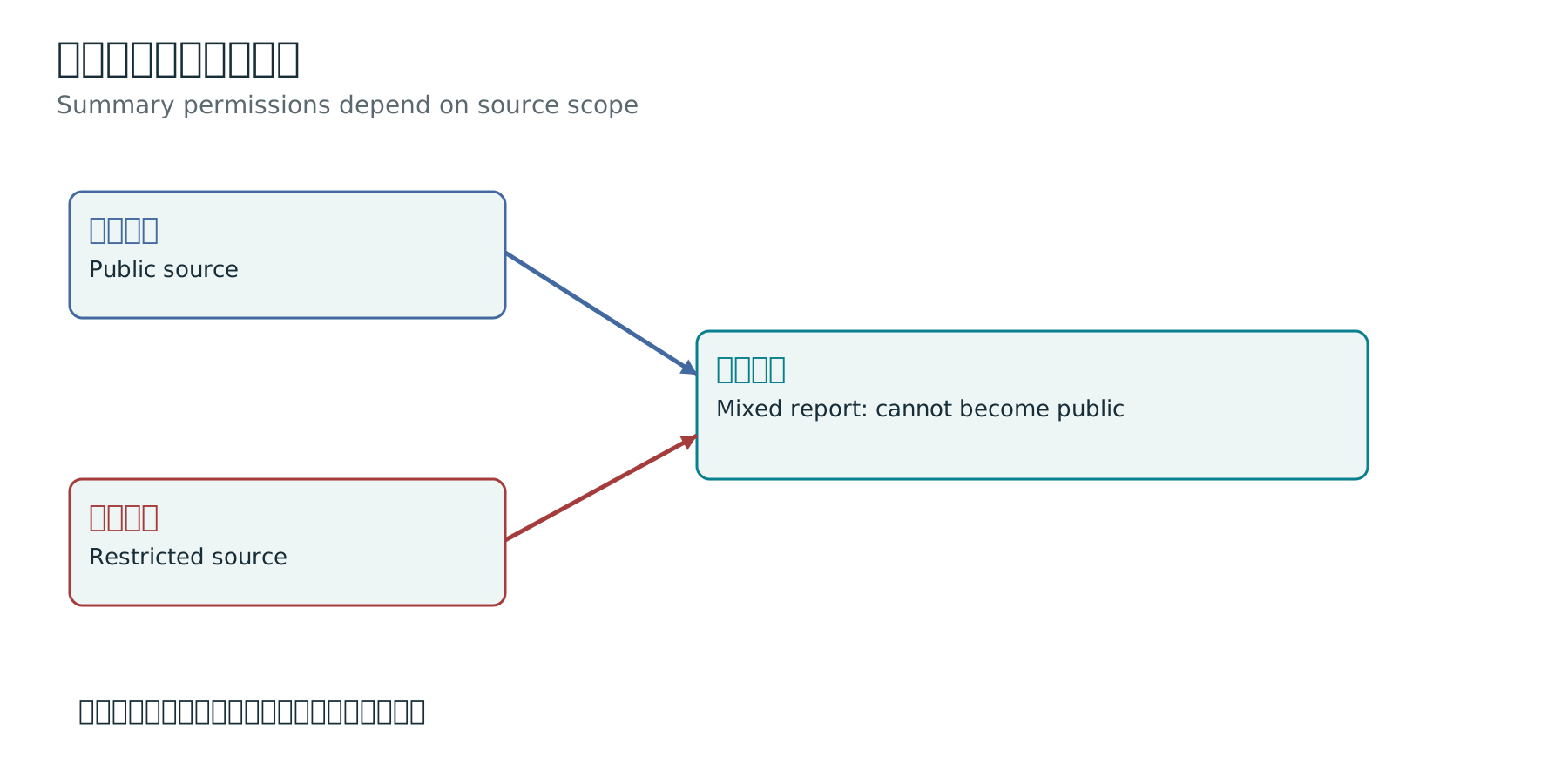
Original design
11.3
Retrieved Content Is Data rather than Execution Authority
Documents, webpages, and images may contain commands to ignore rules, reveal other information, or perform external actions. Retrieval does not grant those commands authority; they remain material to analyze. Multimodal systems can encounter similar instructions inside images or unusual layouts. Architecture should distinguish user requests, application rules, and external material, and treat quoted content as evidence. Extractors should also distinguish description, quotation, and instruction instead of creating a relation merely because a source tells the system to add one.
Protection must extend to tool boundaries. Retrieved documents cannot authorize email, database changes, or downloaded execution. User tasks and application permissions determine such actions. Generation and execution can be separated through inspectable plans and constrained interfaces for authorized operations. Tests should include explicit inducements, paragraphs pretending to be system messages, and instructions embedded in images, then check continued adherence to the original task. Logging suspicious locations helps investigation, but sensitive material should not spread into uncontrolled logs. The same principle governs research writing: sources may be summarized and criticized, but they do not replace the user's research scope or delivery requirements.
11.4
Deletion Correction and a Traceable Lifecycle
Deleting from a graph system means more than removing a filename. A resource may have produced chunks, vectors, entity observations, relations, community reports, and answer caches. Without dependencies, remaining copies are hard to identify. Resource and observation identifiers should support a derived object inventory. Deletion first revokes queryability, then cleans dependencies and records completion. Where auditing requires retention, organizations should define the minimum metadata allowed rather than letting teams copy all content into an audit backup. This is an engineering process, not a substitute for jurisdictional or institutional policy decisions.
Correction differs from deletion. A corrected observation may retain an earlier version to explain historical answers while current queries use the effective version. A withdrawn resource should no longer support new answers through its summaries. Interfaces can show correction dates and affected scope so readers understand invalid citations. Tests should repeat queries before and after deletion and inspect original content, graph paths, vector retrieval, and cached answers. External copies require an explicit statement of control boundaries. Reliable lifecycle management demonstrates how information enters and leaves, rather than merely advertising a delete feature.
11.5
Focus Human Review on High Impact Decisions
Reviewing all knowledge manually is often unaffordable, while complete automation accumulates errors. Review effort can follow impact: observations supporting many answers, entity merges connecting business objects, conflicting updates, and action determining attributes deserve priority. Impact depends on consequences and usage, not only graph centrality. A low degree safety related statement may merit more attention than a popular topic label. Review queues should explain selection reasons and the evidence requiring inspection.
Review interfaces should show original text, image regions, candidates, and change history together, with actions to confirm, reject, split entities, or request more material. Model confidence alone is insufficient because scores may be uncalibrated or incomparable across models. Human decisions should create separate audit records. Repeated error types can motivate rule or process changes instead of indefinitely increasing manual work. Review quality itself needs sampling to detect mechanical acceptance of automated suggestions. Effective collaboration gives people adequate information and real correction power at decisions where they can change outcomes, rather than asking them to stamp every output.
11.6
Make Incident Response and Responsibility Operational
When a system produces an incorrect or unauthorized answer, first limit the impact and then investigate. Affected indexes or routes may be paused while necessary request and version records are preserved and responsible staff are informed. Investigation follows the evidence chain: incorrect sources, distorted extraction, mistaken merges, missed permissions, or generation beyond support. Different causes need different repairs; calling every incident hallucination prevents diagnosis. Before restoration, the original failure and nearby variants should confirm the fix.
Responsibilities should be defined before deployment. Data owners govern sources and scope, knowledge maintainers ontologies and merges, service teams retrieval, permissions, and availability, and business owners decide which outputs may influence action. Corrections and appeals need clear entry points. Incident records can cover impact, cause, repair, verification, and prevention while restricting sensitive detail. Maturity concerns detection speed, repair speed, and recurrence control rather than claims of never failing. Traceability makes a practical contribution by decomposing a wrong answer into accountable and editable stages and helping organizations improve through evidence.
Enterprise and Scientific Application Blueprints
12.1
Event Evidence Chains for Equipment Maintenance
The following scenarios are proposed blueprints rather than completed deployments. Maintenance can connect equipment, components, incidents, work orders, and manuals. Images document site conditions and text records operations and replacements. A question about repeated alarms first requires device identity and temporal scope, followed by related alarms, work orders, and component changes. The graph connects scattered evidence but cannot infer causation from sequence alone. Answers should distinguish recorded causes, engineer hypotheses, and unresolved associations.
Event modeling is central. An alarm is not a permanent property, and one error code can have different causes. Images need capture time and equipment identifiers to avoid confusing similar machines. Historical tasks can test complete record recovery and preservation of unresolved status, with engineers judging search time savings. Errors include merging devices, missing post repair versions, and treating temporary conditions as persistent faults. The system supports retrieval and preparation of inspection material; maintenance actions follow established professional procedures. Benefits should be measured through task time, omitted evidence, and error severity rather than expert sounding prose alone.
12.2
Product Support and Versioned Knowledge
Product support often has abundant material applying to different models, regions, and software versions. A graph can represent families, models, components, features, release dates, and applicability rules, with pages and screenshots as evidence. A feature question should establish the version before locating manuals and changes. Missing confirmation should produce uncertainty rather than inference from neighboring models or old screenshots. Visual material can identify interface locations and explain steps, but screenshots need version conditions too.
Paired questions about a feature changing across versions can test correct evidence assignment. Outdated documents, regional restrictions, and configuration exceptions test whether qualifiers reach the answer. Support staff should be able to inspect cited pages quickly. Graph structure helps locate compatibility, but compatibility is not automatically transitive. A product supporting a component and that component being related to another product do not establish mutual support. Rules need explicit types and scope. The main potential benefits are fewer inappropriate matches and less repeated searching, to be validated through actual support tasks rather than generic language quality.
12.3
Claims Methods and Evidence in Scientific Literature
Scientific literature can connect papers, datasets, methods, tasks, and experimental results. Comparing methods under different data conditions requires more than similar abstracts. A graph can link results to splits, metrics, models, and paper versions, helping researchers identify comparable evidence. Figure pages provide numerical context, text supplies qualifiers, and supplements may contain implementation details. Author reported results, independent reproductions, and a researcher's inferences should remain distinct rather than becoming equally confirmed edges.
Version and publication status are especially important. Preprint updates may revise experiments, while conference and extended journal papers can belong to one research series. Counting them independently exaggerates evidence. Citation centrality is not correctness: frequent citation may reflect foundational status, controversy, or history. Evaluation can ask a conditional comparison and require explicit comparable and incomparable aspects. Human review should inspect experimental units, metric directions, and missing results. Discovery tools improve access to material, while research judgment still requires critical reading of originals. This report follows that division when using Consensus and SciSpace for literature discovery.
12.4
Theme Discovery and Minority Views in Organizational Knowledge
Meeting notes, retrospectives, and internal reports often contain themes spanning documents. A question about recurring collaboration barriers requires multiple projects rather than one similarly worded note. Community reports can provide entry points, but synthesis should trace to sources and distinguish repetition, occasional mention, and insufficient evidence. Teams may interpret one event differently, and tidy themes should not erase disagreements.
Evaluation can ask knowledgeable reviewers to establish themes independently, then assess important discoveries, minority omissions, and overgeneralization from isolated incidents. Unequal document volume needs control: more talkative teams are not necessarily more representative, and repeated weekly reports do not create independent events. Theme summaries can report independent projects and temporal scope instead of only mentions. Permissions are critical because cross document combinations may reveal personal relationships. Management questions should also avoid unsupported attribution to individuals. The value lies in organizing clues and generating verifiable questions rather than replacing organizational investigation with automatic summaries.
12.5
Matching Boundaries in Supply and Product Relations
Supply and product records contain identical names with different specifications and different names for the same object. Multimodal graphs can combine packaging, specifications, identifiers, and supply records to propose matches, followed by explicit confirmation rules. Same product, same category, substitute, and accessory are different relations with different business consequences. Visual similarity helps discover candidates but cannot alone authorize stock merging or supply substitution. Versions, package quantities, and measurement units belong in identity decisions.
Hard negatives include one brand with different capacities, similar looking models, and redesigned packaging for the same product. Error costs are asymmetric: false merges can contaminate inventory and analysis, while missed matches create manual work. Thresholds should follow those costs rather than maximum aggregate accuracy alone. Review interfaces can show decisive differences and source evidence and preserve unresolved status. Graph structure may flag anomalies such as one identifier linked to incompatible specifications, but anomalies remain inspection clues. Success concerns false and missed merges, review time, and later corrections, not the appearance of an attractive network.
12.6
A Shared Evaluation Framework with Domain Specific Conditions
These applications share an evidence workflow: establish objects and time, locate sources, connect relations, preserve qualifiers, and generate verifiable outputs. Their correctness criteria differ. Maintenance emphasizes events and professional procedures; support version compatibility; research experimental comparability; organizations representativeness; and products identity. One generic benchmark can miss decisive errors. A common platform may share resource management, evidence interfaces, and auditing, while domains need their own ontologies, rules, and test sets.
Implementation should close the loop for one frequent task before expanding. Cross departmental reuse requires checking terminology, permissions, source ownership, and review capacity, not just copying code. Success in one department does not establish equivalent data conditions elsewhere. A scenario decision card can record users, question distributions, required evidence, critical errors, update frequency, owners, and stopping conditions. Such cards turn concepts into manageable experiments and provide a common language across domains. Value comes from fewer omissions and better decisions in concrete tasks rather than the number of models or databases adopted.
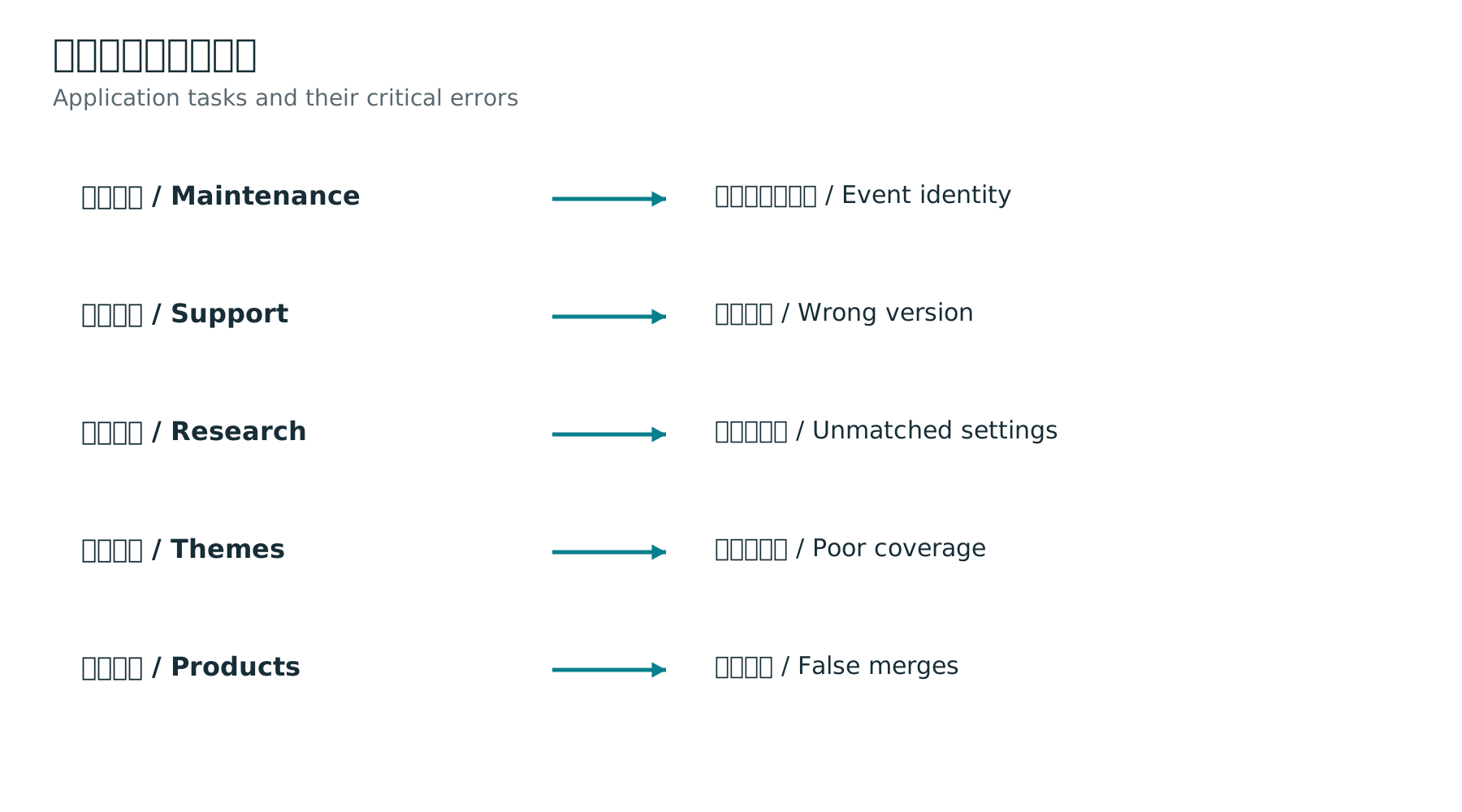
Original design
Education Culture and Visual Thinking Practice
13.1
Teach How Evidence Supports a Conclusion
Introductory AI teaching can begin with a small source collection and ask students to map sources to claims and conclusions before building a complex system. Each evidence card records one verifiable statement with origin, location, time, and status. Conclusion cards need sufficient support and explicit inference links. Visual thinking makes support relations visible rather than decorative. Students see that fluent answers may depend on several records and that an unsourced node does not automatically become a fact.
A lesson can progress from individual annotation to group agreement and class comparison. Individuals identify objects and conditions, groups negotiate identity, and the class examines why different graphs produce different answers. The goal is not one attractive layout but clear edge meanings, preserved negation, and locatable evidence. Paper cards or ordinary presentation software can precede graph databases and retrieval code. Assessment should emphasize evidence organization and error explanation rather than node count. A smaller graph with clear provenance and explicit unknowns can demonstrate more understanding than a large disordered automatic graph.
13.2
Use Controlled Activities to Understand RAG and GraphRAG
A controlled classroom activity can solve one question through three routes: prior knowledge alone, independent passage lookup, and relationship cards organizing the same evidence. The teacher supplies a factual, relational, global thematic, and unanswerable question, asking students to record discoveries, omissions, and citation locations. Abstract method differences become observable processes. The activity should not guarantee a GraphRAG victory; it should reveal that questions require different evidence structures.
Groups need equal material and time and should rotate methods. Discussion separates answer correctness, citation support, necessary evidence coverage, and overinference. Relationship cards may help a cross passage question, while drawing a graph for a simple fact may only add time. Every method should acknowledge an unanswerable question. Students can insert an erroneous edge and observe its effect, showing that structure can propagate errors as well as assist reasoning. Each group then writes a conditional conclusion, such as usefulness for relational questions in this source set, rather than claiming universal superiority. This trains the distinction between an observation and a general law.
13.3
Image Text Alignment Activities Train Visual Judgment
A multimodal activity can provide dish descriptions, images, and menu versions containing correct pairs, similar appearances, outdated photographs, and unresolved cases. Students propose candidates and list identity evidence. They distinguish observed features, inferred categories, and confirmed attributes. Seeing small red pieces is an observation; identifying them as chilli is a candidate judgment; asserting chilli in a specific product also requires identity and version evidence. Layered expression explains why visual models cannot perform all factual confirmation directly.
Three edge types can connect resources to observations, observations to candidate entities, and confirmations to attributes. Colour supports categories while written edge labels carry meaning, preserving readability for colour vision differences and monochrome printing. Students can crop images for another group and test whether lost context changes judgment. Removing a menu date or legend may undermine an apparently certain match. Assessment should reward justified rejection and requests for evidence rather than force one answer for every image. The goal of visual thinking is to expose evidence boundaries, not merely produce denser pictures.
13.4
Multiple Interpretations and Provenance in Cultural Collections
Cultural and historical sources contain alternate names, editions, legends, and scholarly disputes. A multimodal graph can connect works, people, places, image regions, and records while distinguishing historical claims, interpretations, and later traditions. An image interpreted as depicting a story does not confirm that the story's events occurred. Multiple interpretations can retain separate sources instead of assigning each object one standard answer. The graph helps compare evidence and interpretive paths rather than eliminate disagreement.
A course project can use a small public collection to connect editions and interpretations. Students identify image collections or publication versions, cropped regions, supporting texts, and uncertain dates or attributions. Bilingual terminology needs care because some cultural concepts lack exact equivalents; original terms with explanations may be preferable. Assessment can examine provenance, separation of interpretation, visual localization, and fair treatment of disputes. Public displays also require checking image conditions and attribution. The research design concerns evidence organization and does not automatically authorize copying or publishing every retrieved image. Graphs can represent cultural richness without reducing it to one category.
13.5
Practical Assignments and Verifiable Learning Assessment
An assignment can require a small evidence graph, answers to two question types, an error analysis, and a methodological reflection. The collection should be inspectable rather than graded by crawling volume. Graphs should contain a temporal condition, an uncertain observation, and a potential conflict; answers should link to source locations. Models may assist extraction if students record how candidates were reviewed. These requirements emphasize an explainable process and help teachers distinguish understanding from tool operation.
Rubrics can assess object and relation definitions, traceability, answer boundaries, correction quality, and clarity. Descriptions should distinguish a locatable but insufficient citation from direct support preserving all conditions. Peer reviewers can calibrate on one example before reviewing another project and identifying a specific improvement. Teachers can sample high scoring and disputed work to avoid grading visual polish alone. Reflection should explain where structure helped, what it cost, and where it did not help. This recognizes learning from both success and failure. An honest experiment finding no graph benefit may be stronger than an unsupported claim of improvement.
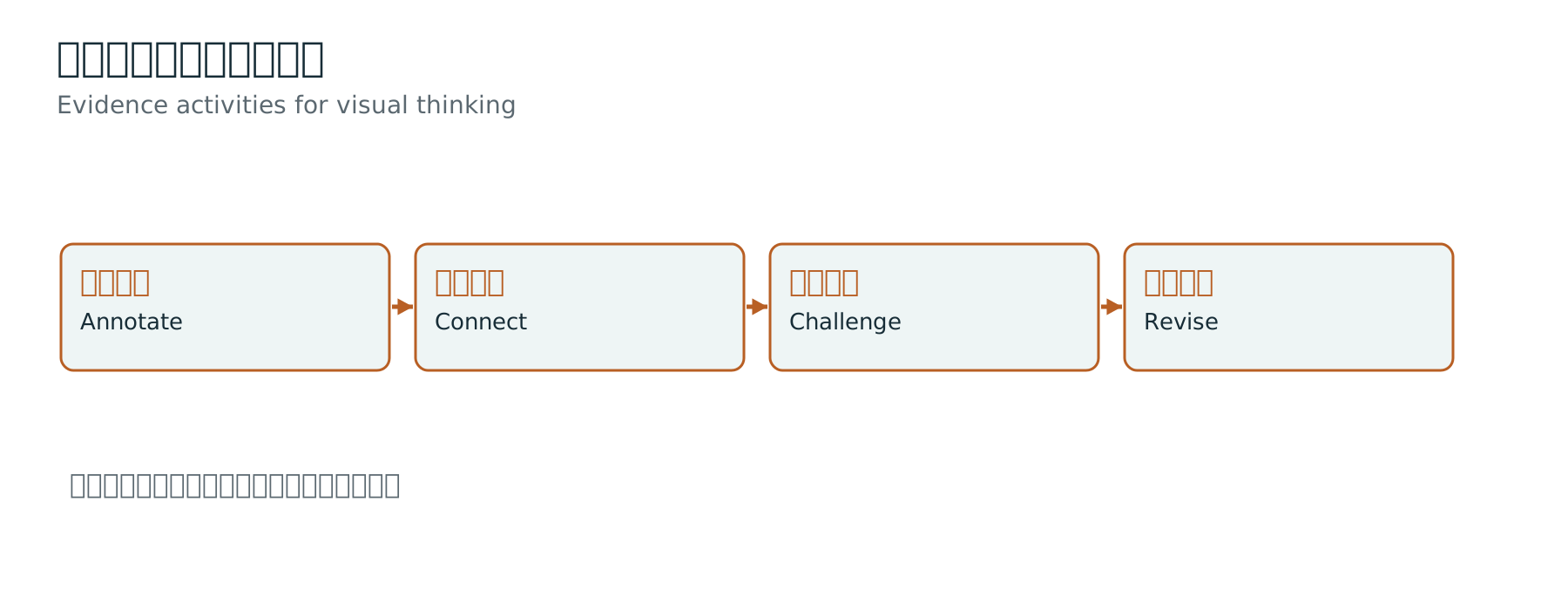
Original design
13.6
Bilingual Teaching and Cognitive Load
Bilingual teaching connects Chinese classes with English research, but stacking both languages word for word raises reading load. Chinese can frame questions and boundaries while English supplies corresponding concepts and research expression, with shared diagrams maintaining meaning. A glossary should address common confusions: grounding concerns connection to evidence, faithfulness concerns adherence to supplied evidence, and neither alone guarantees factual correctness. Figure labels should remain short, with longer explanations in prose or narration. The purpose is conceptual transfer rather than placing two essays inside every diagram.
A lesson can move through question, diagram, activity, discussion, and transfer, introducing few concepts at each stage. Experiencing retrieval difficulty before seeing graph structure can be more accessible than starting with a complete architecture. Stable colours and edge meanings reduce unnecessary cognitive effort. Paper, table, and code entry routes can serve different backgrounds while sharing tasks and assessment. Students finally transfer the method to a small disciplinary problem and explain changed conditions. This preserves rigor without presenting GraphRAG as either a programmer only black box or a slogan capable of solving every knowledge problem.
A Campus Dish Multimodal GraphRAG Blueprint
14.1
Bound the Task to Information Discovery and Verification
A campus dish system offers a concrete design connecting the two anchor articles. Its purpose is to find known information, related images, and unresolved issues for a stall's dish version, rather than decide what a student should eat. Questions may concern records mentioning chicken, possible matches for an image, or whether same named products share a version. They require relations, visual identity, and evidence. Outputs should state sources, time, and unknowns instead of treating a common recipe as an actual canteen ingredient list.
Requirements can collect real student and staff questions and classify precise lookup, ingredient discovery, image matching, feedback themes, and conflicts. Each needs acceptance criteria. Questions unsupported by records should request current information or stall confirmation. Clear scope makes technology selection easier: global communities and visual models are not needed for every request. A useful minimum system can cover a few stalls on specified dates while closing update and correction loops. The later simulated records test information logic and describe no actual campus food service.
14.2
Model Dish Versions and Observation Sources
The model should distinguish a dish concept, a stall product, and a product version. Kung pao chicken as a concept may connect to common preparation, the item sold by stall A is a product, and its recipe effective on a date is a version. Ingredient relations should attach primarily to versions rather than permanently to names. Menus, staff confirmations, photographs, and reviews produce different observations. Suspected visible ingredients should not overwrite confirmed lists, and taste reviews should connect to experience events instead of becoming timeless properties.
The model handles change and disagreement. An old photograph remaining after a recipe update creates a temporal mismatch rather than a reason to merge evidence. A known capture date without a known version can remain unresolved. Renaming does not necessarily change identity, and identical names do not guarantee identity, so stall, time, and management records matter. Staff interfaces should support version updates, attribute confirmation, and image withdrawal. User views may simplify presentation while underlying evidence remains complete. Users receive clear current information and maintainers retain its history.
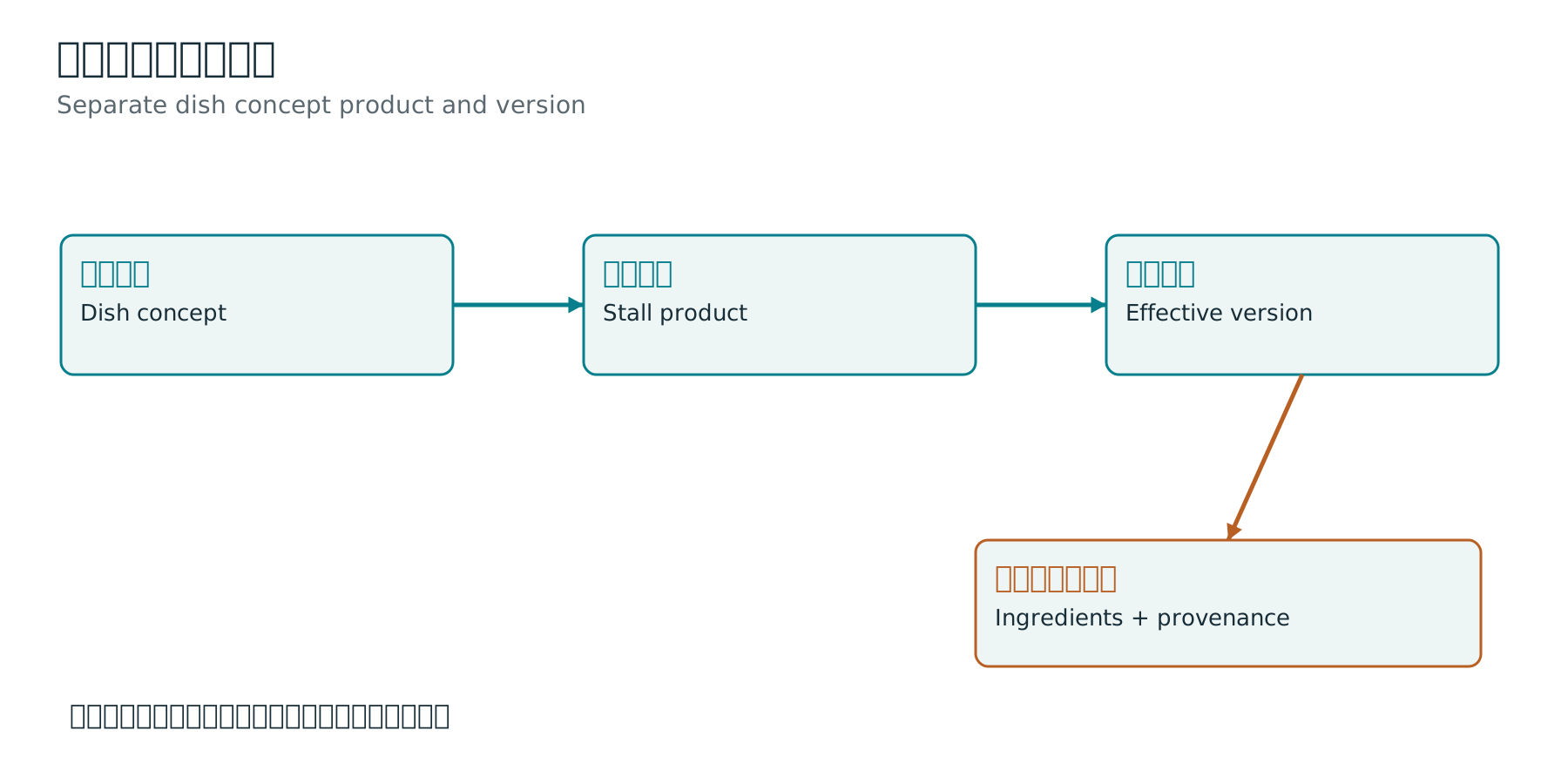
Original design
14.3
Fuse Text Images and Human Confirmation
Menu extraction identifies names, ingredients, and preparation while preserving source locations. Image processing first checks quality and product association, then proposes ingredient categories and regions. Fusion compares identity, version, and semantic conditions, treating agreement as support and disagreement as a review item. Images cannot establish the absence of invisible seasoning, and text extraction must preserve negation. Human confirmation should remain a separate record with explicit scope, such as confirming a published ingredient description without claiming verification of every processing step.
Rules can automate low risk matches while high impact ambiguity receives review. Explicit product identifiers may match current menus automatically, while unclear images and conflicting ingredients remain candidates. A review interface can show text, regions, and older versions together. Confirmations generate queryable views while preserving original candidates for error analysis. Sampling should cover stalls, dish categories, and camera conditions rather than only clear photographs. The goal is manageable evidence rather than converting a detector score directly into trust. Models discover clues; confirmation rules determine which clues enter current knowledge.
14.4
Choose Retrieval Routes for Different Questions
Precise product questions first retrieve current versions and confirmed attributes, then return menu or confirmation records. Ingredient discovery traverses from ingredients to products while separating confirmation, textual mention, and visual candidates. Image matching generates candidates before checking stall and time; missing context can lead to a candidate list rather than one identity. Feedback themes can summarize review events but must state sampling periods and coverage instead of treating a few comments as all students' views. Routes share evidence identifiers without requiring identical algorithms.
Interfaces should expose information status. A record mentioning chicken differs from confirmed absence of an ingredient, which requires explicit exclusion evidence. Conflicts can show both sources and dates pending confirmation. Missing retrieved edges should not become absent attributes, and personal taste reports should not become objective product facts. Global comparisons should first define comparable stalls and dates. Without matched information, rankings should remain limited. This applies graph organization to information gaps without generating certainty beyond the sources.
14.5
Data Operations and Feedback Theme Analysis
A campus application requires continuing menu and image maintenance, not one graph build. Resource manifests can update daily or when changes occur, with staff confirming current versions and student corrections entering review. Frequency should follow actual change rather than repeatedly processing unchanged files for apparent real time operation. Feedback categories can separate incorrect information, mismatched images, outdated versions, and experiences, routing each to responsible people. Time from discovery to correction becomes a maintenance measure.
Theme analysis can reveal recurring issues such as stale images or missing attributes, while repeated submissions should not amplify one event. Aggregate independent events over time and preserve minority views. Operational analysis describes patterns in records but cannot infer causes from comment cooccurrence. High evening order volume and long waits suggest an association to investigate, not proof that volume explains every delay. Improvement decisions require staffing, equipment, and process evidence. The graph organizes these investigation routes and helps staff ask better questions rather than replacing observation and judgment.
14.6
Pilot Acceptance and Conditions for Expansion
A pilot can cover a few stalls, fixed dates, and frequent questions. Acceptance checks correctness, traceability, visible conflicts, and effective updates. Staff and students can perform search tasks while measuring time, errors, and understanding of uncertainty. Faster lookup is insufficient if the interface makes every attribute appear confirmed. Unanswerable cases should test guidance toward missing evidence. Automated measures, human task outcomes, and maintenance effort belong in one assessment.
Before expansion, verify that identity rules, ontology, and update processes still apply. Vendors differ in naming, image quality, and ingredient disclosure. Add deliberately different stalls as a transfer test rather than only similar data. Quality declines should be traced to insufficient evidence, ambiguous identity, or unsustainable processes. Stopping conditions can include unresolved critical errors, persistently stale versions, or inadequate sources, leading to narrower answer scope. A trustworthy application works consistently within a defined range and expresses its boundaries. Expansion should follow measured performance in the new range rather than the number of graph nodes already accumulated.
A Reproducible Miniature Graph Experiment
15.1
Records and Experimental Scope
The experiment uses seven authored records and describes no real vendor or food service. D1 states that stall A's kung pao chicken contains chicken and peanuts. D2 assigns tofu and beef to stall B's mapo tofu. D3 reports long evening waits at A, and D4 high evening order volume there. D5 assigns chicken and lettuce to stall C's salad, D6 describes mild taste, and D7 explicitly excludes peanuts from A's kung pao chicken. To isolate conflict, D1 and D7 are assumed to share one effective version; a real system must verify that condition.
Relations are manually supplied. The program performs deterministic filtering, status classification, and arithmetic without language model extraction, visual recognition, or a GraphRAG framework. Results verify implementation of the supplied logic, not automatic construction, semantic retrieval, or generation quality. The small collection permits record by record inspection and classroom calculation. Future model integration should treat manual relations as reference annotations and separately test extraction errors, ambiguous names, and versions. Correct structure provided by hand is not evidence that a model learned to construct it.
15.2
Relation Queries and Source Traceback
The query asking which recorded dishes contain chicken filters positive ingredient observations and returns A's kung pao chicken and C's salad, supported by D1 and D5. It answers explicit relations in the records rather than inferring recipes from general knowledge. A stronger question asking which dishes certainly contain chicken in reality is not supported by authored statements alone. The example separates retrieval results from real world guarantees, which additionally require source reliability and applicability.
Traceback can connect the question to an ingredient, the ingredient to observations, observations to dish versions, and observations to sources. Each answer needs provenance. If D5 were deleted, the salad's chicken relation would lose its sole support and should leave the current answer rather than survive because chicken appears in its name. Names can retrieve candidates but cannot replace evidence. Another independent confirmation could preserve the relation with a changed support set. This deletion thought experiment illustrates dependency graphs: conclusions must retain their supporting observations so source changes can update them correctly instead of leaving a fixed answer.
15.3
Conflict Unknowns and Causal Boundaries
The program returns conflict for peanuts in A's dish because D1 affirms presence and D7 explicitly denies it. It does not select a side by majority, filename recency, or sentence length. Peanuts in B's dish remain unknown because no relevant observation exists. Unknown is distinct from explicit absence. If version evidence later assigns D1 and D7 to different dates, apparent conflict can become temporal change. Conflict is therefore relative to current identity and time assumptions rather than a permanent label.
D3 and D4 describe evening conditions without establishing causation. Both can be retrieved, but the answer should report their coexistence rather than claim proof that order volume caused waiting. Causal investigation needs additional temporal, process, and comparison evidence. A future generation test could inspect whether a model adds words such as therefore or causes. Such a test would require saved prompts, model versions, and outputs. This report executes deterministic state checks only and does not present that proposed generation experiment as completed.
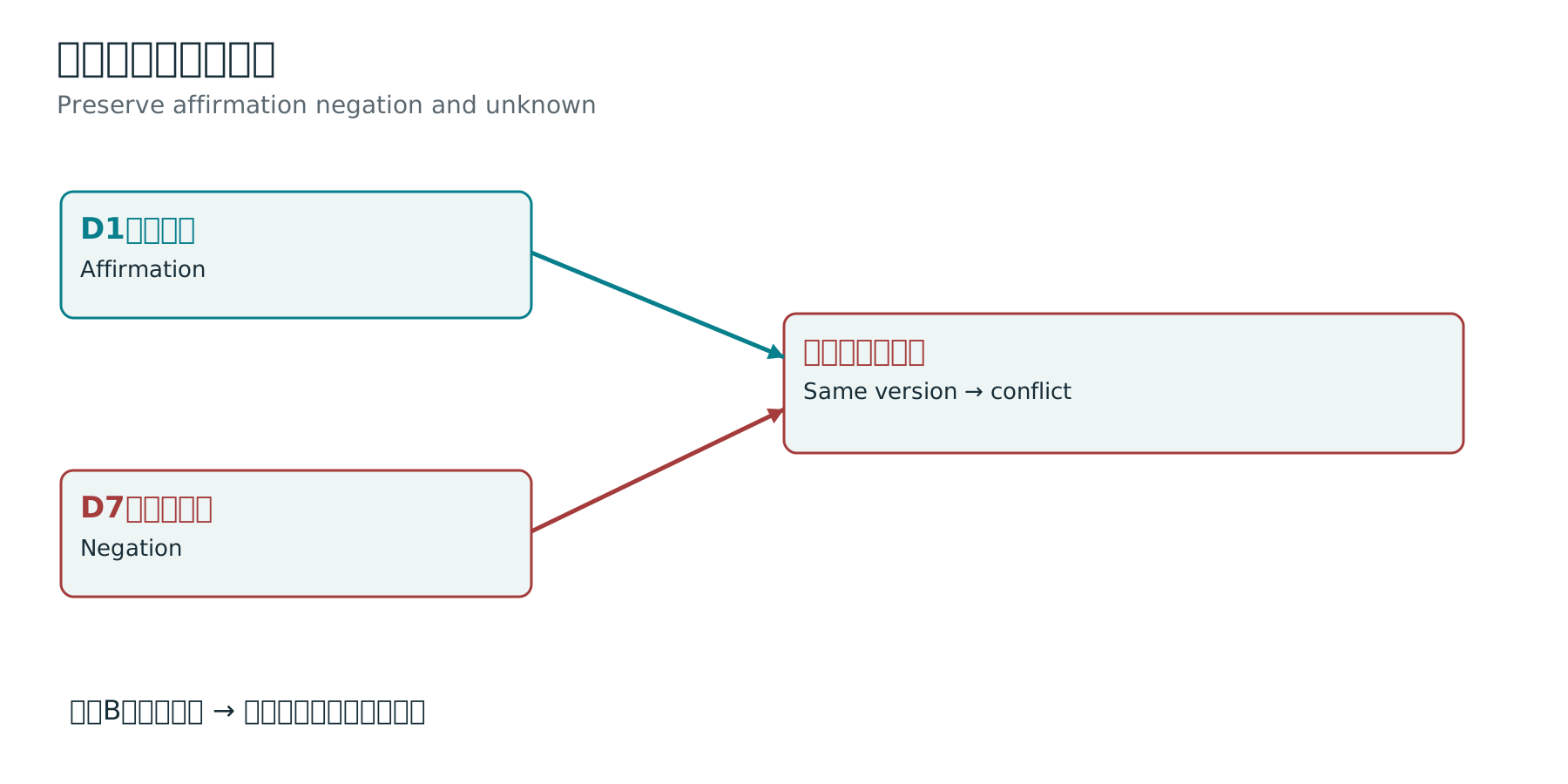
Synthetic records, no model inference
15.4
Recalculate Ranking Metrics by Hand
The ranking demonstration returns grades 3, 0, 2, 0, 1. Another relevant candidate with grade 1 is not retrieved, giving six candidates and four relevant items overall. Three relevant results among five give precision 0.60 and recall 0.75. Under the stated exponential gain and logarithmic discount, DCG is approximately 8.886853. The full collection's ideal top five, 3, 2, 1, 1, 0, gives IDCG approximately 9.823466 and nDCG approximately 0.904656. Script results were checked against Wolfram. These are constructed metric examples, not measured rankings from a retriever.
Precision and nDCG emphasize different properties. Two irrelevant candidates lower precision, while placing the most important evidence first keeps graded ranking quality relatively high. Moving grade 3 to the end preserves precision and recall but lowers nDCG. Without the total number of relevant items, the stated recall cannot be computed. The record therefore includes grades, ideal order, relevant total, and formula definitions rather than only a final score. Readers can modify the sequence and inspect changes. Metrics must be delivered with annotation rules because identical numbers can describe different retrieval conditions.
15.5
Assumed Cost Scenarios and Break Even
The cost scenario assumes a baseline build of 100 units and one unit per query, versus a graph build of 400 and 0.6 per query, omitting updates and operations. At 100, 500, 1,000, and 5,000 queries, totals are respectively 200 versus 460, 600 versus 700, 1,100 versus 1,000, and 5,100 versus 3,400. Equality occurs at 750 queries. These are assumptions, not prices, measured performance, or evidence that graphs generally cost less. The calculation illustrates fixed and marginal cost interaction.
Real decisions need update frequency, graph maintenance, review effort, and task distributions. If graph queries are not cheaper, no positive break even may exist. If their value is reduced serious error, compute fees alone are inadequate. Sensitivity analysis can vary construction and query costs separately to identify decisive assumptions. Attached CSV and JSON permit replacement values. Figures must label query counts and assumed cost units and state their scenario status. The visualization explains conditional relationships rather than proving that an architecture is necessarily worthwhile.
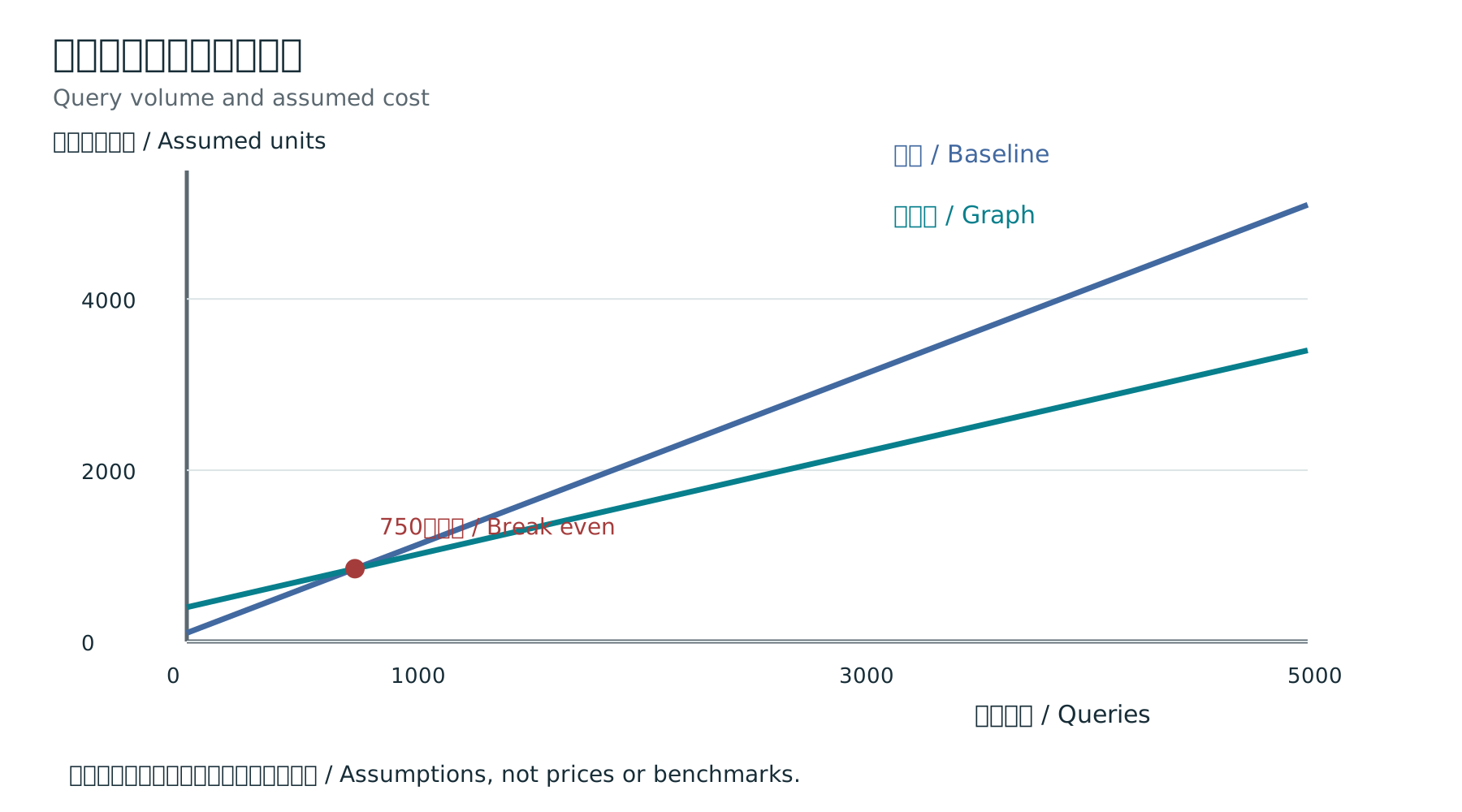
Assumed inputs in attached data
15.6
Extend a Logic Demonstration into a Real Study
Five code checks cover the chicken relation result, peanut conflict, another object's unknown state, preservation of conflicting sources, and ranking consistency. The demonstration is individually explainable but contains no language understanding, visual noise, or large scale retrieval. Extension should first add a small auditable real collection with manual references, then extraction and linking models, then retrieval and generation, and only afterward scale. Earlier checks should remain so final answers do not conceal intermediate errors.
Real experiments should add same named distinct objects, one object across dates, negation, missing images, and wrong pairings. Baseline and graph comparisons should fix sources, models, and budgets and record construction overhead. Output differences should trace to candidates, paths, and citations rather than only total scores. No improvement can motivate tests of graph quality, routing, or whether the questions need structure. Research value comes from falsifiable judgments and inspectable processes. A small honest experiment can support later work; unexecuted performance numbers cannot.
Research Agenda Adoption Roadmap and Synthesis
16.1
Test What Graph Structure Actually Contributes
Future work should isolate graph structure from accompanying improvements. One testable hypothesis is that typed relations with correct identity help cross passage questions more than the same entity names alone. Fix sources, generator, and context budget, then compare real relations, random relations, no relations, and manually annotated reference relations. If the real graph adds little while the reference graph helps, construction may be the bottleneck. If neither helps, the questions may not need structure or the generator may not use it.
This design explains more than simply adding a graph module. Grouping by path length, ambiguity, and relation rarity can identify useful conditions. Random controls should preserve density to avoid context length confounding. Reference graphs need annotation cost rather than being treated as free. Successful and failed evidence paths should accompany scores so readers can inspect whether connections are reasonable. Graph value need not appear on every task. Identifying the subset that benefits and using simpler retrieval elsewhere is itself a practical research result.
16.2
Propagate Uncertainty into Summaries and Answers
Uncertainty can disappear through successive summaries: possible statements become affirmative observations, and disagreements disappear inside community reports. Research should propagate knowledge states through dependencies rather than append vague caution at the end. Observations can retain support, opposition, and unknown conditions; summaries can preserve disagreement; answers can be checked for equivalent boundaries. Model probability, source reliability, and evidence completeness are different quantities and should not be multiplied as if they shared one interpretation.
A testable hypothesis is that explicit states and dependencies reduce unwarranted certainty on conflicts without excessive abstention. Experiments need consistent, conflicting, temporally changing, and incomplete cases, measuring both correct judgments and justified answer scope. Compression should be tested for minority evidence retention. Presentation research can compare concise state labels, parallel sources, and expandable evidence to balance clarity with reading burden. Good uncertainty communication identifies supported conclusions, unresolved conditions, and evidence that could change judgment, rather than merely repeating words such as perhaps.
16.3
Study Modality Necessity and Evidence Sufficiency
Multimodal GraphRAG needs a stricter question than whether it accepts images: which questions require them and which regions change answers? Modality necessity can become an annotation field explaining whether text suffices, what vision contributes, and whether alternative evidence exists. Compare complete input, removed vision, and incorrect vision. Stable answers without images may mean text is sufficient or the model ignored vision; scores alone cannot distinguish these explanations.
Evidence sufficiency can be studied through minimum support sets. Which observations jointly support a claim, which provide background, and which challenge it? Graphs can encode these roles while generation preserves crucial combinations under budgets. Experiments can measure quality as evidence is removed rather than testing only one fixed top count. Video and complex pages also require spatial and temporal necessity analysis. The goal is sufficient and necessary evidence, not permanent participation of every modality. This can reduce cost, improve explanations, and limit distraction from irrelevant images or redundant paths.
16.4
Dynamic Knowledge and Longitudinal Evaluation
Static tests rarely establish reliability after months of operation. Longitudinal studies can introduce new records, revisions, and withdrawals over time, repeatedly querying historical and new questions. Measures include change to availability delay, continued citation of invalid evidence, accumulated false merges, and recurrence after repairs. Complete versions are essential to reconstruct what information was available when an answer was produced and evaluate it fairly.
Studies should also measure maintenance rather than only automation. Human review, rule changes, and incident work may dominate costs. Full rebuilds, local updates, and delayed updates can be compared under one change sequence. Data drift and software upgrades should be recorded separately instead of combined into one before and after comparison. Snapshot findings need temporal boundaries; claims of stability across updates need evidence across those updates. Dynamic evaluation moves GraphRAG from a one time indexing exercise toward a sustainable knowledge service, a central condition for durable application value.
16.5
A Staged Adoption Roadmap
A roadmap can use four stages with exit conditions. First inventory sources and questions, permissions, and reference answers. Second establish reliable basic retrieval and citations and identify remaining errors. Third add structure only for relational, global, or visually necessary questions and compare under matched conditions. Fourth introduce updating, correction, and operational monitoring. Deliverables should be inspectable outcomes rather than completed modules. Progress should follow evidence and team capacity instead of a fixed calendar.
Before advancing, ask whether the addition improves target work, whether new failures can be detected and repaired, and whether maintenance has an accountable owner. Unclear answers justify narrower scope or further testing. Universities can translate the roadmap into paper, table, and code learning stages; enterprises into bounded pilots and expansion. Graph size, model parameters, and image counts do not replace acceptance results. Decision records should preserve choices, evidence, unresolved issues, and fallback routes so the approach can change with experiments. Mature adoption permits simplification rather than treating complexity itself as progress.
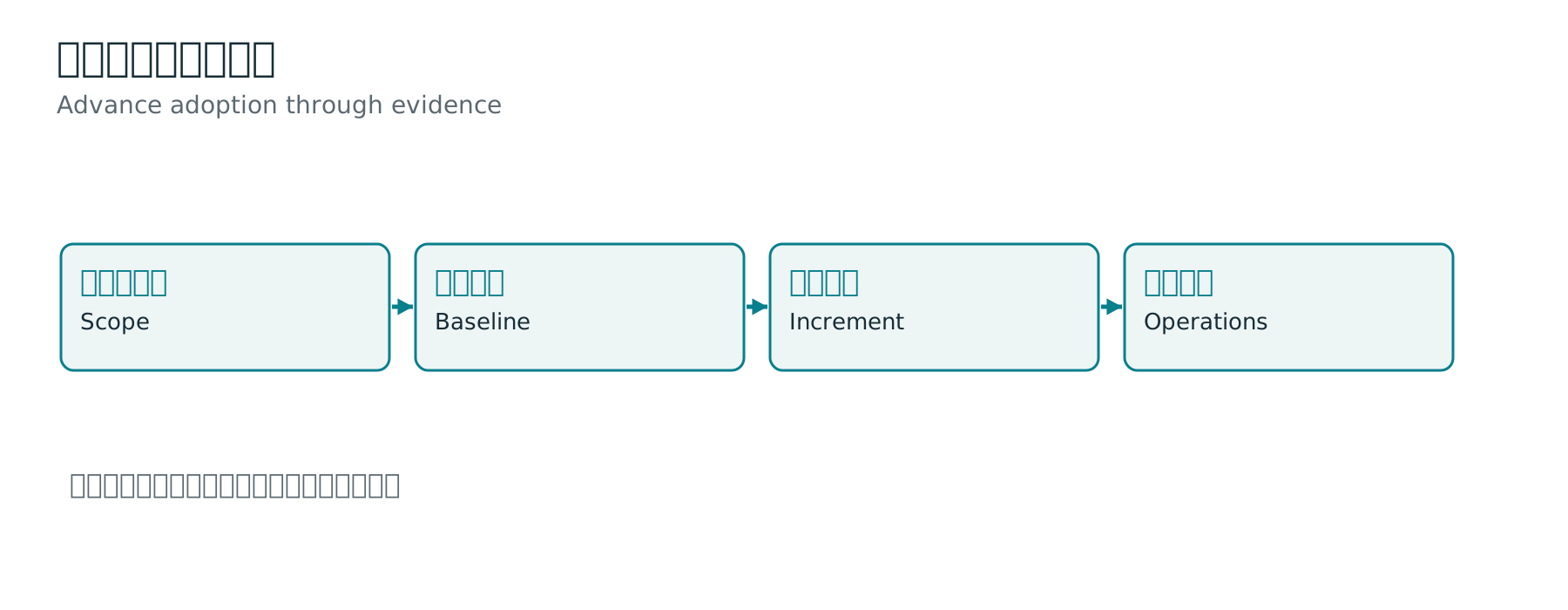
Original design
16.6
Connecting the Two Research Lines and the Final Assessment
The Microsoft and Meituan articles emphasize different sides of knowledge use and construction. The former shows how relationships and community hierarchies can support discovery in private narrative material. The latter shows how ingredient level multimodal information supports detailed dish understanding. Connecting them requires shared identity, evidence locations, versions, permissions, and evaluation, not simply adding multimodal to a system name. Graphs structure relations, modalities provide complementary observations, retrieval selects material for questions, and generation organizes expression. Errors at any layer can change the final judgment.
The synthesis is that GraphRAG and multimodal graphs are useful as testable research and engineering methods when questions require relational or visual evidence, sources are adequate, errors are traceable, and maintenance is sustainable. They do not automatically eliminate hallucinations, turn similarity into fact, or convert cooccurrence into causation. Persuasive applications provide more complete necessary evidence, clearer uncertainty, and more repairable processes for concrete tasks rather than the largest network. Future work should examine these observable outcomes and report conditions without improvement. That discipline connects technical progress to reliable knowledge work and substantive teaching practice.
Appendix A Research and Implementation Worksheets
17.1
Literature Discovery Logs and Screening Fields
A discovery log should retain queries, dates, platforms, screening reasons, and final primary sources. Query combinations can include GraphRAG and evaluation, multimodal knowledge graph and entity linking, ingredient retrieval and CMIngre, plus task terms. Broad searches discover branches; exact titles locate originals and datasets. Exclusion reasons such as absent methods, news republication, or uncertain versions explain selection. A narrative review need not claim exhaustive retrieval, but its choices should be understandable.
This report uses Consensus and SciSpace for discovery and checks paper pages, publication records, author datasets, or official documentation. Generated summaries and limitations are not automatically author conclusions. Criticism of baselines must not become limitations attributed to a new method. Reading scope distinguishes articles, workflow sections, and abstract records. A future systematic review could add databases, preregister criteria, and use multiple screeners, but that is a separate study. The worksheet preserves what later researchers need to read and verify rather than treating result counts as quality.
17.2
A Claim and Evidence Register
An important claim can occupy one register row containing identifier, wording, type, source, location, conditions, support strength, and verification status. Types include reported result, cross source synthesis, design recommendation, and demonstration calculation. Results retain experimental scope; syntheses list reasoning; recommendations state validation goals; calculations supply inputs and formulas. Distinct components in one paragraph then do not disappear behind one broad citation. Alternative explanations encourage active counterexample search.
Verification can use two passes. First check source existence, title and date, and copied numbers. Then check actual support and whether scope expanded. Percentages need denominators and units; comparisons need configurations. Missing evidence should not be filled with fluent prose. Incomplete support requires narrower wording or a hypothesis label. Bilingual claims can share a row to compare quantifiers, negations, and time. The register reduces lost conditions and citation drift in long and repeatedly revised reports rather than merely adding paperwork.
17.3
A Graph Data Contract Checklist
A data contract defines object types and identity rules before relation direction, qualifiers, and allowed states. Dish versions need creation, effective and expiry rules, overlap policy, and confirmation responsibility. Ingredient observations distinguish affirmation, negation, and unknown rather than treating missing Boolean values as false. Resource locations should survive filename changes. Model outputs retain method versions, and human edits create new records instead of overwriting history.
Ingestion tests can include duplicate identifiers, same named distinct objects, missing units, reversed times, unsourced relations, and contradictory observations. Invalid structures should be rejected or isolated; a successful database write is not quality acceptance. Export and reconstruction should confirm evidence does not depend on private interface state. Every field needs an owner, validation rule, downstream purpose, and missing value behavior. Contract changes need versions and migration notes. The worksheet turns an ontology into executable constraints and gives data providers and developers a shared quality language.
17.4
Experiment Run Cards and Configuration Records
A run card records hypotheses, inputs, splits, code, model identifiers, prompts, seeds, retrieval budgets, and execution time. Services may not be fully reproducible, so uncontrollable factors such as external model changes and approximate search randomness also matter. Results link to run cards, including failed runs. Before comparison, confirm that only intended factors changed; otherwise configuration drift may explain score differences.
Cards should distinguish executed, partially executed, and planned work. Failed calls should not receive guessed outputs, and unrun ablations remain unreported. Analyses may include overall and grouped metrics, errors, and costs within actual execution scope. This report's run card specifies manual relations, seven records, deterministic queries, and five checks, with no language or visual inference results. Scripts reproduce the numbers. Real studies can add dependency locks and permitted response archives. Reproducibility means providing conditions sufficient to explain and retest main conclusions, not promising identical text in every future environment.
17.5
Figure Data and Visual Verification Worksheets
Each figure needs a purpose, source, units, calculation steps, chart type, and intended observation. Relationship diagrams need labeled directions, quantity plots axes and bases, and workflows a distinction between sequence and dependency. Stable colours should be reinforced by words or line types for monochrome reading. Source figures and original redrawings need separate attribution, and crops must retain context. Assumed data should be labeled directly in titles or captions rather than only in distant prose.
Verification has content and layout layers. Content checks values, units, labels, textual references, causal implications, and exceptions. Layout checks type size, cropping, overlap, resolution, and pagination at actual embedded size. Complex figures can split into overview and detail rather than compress an entire system onto one page. Editable sources should retain text and shapes instead of only low resolution screenshots. Attached SVG and data support later teaching adaptation. Visual quality means helping accurate judgment rather than maximizing decoration or colour.
17.6
Pilot Decisions and Review Records
A pilot decision sheet can record target tasks, baseline, expected gains, critical risks, resources, and stopping conditions. Gains should be observable, such as fewer evidence omissions or shorter verification time, rather than generic intelligence claims. Risks should follow actual scenario failures. Stopping conditions need actions, such as narrowing scope after persistent critical errors or delaying expansion without maintenance ownership. This gives technical and management discussion a common factual basis.
Reviews compare initial assumptions with current evidence and record reasons to retain, adjust, or stop. Failure does not prove permanent uselessness, but changing goals repeatedly should not make every pilot successful. Define primary measures and acceptable changes beforehand and report exploratory findings separately. Adoption needs maintenance ownership and a next review date; simplification can preserve inventories, identifiers, and tests. Research outcomes include knowing which conditions work, not only a final system. Transparent decisions accumulate experience and permit reassessment under new data and models instead of repeating an unexplained trial.
Appendix B Bilingual Terms and Common Confusions
18.1
Knowledge Graph Entity and Relation
A knowledge graph organizes information through explicit objects and semantic relations. An entity is a distinguishable object within a modeling scope. A relation expresses a meaningful connection. A node is a structural position and may represent an entity, document, observation, or event. An edge is a connection whose meaning requires type and direction. These distinctions prevent every drawn connection from being treated as a confirmed real world relationship.
An image linked to a dish may depict it, possibly depict it, or merely come from its product page. Those meanings should not collapse into related to. An ontology defines expressible concepts and relations, while a schema defines concrete structure; they overlap but a field list is not all domain knowledge. Use entity for identity, node for structure, and observation or claim for evidence. This also helps read papers whose graphs may actually be entity, chunk, or document networks.
18.2
The Scope of Retrieval Augmentation and Graph Augmentation
Retrieval augmented generation uses external retrieved material to support generation. GraphRAG broadly means that graph structure participates, but the point of participation varies. Retrieval finds candidates, reranking reorders them, and generation organizes output. Different models or rules may implement these stages. Correct evidence does not guarantee correct generation, and fluent generation does not establish sufficient retrieval. Effectiveness claims need an explicit stage and evaluation object.
Microsoft GraphRAG is a specific project and method family, not a name for every graph augmented study. Global search synthesizes a broader scope; local search organizes material around relevant objects. Global does not mean all world knowledge, and local does not mean one file. Multihop questions require connecting evidence steps. Lengthy reasoning prose does not turn a lookup into a multihop task. Terms should follow evidence structure rather than output appearance or promotional wording.
18.3
Alignment Linking Fusion and Completion
Alignment establishes correspondence between representations, entity sets, or regions. Linking usually assigns a mention or observation to an entity. Fusion combines sources and may retain conflicts instead of producing one value. Completion predicts missing attributes or relations, creating candidates rather than confirmed facts. These terms ask different questions: what corresponds, which entity is meant, how sources combine, and what might be missing.
For a dish image, shared space similarity is alignment, assignment to stall A's product is linking, joint registration of menu and image observations is fusion, and guessing another ingredient from a recipe pattern is completion. Writing that guess into confirmed attributes creates circular evidence. Later retrieval may mistake it for independent support. Systems should preserve production methods and states and distinguish training labels, predictions, and human confirmations. Linking accuracy, fusion benefits, and completion ranking require different reference answers and analyses.
18.4
Grounding Faithfulness and Factual Correctness
Grounding connects an answer to locatable evidence. Faithfulness means not distorting or exceeding supplied material. Factual correctness concerns agreement with reality or reliable references. These are related but distinct. An answer can cite an irrelevant paragraph, faithfully repeat an incorrect record, or recall a correct fact without evidence required by the task. Evaluation should separately inspect support, faithfulness, and factual status.
Hallucination should be diagnosed more specifically as unsupported additions, misattribution, lost conditions, or invented sources. Abstention can be justified by insufficient evidence, while excessive abstention blocks answerable work. Calibration concerns agreement between expressed confidence and actual correctness; a score of 0.9 is not automatically calibrated for a business domain. Users often benefit more from explicit sources and gaps than a precise score. A current menu with an unconfirmed image version is more informative than an unexplained high confidence label. These concepts make answers inspectable.
18.5
Precision Recall Coverage and Percentage Points
Precision usually means the relevant share of retrieved results, while detection also requires matching rules and thresholds. Translation depends on the original definition. Recall measures recovered relevant items; coverage may concern objects, attributes, or tasks and is not automatically recall. Accuracy requires a defined unit and denominator. Average precision and nDCG are different measures and cannot be compared merely because both may lie between zero and one.
Percentage points differ from relative change. Moving from 80% to 87.01% adds 7.01 points or approximately 8.76% relatively. Error falling from 20.38% to 2.3% drops 18.08 points or approximately 88.71% relatively. Reporting a drop of 18.08% would change the meaning. Preserve metric names and definitions, adding formulas and denominators when needed. Axes should distinguish percentages, proportions, and point differences. Numerical checking concerns both copied digits and their meaning in context.
18.6
Reproduction Generalization Causality and Application Value
Reproduction retests reported findings, but terminology conventions vary, so state code, data, and conditions directly. Generalization requires specifying what is unseen: entities, sources, time, or tasks. Ablation studies component contributions while controlling other factors. Benchmarks provide shared tasks and rules, but high scores alone do not establish deployment value.
Association records a connection; causality requires stronger support for causes or interventions. Directed graph edges may express statement structure or temporal order rather than causation. Utility depends on tasks, consequences, time, and cost and may diverge from generic scores. Average gains can coexist with disqualifying version errors, while simpler systems may better serve frequent precise queries. Technical capability, measured conclusions, and adoption are therefore distinct: capability needs experiments, conclusions need boundaries, and adoption needs task and maintenance evidence. Careful terminology reduces exaggerated communication and helps Chinese and English readers discuss the same question.