15.1
Records and Experimental Scope
The experiment uses seven authored records and describes no real vendor or food service. D1 states that stall A's kung pao chicken contains chicken and peanuts. D2 assigns tofu and beef to stall B's mapo tofu. D3 reports long evening waits at A, and D4 high evening order volume there. D5 assigns chicken and lettuce to stall C's salad, D6 describes mild taste, and D7 explicitly excludes peanuts from A's kung pao chicken. To isolate conflict, D1 and D7 are assumed to share one effective version; a real system must verify that condition.
Relations are manually supplied. The program performs deterministic filtering, status classification, and arithmetic without language model extraction, visual recognition, or a GraphRAG framework. Results verify implementation of the supplied logic, not automatic construction, semantic retrieval, or generation quality. The small collection permits record by record inspection and classroom calculation. Future model integration should treat manual relations as reference annotations and separately test extraction errors, ambiguous names, and versions. Correct structure provided by hand is not evidence that a model learned to construct it.
15.2
Relation Queries and Source Traceback
The query asking which recorded dishes contain chicken filters positive ingredient observations and returns A's kung pao chicken and C's salad, supported by D1 and D5. It answers explicit relations in the records rather than inferring recipes from general knowledge. A stronger question asking which dishes certainly contain chicken in reality is not supported by authored statements alone. The example separates retrieval results from real world guarantees, which additionally require source reliability and applicability.
Traceback can connect the question to an ingredient, the ingredient to observations, observations to dish versions, and observations to sources. Each answer needs provenance. If D5 were deleted, the salad's chicken relation would lose its sole support and should leave the current answer rather than survive because chicken appears in its name. Names can retrieve candidates but cannot replace evidence. Another independent confirmation could preserve the relation with a changed support set. This deletion thought experiment illustrates dependency graphs: conclusions must retain their supporting observations so source changes can update them correctly instead of leaving a fixed answer.
15.3
Conflict Unknowns and Causal Boundaries
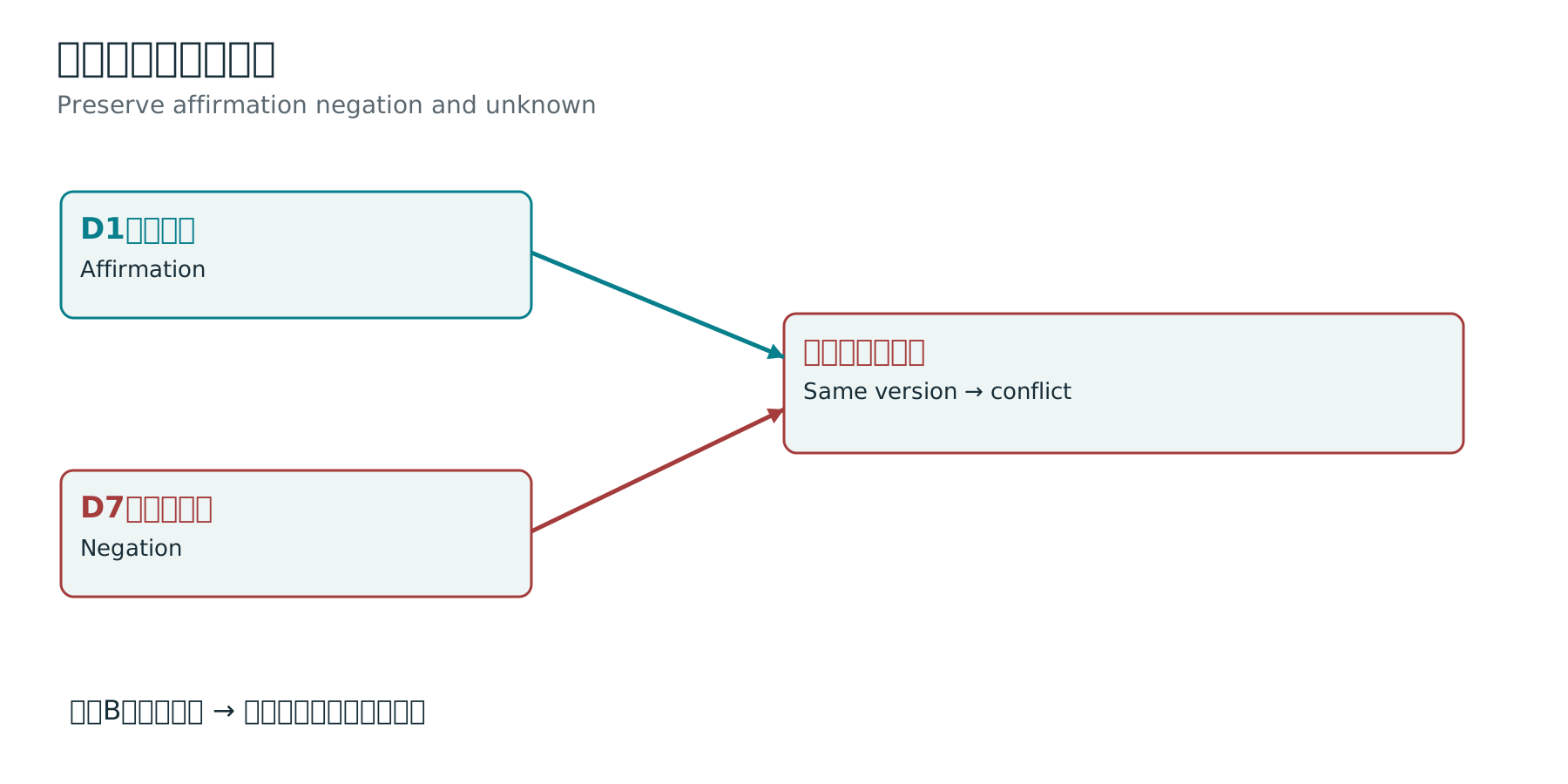
The program returns conflict for peanuts in A's dish because D1 affirms presence and D7 explicitly denies it. It does not select a side by majority, filename recency, or sentence length. Peanuts in B's dish remain unknown because no relevant observation exists. Unknown is distinct from explicit absence. If version evidence later assigns D1 and D7 to different dates, apparent conflict can become temporal change. Conflict is therefore relative to current identity and time assumptions rather than a permanent label.
D3 and D4 describe evening conditions without establishing causation. Both can be retrieved, but the answer should report their coexistence rather than claim proof that order volume caused waiting. Causal investigation needs additional temporal, process, and comparison evidence. A future generation test could inspect whether a model adds words such as therefore or causes. Such a test would require saved prompts, model versions, and outputs. This report executes deterministic state checks only and does not present that proposed generation experiment as completed.
Synthetic records, no model inference
15.4
Recalculate Ranking Metrics by Hand
The ranking demonstration returns grades 3, 0, 2, 0, 1. Another relevant candidate with grade 1 is not retrieved, giving six candidates and four relevant items overall. Three relevant results among five give precision 0.60 and recall 0.75. Under the stated exponential gain and logarithmic discount, DCG is approximately 8.886853. The full collection's ideal top five, 3, 2, 1, 1, 0, gives IDCG approximately 9.823466 and nDCG approximately 0.904656. Script results were checked against Wolfram. These are constructed metric examples, not measured rankings from a retriever.
Precision and nDCG emphasize different properties. Two irrelevant candidates lower precision, while placing the most important evidence first keeps graded ranking quality relatively high. Moving grade 3 to the end preserves precision and recall but lowers nDCG. Without the total number of relevant items, the stated recall cannot be computed. The record therefore includes grades, ideal order, relevant total, and formula definitions rather than only a final score. Readers can modify the sequence and inspect changes. Metrics must be delivered with annotation rules because identical numbers can describe different retrieval conditions.
15.5
Assumed Cost Scenarios and Break Even
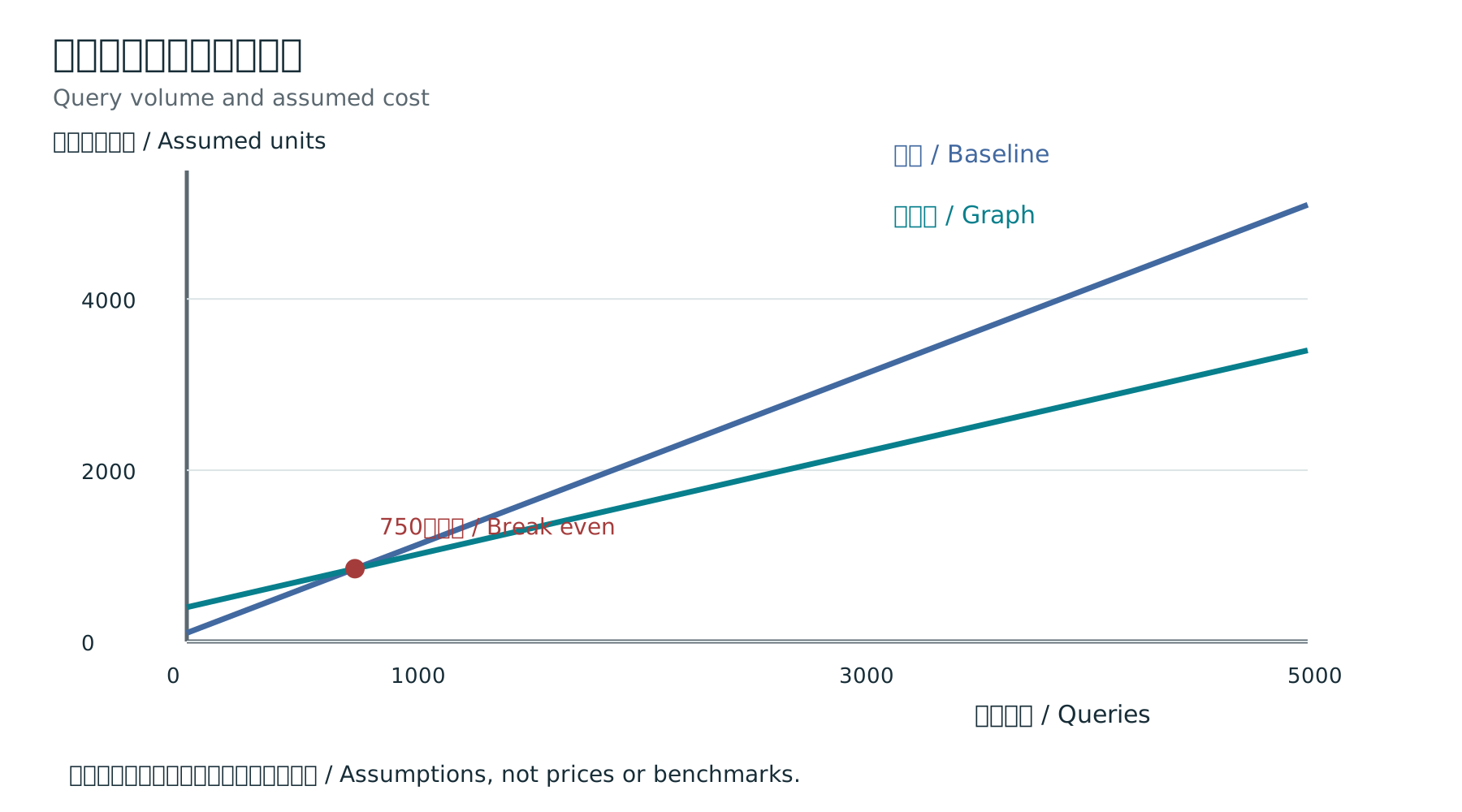
The cost scenario assumes a baseline build of 100 units and one unit per query, versus a graph build of 400 and 0.6 per query, omitting updates and operations. At 100, 500, 1,000, and 5,000 queries, totals are respectively 200 versus 460, 600 versus 700, 1,100 versus 1,000, and 5,100 versus 3,400. Equality occurs at 750 queries. These are assumptions, not prices, measured performance, or evidence that graphs generally cost less. The calculation illustrates fixed and marginal cost interaction.
Real decisions need update frequency, graph maintenance, review effort, and task distributions. If graph queries are not cheaper, no positive break even may exist. If their value is reduced serious error, compute fees alone are inadequate. Sensitivity analysis can vary construction and query costs separately to identify decisive assumptions. Attached CSV and JSON permit replacement values. Figures must label query counts and assumed cost units and state their scenario status. The visualization explains conditional relationships rather than proving that an architecture is necessarily worthwhile.
Assumed inputs in attached data
15.6
Extend a Logic Demonstration into a Real Study
Five code checks cover the chicken relation result, peanut conflict, another object's unknown state, preservation of conflicting sources, and ranking consistency. The demonstration is individually explainable but contains no language understanding, visual noise, or large scale retrieval. Extension should first add a small auditable real collection with manual references, then extraction and linking models, then retrieval and generation, and only afterward scale. Earlier checks should remain so final answers do not conceal intermediate errors.
Real experiments should add same named distinct objects, one object across dates, negation, missing images, and wrong pairings. Baseline and graph comparisons should fix sources, models, and budgets and record construction overhead. Output differences should trace to candidates, paths, and citations rather than only total scores. No improvement can motivate tests of graph quality, routing, or whether the questions need structure. Research value comes from falsifiable judgments and inspectable processes. A small honest experiment can support later work; unexecuted performance numbers cannot.